

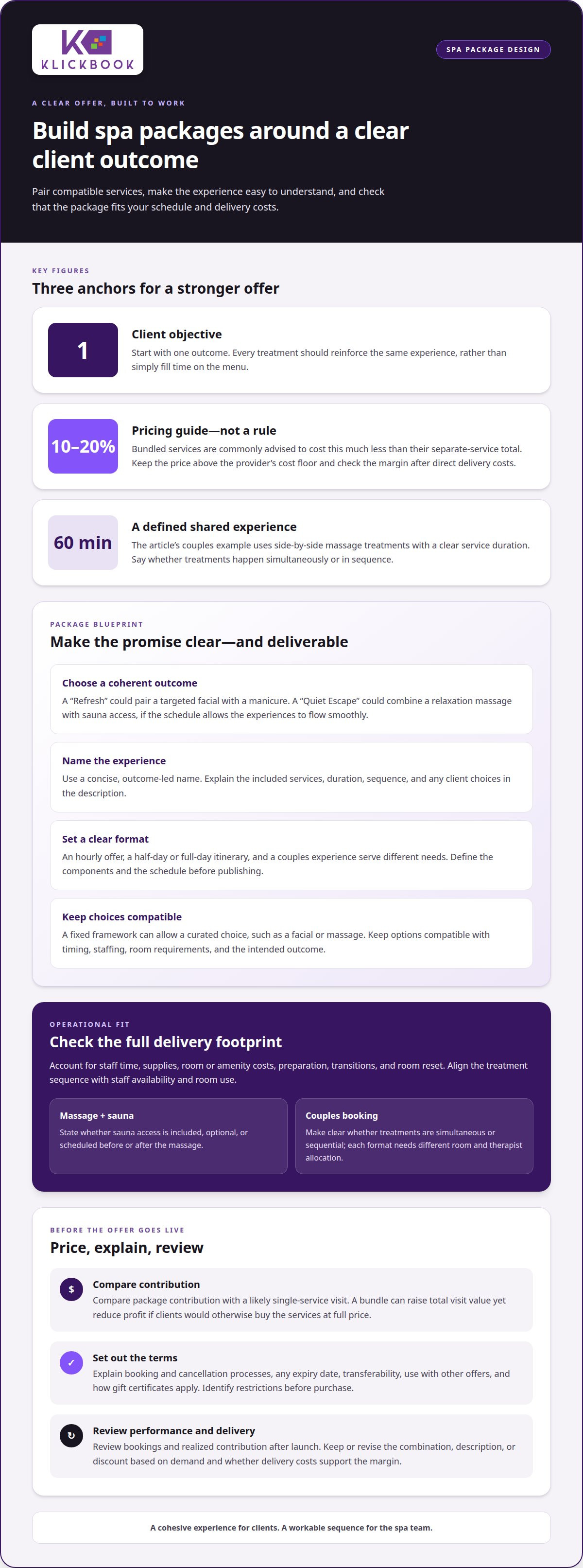
Strong spa packages are built around a clear client outcome, not a loose collection of services. To understand how to create spa treatment packages, pair compatible treatments, name the offer for the experience it delivers, and define a duration and format that fit. The package should also work operationally, with services, staff time, and room use aligned.
A broad menu can offer choice, but unclear combinations make it harder for clients to see the value and for teams to deliver a consistent experience. Structure matters: an hourly offer serves a different need from a half-day retreat, a full-day itinerary, or a couples experience.
This guide explains how to shape these formats around client needs and practical spa operations. You’ll learn how to build cohesive combinations, choose outcome-led names, set package boundaries, and assess whether each offer supports a clear booking decision without adding unnecessary complexity to the treatment schedule.
Key Takeaways
- Pair services that support one coherent client outcome, then name the package so its value is clear at a glance.
- Build hourly offers around a defined experience, with treatment timing and sauna access aligned to available capacity.
- Assess each package against delivery costs, staff time, and the likelihood that clients would book the included services separately.
- Shape half-day, full-day, and couples options around distinct schedules and shared experiences rather than simply adding more treatments.
- Use online booking and reporting to make packages easier to schedule and assess how they perform.
1. Choosing cohesive services and naming packages by outcome
Start with one client objective, then select services that support it. A “Refresh” offer could pair a targeted facial with a manicure for clients seeking a polished reset. A “Quiet Escape” might combine a relaxation massage with sauna access, provided the schedule allows both experiences to flow smoothly. Each service should reinforce the same outcome, not simply fill time on the menu.
Use names that signal the experience before clients examine the details. “Refresh” suggests a shorter reset; “Luxury Escape” signals a more complete visit. Avoid names that list only treatments, such as “Facial and Massage,” because they describe components rather than the reason to book. Keep the title concise, then use the package description to explain included services, duration, sequence, and any client choices.
Flexible spa-day packages can preserve a cohesive outcome while giving clients control. Define a fixed framework, then let each guest select from a curated set of services. For example, a relaxation-focused package could offer a choice between a facial or massage, while keeping the remaining elements consistent. Limit choices to services with compatible timing, staffing, room requirements, and intended outcomes.
Compare package profit with the visit clients would otherwise book. Add each service’s delivery costs, including staff time, supplies, and allocated room or amenity costs. Then compare the package contribution with that of a likely single-service visit. A bundle can increase total visit value yet reduce profit if it discounts services clients would have purchased at full price anyway.
Bundled services are commonly advised to cost 10% to 20% less than their separate-service total, while remaining above the provider’s cost floor. Treat that range as a pricing guide, not an automatic discount. Calculate the margin after direct delivery costs, then choose a saving that supports the package’s purpose without eroding contribution. A new-client welcome offer may use a different discount from a package designed to reward repeat visits.
Package terms in Canada should state how clients book, the cancellation process, any expiry date, and whether the offer can be transferred or combined with other offers. Explain how gift certificates apply and identify restrictions before purchase. Clear terms reduce booking disputes and make the offer easier to administer.
Review bookings and realized contribution after launch. Keep the package if its outcome-led name attracts the intended clients and its service sequence fits daily operations. Revise the combination, description, or discount if bookings remain weak or delivery costs undermine its margin.
2. Hourly massage or sauna packages
Hourly packages give clients a defined experience without requiring a full-day commitment. Build the offer around one primary service, then add a complementary element that fits the schedule. A massage followed by sauna access creates a clear retreat format, while a massage with moisturising body care extends the experience with a distinct finishing step. Account for room turnover and staff availability when planning the sequence.
For massage and body treatments, map the service order before publishing the package. A body scrub followed by moisturising care creates a connected treatment progression; adding massage can make the offer an “Ultimate Renewal” experience. State which services are included, when each takes place, and whether clients can choose the treatment focus. This ensures the package name does not promise more than the booking delivers.
Sauna packages need clear boundaries. Specify whether sauna access is included in the booking, offered as an optional addition, or available before or after a massage. Set a defined schedule for each component so clients understand the visit and staff can coordinate room use. If aromatherapy is offered, identify it as an included enhancement or a selectable option.
RoseWater Spa’s romantic escape includes side-by-side 60-minute massage treatments. That format gives couples a specific shared experience while preserving a clear service duration. A similar offer can distinguish between simultaneous treatments and sequential appointments, since those options require different room and therapist allocation. Use “couples retreat” or “shared escape” only when the booking structure supports the promise.
In Canada, package design should account for health information, informed consent, treatment safety, and accessibility needs. Communicate relevant service details before booking, provide a way to discuss accommodations, and align delivery with applicable local requirements and staff protocols.
Operationally, capture relevant client preferences before the visit, including pressure preferences, fragrance sensitivities, mobility considerations, and sauna access needs. Make this information available to the team responsible for the appointment. A package works only when its booking flow gives staff enough information to prepare the room, sequence treatments, and support the guest appropriately.
Evaluate hourly offers by comparing scheduled service time with the full operational footprint. Include preparation, transitions, and room reset when calculating capacity. Point of Sale records can also help separate package sales from add-on purchases, clarifying how clients use the offer. If a sauna component competes with peak treatment-room demand, adjust its timing or make it a controlled option.
Keep the offer clear at every booking stage. Use a concise package name, a service sequence, and details of what is included. This makes the experience easier to understand and gives the team a consistent delivery plan.
3. How to Create Spa Packages Clients Want?
A spa package should have a defined outcome, compatible treatments, a clear sequence, and the practical details clients need to book. For example, a relaxation offer could combine a Swedish massage, a calming facial, and an aromatherapy enhancement, with the appointment length and included options stated plainly.
Build combinations around the client’s intended experience, not treatments that happen to be available. A “Relaxation Reset” might pair massage with a facial focused on comfort, while a “Head-to-Toe Balance” could combine a body treatment with moisturising care. As seen with aesthetic destinations such as devotionbeautique.com, structuring packages around personalised facials and body refinement allows providers to address distinct skin concerns cohesively. Each component should support the same outcome and fit available staff, rooms, and schedule.
Use a three-step design process. First, define the need, such as stress relief, a pre-event refresh, or a restorative moment during a retreat. Next, select treatments that support it and decide their order. Finally, list what the package includes, what clients may choose, and which enhancements cost extra. This structure makes the offer clear before booking.
For a lounge-oriented relaxation package, consider pairing a massage with a facial and a planned transition to the relaxation area. A luxury indulgence could add a body treatment, provided the longer visit fits the spa’s operating capacity. Aesthetic practices—such as those delivering Botox and dermal fillers Burlington WA—similarly combine clinical skincare with injectables to achieve defined cosmetic outcomes. Both formats have a coherent purpose rather than an arbitrary collection of services.
Set the package price by calculating the delivery cost of every included service, then compare it with the total cost of those services when booked separately. Include staff time, treatment supplies, room use, and any included amenities. A bundle discount should preserve the required margin; a larger reduction is not automatically more attractive if it weakens profitability.
Compare the package’s expected contribution with that of a single-service visit. If a client would otherwise book only a massage, an added facial may increase visit value. If that client regularly books both services separately, discounting the same combination could reduce contribution without changing purchasing behaviour. Track package bookings and service mix to identify which pattern applies.
Keep choices controlled. A relaxation package could let clients select either a massage focus or a facial focus while retaining the same visit structure. Too many substitutions complicate scheduling and make the offer harder to explain. Define which choices fit the treatment sequence, then ensure the booking description reflects them accurately.
Review the package after launch using bookings, add-on sales, and delivery costs. If the “Relaxation Reset” attracts clients but requires frequent schedule changes, revise its sequence or choices. If a treatment combination sells but contributes less than a single-service visit, adjust its composition or discount before expanding promotion.
4. Half-day and full-day spa packages
Half-day and full-day offers sell a planned wellness experience, not simply more appointments. Set the visit’s duration first, then map treatments, transitions, meals or lounge access, and recovery time around it. Spa package examples span 2 hours 45 minutes, 4 hours 30 minutes, and 6 hours 30 minutes. These durations help frame distinct levels of pampering and give clients a clearer sense of the time commitment.
A half-day package should have a clear start, finish, and treatment sequence. For example, schedule a massage, a body treatment, and a quiet lounge interval, allowing time to move between services. A 4-hour-30-minute format can accommodate a substantial visit without occupying the whole day. State whether guests have planned downtime or continuous appointments; the difference changes the experience and staffing plan.
Full-day packages need more deliberate pacing. Arrange the itinerary so demanding treatments don’t sit back-to-back, and include breaks that let guests use amenities or eat. A 6-hour-30-minute example signals a longer escape, but the itinerary still needs to justify that commitment. Map treatment-room use and staff assignments before selling the package, especially when multiple services rely on the same provider or space.
Build the price from the package’s delivery cost and the total price of the services booked separately. Account for staff time, supplies, room allocation, and included amenities. Then assess whether the savings provide a useful booking incentive while preserving contribution. Avoid assuming every guest would otherwise buy every treatment; compare the package with likely single-service visits, not just its full menu value.
Describe the itinerary precisely. Name each treatment, identify the order, specify included lounge or amenity access, and explain which elements require a choice at booking. If guests can select a facial or massage, show how that choice affects timing. A precise description helps clients assess the commitment and gives staff a consistent delivery plan.
For retreat settings, coordinate package timing with the wider wellness program. Align treatment starts with check-in, meals, group sessions, and quiet periods, then allow realistic transitions between activities. A package that conflicts with the retreat schedule creates avoidable friction. Point of Sale tracking can distinguish package revenue from additional purchases, helping managers assess whether included savings support or dilute overall contribution.
Review performance after launch by comparing bookings, service mix, and delivery costs. If a half-day itinerary sells but creates room bottlenecks, adjust its sequence or availability. If a full-day escape generates weak uptake, reassess its length, included amenities, and perceived value. Keep the offer only when the client experience and operational economics remain aligned.
5. Hourly and couples packages
Hourly packages suit clients seeking a defined treatment window, while couples offers need coordinated appointments and shared value. Build each format around a specific occasion, such as an anniversary, a birthday, or a planned retreat. A couples package might pair side-by-side massage therapy with a shared relaxation period. A signature offer could add a second treatment, provided staffing and room availability support both guests.
To create packages for couples, groups, and special occasions, set the guest count, appointment structure, and included services before setting the price. For couples, clarify whether treatments take place simultaneously or in sequence. For groups, define how guests select services and how the schedule accommodates different treatment lengths. For birthdays or anniversaries, make the occasion clear in the package name and booking description.
Treat these as illustrative reference points, not universal price targets. Calculate your own price from the included treatments, staff time, supplies, room use, and shared amenities. Then compare its contribution with that of the separate services and the likely single-service visit.
Keep hourly choices easy to understand. A two-hour package can combine massage with a complementary body treatment, while a longer couples experience may include additional shared downtime. Specify what the booked duration covers: treatment time, transitions, or lounge access. Clear timing prevents clients from expecting two full treatments within one appointment window.
For a group booking, assign one booking contact and record each guest’s service selection. Stagger treatments when multiple guests share a room or practitioner. If several guests receive massage therapy, align appointment slots with practitioner capacity and room turnover. A written schedule keeps the group experience coordinated without promising simultaneous treatments for every guest.
Special occasions also shape package design. A birthday offer can emphasize a shared facial and relaxation time; an anniversary escape can centre on paired massage appointments. Keep add-ons optional and state how they affect timing. A fixed core experience protects schedule predictability, while limited choices let guests personalize the visit.
Measure performance by comparing package bookings, add-on purchases, staffing requirements, and realized contribution. If an hourly package sells but creates schedule gaps, revise its appointment structure. If a couples offer requires frequent manual adjustments, simplify its service choices or booking flow. Point of Sale tracking can separate package transactions from additional purchases and support a clearer profitability review.
Use package booking and sales tools to coordinate reservations and transaction records.
Milano Software
Milano Software supports spa package operations with Spa Management, Online Booking, Reporting, and Point of Sale. Online Booking lets clients schedule appointments and service packages 24/7 from any device, helping make defined offers accessible beyond reception hours. Point of Sale supports package transactions, while Reporting helps operators review sales and operational performance. These tools are useful when a growing package menu creates more booking, sales, and reporting demands across day spas, resort spas, or wellness retreats. Use them to connect the client-facing booking process with day-to-day spa operations, without losing sight of package performance. For a platform aligned with your spa’s operational needs, contact Milano Software.
Turn package strategy into an operating discipline
A useful next step in learning how to create spa treatment packages is to establish a review process. Treat each offer as an operational decision: assess client uptake, delivery demands, and contribution, then refine the menu as your service mix changes. This keeps package design connected to business priorities rather than leaving offers unchanged after launch.
Milano Software’s Spa Management, Online Booking, and Reporting support the operational work behind package scheduling and performance review. Use these capabilities when a growing offer menu makes it harder to coordinate bookings or understand which packages support your spa’s objectives.
Discuss how your current package model fits your operations with Milano Software. Contact Milano Software to explore the next step for your spa.
Frequently Asked Questions
How to Create Spa Packages Clients Want?
Start with a defined client segment and occasion, then shape the offer around its booking priorities. A commuter seeking a shorter weekday visit has different needs from a retreat guest planning a longer stay. A practical approach to how to create spa treatment packages is to review booking patterns, identify services clients already combine, and design an offer that makes the next booking decision straightforward.
How to Price Spa Packages Without Losing Margin?
Set a minimum contribution threshold before applying a bundle reduction. Calculate the package’s direct delivery costs, then subtract them from the proposed selling price. Include relevant labour, consumables, payment costs, and room use. Compare the result with the contribution from the most likely alternative purchase, not just the full menu total. This helps distinguish incremental sales from discounted revenue you would have earned anyway.
Why Spa Packages Raise Revenue?
Packages can raise revenue by presenting related services as one planned purchase and encouraging clients to book a broader experience. They can also support advance commitment, introduce clients to unfamiliar services, and create opportunities for relevant retail purchases. For example, a treatment package may prompt a client to purchase a compatible home-care product. Track package sales alongside add-ons to see how each revenue source contributes to the total.
How do I choose treatments and durations for a spa package?
Choose treatments that suit the same client objective and can be delivered in a practical sequence. Then calculate the full appointment footprint, including preparation, transitions, and room reset, rather than counting treatment minutes alone. For example, a service that requires a shared specialist or a specific treatment room may constrain start times. Match the published duration to the actual visit flow so clients can plan transportation and other appointments.
How should I price spa treatment packages in Canada?
Present package prices in Canadian dollars and base them on the spa’s operating costs and service menu. Account for local labour expenses, product sourcing, occupancy costs, and the payment methods used by the business. Keep displayed prices consistent across booking, confirmation, and reception materials. For a Canadian spa with multiple locations, model each location’s cost structure rather than assuming one package price delivers the same contribution everywhere.
How do I calculate spa package costs, profit margins, and discounts?
Add the costs of every included service and any package-specific expense to establish total delivery cost. Subtract that figure from the package selling price to determine contribution, then divide contribution by the selling price to calculate the margin. Model proposed discounts against both costs and likely client behaviour. A spreadsheet can compare package scenarios and show whether an upgrade or service substitution changes the result.
What add-ons and upgrades work well in spa packages?
Choose add-ons that complement the package’s main purpose and can be delivered without disrupting its schedule. Retail skincare, a product upgrade, or a beverage service may suit different spa formats, depending on the guest experience and operational setup. Present each upgrade with its added value and any timing implications. Track selection rates and associated costs to determine which options strengthen the package rather than complicate delivery.
How do I name, describe, and promote spa treatment packages?
Choose a concise name that communicates the intended experience, then write a description that states what clients receive, who the package suits, and how to book. Keep the language consistent across the service menu, booking interface, email campaigns, and reception materials. Promote offers to relevant client segments, such as previous guests who booked related services. Review booking activity by campaign to refine the message and audience.


