
A full appointment book can still conceal weak financial health. Spa business financial reporting brings key indicators into view, including profit and loss, costs and personnel, cash flow, revenue and expenses, and the balance sheet. Read together, these reports show where the business earns margin, where costs are building, and whether cash and obligations remain aligned.
Revenue growth alone does not show that a spa is financially sound. Leaders need to understand how sales translate into operating profit, how fixed and variable expenses behave, and how cash moves through the business. Consistent reporting turns these figures into a practical basis for decisions.
This guide explains how to assess each core report and what to look for when interpreting the results. Learn how to compare performance over time, identify cost patterns, distinguish profit from cash flow, and use the balance sheet to understand assets and liabilities. Together, these steps give day spas, resort spas, and other wellness businesses a clearer picture of financial performance.
Key Takeaways
- Use the profit and loss statement to distinguish revenue growth from stronger operating performance, comparing results over time in both dollars and percentages.
- Track cost of goods sold and personnel expense against revenue to spot cost patterns that may be narrowing margins.
- Read the cash flow statement separately from profit: it shows where cash comes from and where it goes.
- Review revenue and expenses against the budget to identify changes in variable costs and assess their effect on operating performance.
- Use the balance sheet to understand what the spa owns, owes, and has available to support operations.
Using a profit and loss statement to assess financial health
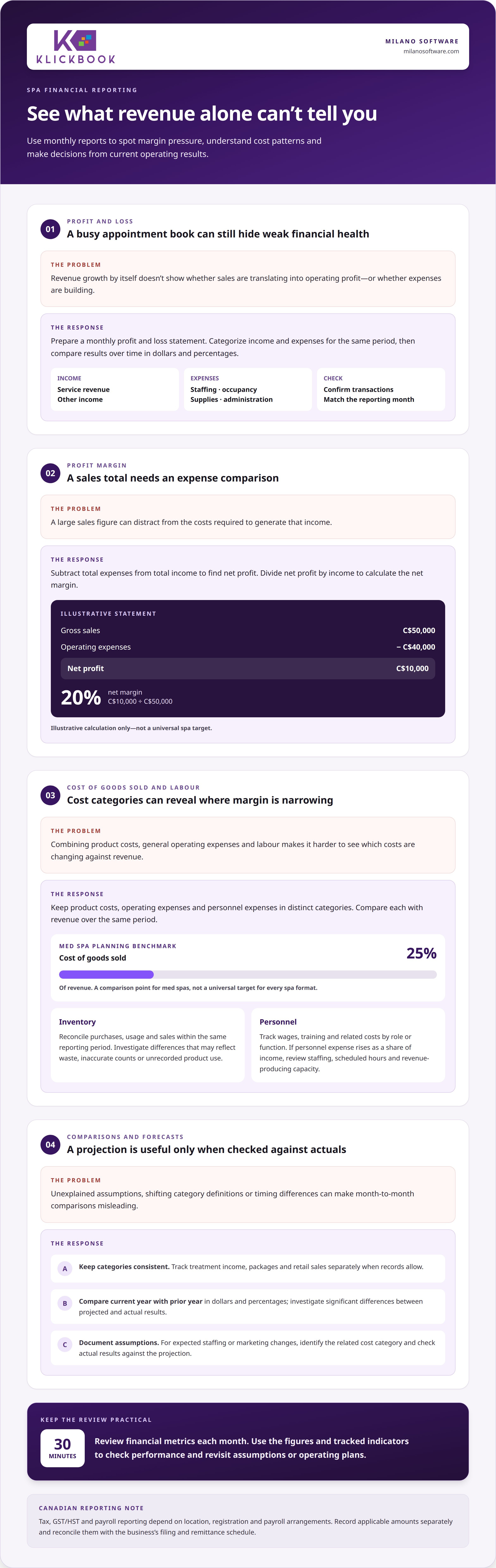
For Canadian spas, tax, GST/HST, and payroll reporting depend on location, registration, and payroll arrangements. Record applicable tax and payroll amounts separately, then reconcile them with the business’s filing and remittance schedule. Prepare a monthly profit and loss statement by categorizing income and expenses for the same reporting period.
-
Compile monthly income and expenditure
Record income and expenses in distinct categories and use consistent accounting periods. Separate service revenue from other income, then group expenses by function, such as staffing, occupancy, supplies, and administration. Confirm that transactions belong to the month being reported, since timing differences can distort comparisons. Reconcile totals with underlying records before relying on the statement to assess performance.
-
Calculate profit margins
Subtract total expenses from total income to calculate net profit, then divide net profit by income to assess the margin. An illustrative statement with C$50,000 in gross sales, C$40,000 in operating expenses, and C$10,000 in net profit produces a 20% net margin. Treat that example as a calculation method, not a universal spa target. Review which expense categories account for the largest share of income.
-
Project profit and analyse financial performance
Build projections from historical income and expense categories, and document the assumptions behind expected changes. Compare projected results with actual monthly performance and investigate significant differences. For useful trend analysis, compare the current year with the prior year in dollars and percentages. Rising revenue or profit indicates growth, while falling expenses as a share of income can signal improved efficiency.
- Separate revenue streams before assessing profitability. For example, track treatment income, packages, and retail sales as distinct categories when the accounting records allow. This shows whether an overall increase reflects stronger performance across the business or growth in just one stream. Keep category definitions consistent between periods so comparisons reflect operating changes, not reclassification.
- Use the statement to test management decisions, not just record outcomes. If a staffing or marketing change is expected to affect expenses, identify the relevant cost category in the projection and compare it with actual results. Separate spa-specific performance from broader industry growth assumptions: market momentum alone does not prove that an individual business is profitable. Review results monthly to keep decisions grounded in current operations.
Med spas can assess performance by comparing current-year and prior-year profit and loss statements in dollars and percentages. Identify and track key performance indicators, then consider them alongside the statements when reviewing results.
Review financial metrics for 30 minutes each month, using the figures and tracked indicators to assess performance and consider whether assumptions or operating plans need attention.
Tracking cost of goods sold and personnel expense
Separate product costs, operating expenses, and labour to identify margin pressure. Compare each category with revenue and operational activity.
-
Track cost of goods sold
Record products and consumables used to deliver services, plus retail inventory sold. Separate those costs from general operating expenses, then calculate cost of goods sold as a share of revenue. A med spa planning benchmark sets total cost of goods sold at 25% of revenue. Treat this as a comparison point for med spas, not a universal target for every spa format.
-
Control operational and inventory costs
Reconcile inventory purchases, usage, and sales within the same reporting period. Investigate differences that could reflect waste, inaccurate counts, or product use missing from the records. For retail, compare the cost of items sold with sales revenue. A point-of-sale system can associate transactions with product categories, while all-in-one business platforms like Mooov similarly help consolidate operational and transaction data for clearer cost analysis.
- Track personnel expenses by role or operating function, using consistent categories for wages, training, and related costs. Compare each category with revenue over the same periods. As revenue grows, personnel expenses may rise in dollars, but their share of income should remain stable or decrease. If that share rises, review staffing levels, scheduled hours, and revenue-producing capacity.
- Map the spa’s cost structure before comparing performance. Day spas, resort spas, and medical spas can have different mixes of labour, inventory, facilities, and service-related supplies. Keep these categories distinct in the accounts. This helps show which costs move with sales and which remain operating commitments as demand changes.
- Build startup estimates from the costs the business will actually incur. Include licensing and permits, lease and renovations, equipment and supplies, staffing and training, marketing, and insurance. Gather Canadian-dollar estimates for the spa’s location and operating model instead of applying another market’s totals as Canadian benchmarks. A qualified accounting partner can help structure projections and assumptions.
- Model payroll timing alongside staffing costs. For a med spa that pays employees every other week, a couple of months in a year may have three paycheques instead of two. Reflect that timing in monthly cost forecasts so payroll does not appear unexpectedly high. Compare actual payroll with the forecast and explain differences by hours, roles, or pay-period timing.
Use role-level staffing assumptions to make personnel forecasts more actionable. The guide estimates med spa staffing and training costs at 40,000 - 200,000, a broad planning range to test against the services and operating model.
Record each role separately and distinguish salaries from training costs. This makes it easier to compare planned and actual personnel expenses by function, identify payroll forecast assumptions, and explain variances without obscuring each position’s contribution. Revisit assumptions when the service mix, staffing needs, or operating plans change.
Cash flow statements
Reconcile appointments with payment records, separating gift-card activity and tips so each amount reaches the correct account. Common reporting risks include unmatched transactions, timing differences, and treating profit as available cash. Accurate transaction records are essential to consistent spa business financial reporting.
-
Reconcile appointments and payments
Match completed appointments with payment records, then investigate cancellations, refunds, and unpaid balances. Reconcile card and cash totals with deposits, recording gift-card sales separately from redemptions to avoid counting the same value twice. Keep tips distinct from spa revenue and trace discrepancies to individual transactions. Daily reconciliation gives the monthly cash flow statement a stronger transaction-level foundation.
-
Review cash flow statements
Use the statement of cash flows to track where cash comes from and where it goes. Separate operating activity from investing and financing, then compare the reported balance with bank records. A profitable month can still leave cash constrained if receivables rise, inventory ties up funds, or capital purchases are made. Review timing as well as the final cash balance.
- Organize financial records around a consistent reporting period. Retain appointment summaries, payment settlement records, deposit details, refund records, and supporting invoices. These records connect operational activity to financial statement entries. If a monthly total changes sharply, trace it to its source document instead of adjusting the report without an audit trail.
- Read cash flow alongside the profit and loss statement, not as a replacement for it. For a medical spa, distinguish EBITDA from cash flow and net profit. Working capital, capital expenditures, financing, depreciation, interest, and taxes affect how these measures differ. For example, equipment purchases can use cash without appearing as an equivalent operating expense in that period.
- Use a pro forma income statement to model expected income and expenses, then translate its assumptions into cash timing. Project when clients pay, suppliers are paid, and payroll or financing commitments fall due. Compare actual results with the forecast and identify whether a difference comes from sales, payment timing, or spending. This makes the projection useful for cash planning as well as anticipated profitability.
- Follow a monthly close sequence: reconcile transactions, review unmatched items, compare bank activity, and document adjustments. Common risks include duplicate revenue, omitted refunds, gift-card sales recorded again at redemption, and tips mixed into service income. Each error can distort cash availability or reported performance. Keep an exception list and resolve every item before finalizing the period’s statements.
Reviewing revenue and variable expenses
Track revenue by source, then compare variable and fixed expenses with income. KPIs include revenue by category, expense ratios, and net operating income; Canadian operating costs vary with service mix, staffing, occupancy, and inventory. Med spa planning guidance recommends net operating income of at least 15-20% of total revenue, not a universal Canadian spa margin.
-
Track revenue by spa offering
Separate service, retail product, and membership revenue in the accounting categories. Compare each stream across reporting periods using consistent definitions. For example, record a membership sale separately from services later redeemed against it, so revenue timing remains visible. Avoid combining retail sales with treatment income, which can obscure changes in product performance or service demand.
-
Project revenue and expenditure
Build projections from historical revenue by category and expected operating activity. List planned spending beside each revenue stream, including costs that rise with service volume or product sales. Compare actual results with the projection monthly and identify the driver of each difference. Revenue growth paired with faster growth in consumables, for example, may deliver less margin improvement than sales alone suggest.
-
Assess expense percentages and benchmarks
Calculate each expense category as a percentage of total revenue. Med spa planning benchmarks include fixed expenses at 37.5%, advertising and promotion at 6%, and rent at 3-5% of revenue. Consumables and injectables are benchmarked at 20-25%. These are med spa reference points, not guarantees or universal targets for Canadian day, resort, or Nordic spas.
-
Track key financial KPIs
Set a monthly KPI view covering revenue by offering, cost ratios, and net operating income. Payroll benchmarks can vary by a spa’s staffing model and service mix, so compare them with your own financial trends. Interpret these categories carefully: role mix, service model, and accounting treatment affect comparisons. Investigate sustained movement rather than reacting to one period.
- Compare fixed expenses with revenue over time. Med spa guidance uses 5% of revenue as a retail products benchmark and 7-10% for other expenses. A fixed expense may change little while revenue shifts, changing its share of income. Separate rent and other recurring commitments from variable costs to see whether revenue growth is improving operating leverage.
- Use the expense breakdown to guide operational review. If consumables rise as a share of revenue, examine product usage and service mix. If advertising costs rise, compare them with revenue trends. No single percentage defines typical costs for every Canadian spa. Location, staffing model, facility requirements, and offerings all shape the cost structure and sustainable margin.
Balance sheets
Use the balance sheet to assess what the spa owns, owes, and retains. Reviewing its account categories alongside operating results shows financial position beyond monthly profitability.
- List assets as of the statement date, separating current items from longer-term resources. Include cash, amounts clients owe, inventory, equipment, and leasehold improvements where applicable. For a medical spa, treatment equipment and room improvements may represent substantial recorded assets. Compare each balance with supporting records so the statement reflects owned resources, not planned purchases or unverified estimates.
- Record liabilities separately, including supplier balances, loans, and other amounts the business must pay. Distinguish near-term obligations from longer-term financing commitments. A spa can have valuable equipment and still face pressure if upcoming payments exceed readily available cash. Review liability balances against invoices, loan statements, and payment records before using them to make decisions.
- Calculate equity by subtracting total liabilities from total assets. This residual measure shows the owners’ recorded interest in the business, not its market sale price. If liabilities increase while assets remain unchanged, equity falls. Track the change between reporting periods and identify whether it reflects operating losses, owner withdrawals, new financing, or asset purchases.
- Reconcile key balance sheet accounts at each close. Match cash with bank records, receivables with unpaid client invoices, inventory with product records, and debt with lender statements. Investigate unexplained differences rather than carrying them forward. A reconciliation trail helps distinguish actual financial changes from posting errors or transactions assigned to the wrong account.
- Compare balance sheets across periods using the same account structure. Assess whether cash, receivables, inventory, equipment, and liabilities are moving in ways that support the operating plan. Rising receivables, for example, can indicate slower collection even when reported revenue is steady. Consider these trends alongside cash flow and profit results, since no single statement explains every change.
- Use the resulting financial position to assess strategic opportunities and constraints. Before adding treatment capacity, consider existing equipment, outstanding financing, and available cash together. Before expanding retail inventory, review current stock and supplier obligations. These checks show whether the spa’s financial position can support an investment, rather than relying on revenue projections alone.
- Keep clear supporting records for each balance. Store the relevant bank reconciliation, receivables schedule, inventory summary, asset register, and liability documentation with the reporting period. Consistent records help owners and accounting partners trace how each balance was derived. They also make comparisons between periods more useful by linking reported movements to specific business activity.
Milano Software: Reporting
Milano Software provides reporting tools for spa operators who need clearer visibility into daily performance. Klickbook by Milano Software brings reporting, point of sale, and online booking into one operational context, helping leaders examine activity alongside financial results. It can be a practical next step when manual reporting makes it difficult to maintain consistent views of appointments, sales, and business performance.
Use reporting to support regular review of revenue and expenses, then apply the findings to operational decisions. Online booking allows clients to schedule appointments and service packages 24/7 from any device, while point-of-sale capabilities support retail sales workflows. Together, these offerings provide operational inputs for a more structured financial review.
Contact Milano Software to discuss your spa’s reporting needs.
Turn financial visibility into operational decisions
Make financial review part of the spa’s operating rhythm, not an exercise reserved for year-end planning. Assign clear responsibility for preparing reports, explaining variances, and carrying decisions into the next planning cycle. This discipline helps leadership connect financial insight to capacity, service mix, staffing, and investment priorities.
Spa business financial reporting is most valuable when each review leads to a defined action. Set a priority, assign responsibility, and record the expected business effect. Revisit the decision in a later reporting period to see whether operations changed as intended. This creates a repeatable management process rather than a collection of disconnected statements.
Milano Software offers spa management, online booking, and reporting to support spa operations and financial visibility. If your current processes make it difficult to turn operational activity into usable reporting, contact Milano Software to discuss your needs.
Build a reporting practice that supports confident decisions and sustainable spa performance.
Frequently Asked Questions
What financial reports should a spa business prepare regularly?
Prepare a profit and loss statement, cash flow statement, and balance sheet, supported by reconciled transaction records. Review the statements together each month: the profit and loss statement shows operating results, cash flow tracks cash movements, and the balance sheet summarizes assets and liabilities. Add a budget-versus-actual view to identify variances, assign someone to investigate them, and document adjustments for the next reporting period.
How should spas forecast cash flow and manage seasonal fluctuations?
Use historical demand patterns to build a rolling cash forecast, separating expected bookings from cash actually collected. Map seasonal revenue changes against fixed commitments, supplier payments, payroll, and planned purchases. Create alternative projections for stronger and softer booking periods, then update them as booking activity changes. This helps managers identify potential cash pressure early and adjust discretionary spending or purchasing plans before a slower period affects operations.
What spa accounting software integrates with booking and point-of-sale systems in Canada?
Milano Software provides spa management with online booking, point of sale, and reporting capabilities. Its booking module synchronizes appointments with the spa’s internal calendar, while point of sale supports transactions, service charges, gift cards, retail merchandise, and inventory and sales records. These operational records can support financial review by connecting booking and transaction activity with reporting. Align the accounting workflow with the spa’s ledger and reconciliation requirements.