

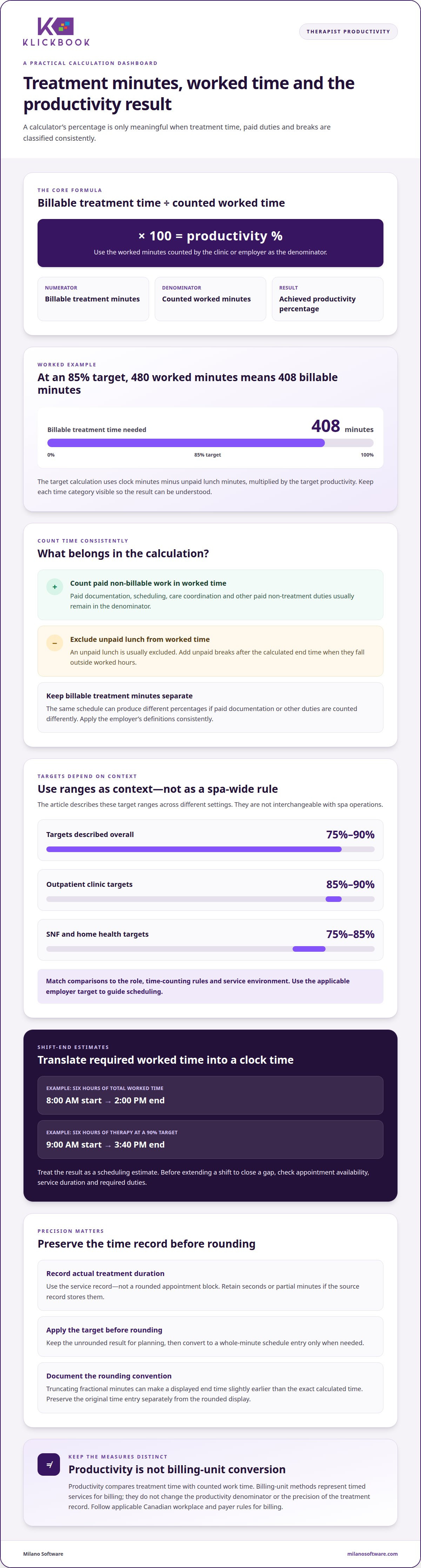
When calculating spa therapist productivity, divide billable treatment minutes by counted worked minutes, then multiply by 100. A calculator can return the achieved percentage or estimate the work time needed to meet a target. Its output depends on the time definitions used for the calculation.
The percentage is meaningful only when the spa consistently classifies treatment, paid duties, and breaks. Those inputs determine how well the result reflects a therapist’s scheduled work.
This guide explains how to interpret calculator results, account for fractional minutes, and assess documentation and administrative work. Use the method to support clearer scheduling and operational decisions.
Key Takeaways
- Use the calculator to translate a productivity target into the worked time or shift end time needed to meet it.
- Account for fractional minutes: rounding down can make the calculated end time slightly earlier than the exact target.
- Separate billable treatment minutes from total worked time so the percentage reflects the clinic’s or employer’s time-counting rules.
- Include paid documentation and administrative duties in the denominator when they count as worked time, even though they aren’t billable.
- Use booking and reporting tools to bring appointment activity and operational performance into clearer view.
What is a therapy productivity calculator?
A therapist productivity calculator uses treatment time and a target to estimate required work duration or a shift end time. Treat the result as a scheduling measure, not a universal performance standard.
-
Identify Employer Productivity Definitions and Targets
First, record how the spa defines billable minutes, worked time, and breaks. The same schedule can produce different percentages if one calculation excludes paid documentation while another includes it. Confirm the target for the role and setting, then apply those definitions consistently across shifts.
For an end-time estimate, add total worked time to the shift’s start. Six hours of total worked time beginning at 8:00 AM gives a perfect end time of 2:00 PM. Add unpaid breaks after the calculated end time if they fall outside worked hours. For a 9:00 AM start, six hours of therapy at a 90% target requires a 3:40 PM end time.
-
Review Therapist Targets and Workload
Compare the target with scheduled treatment hours and the duties assigned during the shift. Productivity is not simply a client count: session length, appointment gaps, service mix, and paid non-treatment work all affect the calculation. Assess workload against the actual schedule and responsibilities, rather than assuming a client count transfers from another role or workplace.
Targets vary by therapist and employer. Use the applicable employer definition and treat the calculator’s result as a planning estimate. Don’t automatically extend a shift to close a gap. First identify whether it stems from appointment availability, service duration, or required duties.
-
Compare Typical Productivity Target Ranges
Use the stated target range as context, not as a spa-wide rule. Productivity targets are typically described as 75% to 90%, depending on setting; outpatient clinic targets are given as 85% to 90%, while SNF and home health targets are given as 75% to 85%. Those settings are not interchangeable with spa operations.
Choose a relevant comparison by matching the role, time-counting rules, and service environment. A target should guide scheduling, not override service requirements or employer policy. Record the target before calculating shift time so managers can interpret results consistently.
-
Compare Productivity Across Therapists and Services
Compare therapists only after aligning the reporting period, target, and treatment-minute definitions. For different services, distinguish appointment duration from billable treatment time: a longer booking doesn’t necessarily mean more billable minutes. For seasonal comparisons, use equivalent periods and account for changes in appointment mix and demand.
Revenue per therapist hour is service revenue divided by therapist hours worked; average service ticket is service revenue divided by completed services. Commission, hourly pay, and tips affect compensation measures, not the productivity formula. Improve capacity through balanced scheduling and manageable administrative workflows. Don’t raise targets by compressing service time or removing necessary breaks.
How are fractional minutes handled?
- Record treatment duration at the source. Use the actual treatment duration in the service record, not a rounded appointment block. If the record stores seconds or partial minutes, retain that precision throughout the calculation. This prevents small rounding differences from accumulating across a therapist’s schedule.
- Apply the target before rounding. Use the target as a decimal when calculating required treatment time from available worked time. Keep the unrounded result for planning, then convert it to a whole-minute schedule entry only when needed. Rounding too early can shift the requirement away from the intended target.
- Choose a consistent rounding convention. Some calculators truncate fractional minutes to the next whole minute. Their displayed end time may therefore be slightly earlier than the exact calculated time. Document the convention, especially when comparing tools or transferring results into a schedule.
- Separate productivity calculations from billing-unit rules. A productivity percentage measures treatment time against the work time counted by the employer. Billing-unit methods determine how service time is represented for billing, a separate process. Follow applicable Canadian workplace and payer rules for billing, and don’t use a billing-unit conversion to alter recorded treatment minutes.
For reliable reporting, preserve the original time entry and the calculator’s rounded display as separate values. This lets managers trace small differences to rounding rather than changing the underlying schedule or time definition.
The denominator matters as much as the treatment-time total. Therapy productivity uses billable treatment minutes divided by the worked minutes counted by the clinic or employer; unpaid lunch is usually excluded, while paid documentation, scheduling, care coordination, and other paid non-billable time usually remain in the denominator. The billable minutes needed for a target are calculated from clock minutes minus unpaid lunch minutes, multiplied by the target productivity. At an 85% productivity target, a therapy day with 480 worked minutes requires 408 billable minutes. Keeping the underlying time categories visible helps explain why a fractional result may arise and prevents a lunch deduction from being mistaken for rounding.
Do not confuse that calculation with the conversion of timed services into billing units. Under the page’s Medicare 8-minute rule chart, 23-37 timed minutes correspond to 2 units. For Medicare timed therapy services, the page states that at least 8 minutes of a timed service are needed to bill one unit under the 8-minute rule. Those thresholds govern unit representation, not the productivity denominator or the precision of the treatment record. A therapist with 6 hours of therapy time and a 90% productivity target needs 400 minutes, or 6 hours and 40 minutes, at work. If a calculated time falls between whole minutes, retain the exact treatment and calculation values for productivity reporting, then apply the relevant unit method separately when billing. This keeps schedules, productivity reports, and claims aligned without treating them as interchangeable measures. When reviewing a difference, check whether it came from the time counted as work, the target calculation, rounding for display, or a billing-unit threshold. That distinction makes the result easier to interpret while preserving the original time information.
Billable versus non-billable work
- Define billable time using the spa’s productivity rules. For a therapist, billable minutes generally mean hands-on treatment time counted toward the target. A booked appointment may include intake, changing, or room turnover, so don’t automatically count its full duration as treatment. For example, separate service minutes from preparation time. Apply the same definition throughout the schedule.
“Billable” describes time counted in the productivity calculation; it doesn’t automatically mean an insurer reimburses the service. In a Canadian spa, distinguish operational productivity tracking from any separate payment or benefits arrangements.
- Classify each duty before measuring a shift. Create clear categories for treatment, documentation, scheduling, care coordination, breaks, and other assigned tasks. Mark whether each category is paid and whether the employer counts it as worked time. This prevents patient-facing service minutes from being confused with total work hours.
For example, record a treatment as billable only when it meets the spa’s stated criteria. Record paid charting or appointment coordination separately, even when those duties happen between services.
- Keep paid non-billable duties visible in the denominator. Productivity compares billable treatment minutes with the worked minutes counted by the employer. Paid documentation, scheduling, care coordination, and other paid non-billable work generally remain in that denominator. Excluding them can make the percentage look higher than the shift allocation supports.
Unpaid lunch is usually excluded from worked time. Keep breaks separate from paid tasks, and apply the same time-counting method to every therapist and reporting period.
- Separate service delivery from revenue reporting. A treatment can add billable minutes without generating the same revenue as another service. Retail activity may contribute to sales without adding treatment time. Track these measures separately: treatment productivity describes time utilization, while revenue reporting describes financial activity.
A point-of-sale record can help distinguish treatment charges from retail transactions. Don’t add retail time to billable therapy minutes unless the employer’s defined metric explicitly includes it.
- Audit the classification using a real shift. Select one therapist’s schedule and reconcile appointment records with time entries. Check each service’s treatment duration, then identify paid documentation and administrative blocks. Documentation taking five to ten minutes per patient can make these blocks material; for ten to twelve patients daily, it may total an hour or more.
Use the comparison to locate scheduling pressure, not erase necessary work. If the calculation excludes paid duties, label the metric accordingly. If it includes them, count those minutes consistently.
How paid documentation and administrative work affect productivity
- Map documentation to the schedule. Mark when notes are completed: between appointments, in designated blocks, or after the final service. A therapist who finishes records after the last booking may have a different daily work pattern from one who documents between clients. Recording the timing makes schedule pressure visible without assuming every note follows the same workflow.
- Separate scheduled tasks from unplanned work. Track recurring documentation and administrative blocks separately from interruptions, such as a late client arrival or a service record needing correction. This distinction helps managers identify predictable workload and operational exceptions. For example, a regular end-of-shift note block calls for a different scheduling response than repeated, unscheduled coordination tasks.
- Review trends by therapist and reporting period. Compare documentation and administration patterns using the same definitions in every report. A single shift may reflect an unusual client mix, while recurring patterns can reveal a workflow constraint. Keep the period and task categories visible; otherwise, changes in recorded duties may appear to be changes in therapist performance.
- Connect workflow changes to operational effects. If the spa changes its note process or appointment sequence, record the change alongside productivity results. Compare the same therapist role and service mix before drawing conclusions. For instance, moving documentation into planned schedule blocks may change available appointment capacity even when treatment delivery remains unchanged.
- Use the breakdown to guide a focused review. Examine whether back-to-back appointments, unclear handoffs, or administrative steps across multiple systems delay documentation. Each cause points to a different operational adjustment. Managers can review scheduling, task ownership, and record workflows together, then assess whether a revised process changes capacity without removing required documentation.
Keep metric definitions stable during the review. If a reporting category changes, annotate it so managers can distinguish an operational shift from a change in how therapist productivity is measured.
Calculating therapist productivity percentages
- Set the formula and time boundary. For calculating spa therapist productivity, divide billable therapy minutes by counted worked minutes, then multiply by 100. Apply the employer’s time rules to both values. For example, 306 billable minutes in a 360-minute paid work period equals 85%. That percentage measures treatment time against counted work time, not revenue or attendance.
- Reconcile treatment minutes before calculating. Add billable minutes from completed services, using the same treatment-duration rules for each appointment. Seven hours of therapy during an eight-hour workday equals 87.5% productivity; five hours during that day equals 62.5%.
Check appointment records against completed services. A booked hour may include non-treatment time, so don’t assume every scheduled minute belongs in the billable total.
- Calculate utilization from available capacity. Divide booked treatment hours by available therapist hours, then multiply by 100. This measures how much appointment capacity is booked. Productivity instead compares billable treatment with counted worked time.
For an eight-hour day with seven booked treatment hours, utilization is 87.5% if all eight hours count as available. If blocked periods are excluded, use the reduced available-hours figure consistently.
- Compare equivalent metrics and periods. Apply the same time boundary, treatment-minute rules, and denominator for each therapist. An 85% productivity result based on paid hours isn’t directly comparable with utilization based on appointment availability. Label each metric and reporting period clearly.
- Interpret the percentage alongside its inputs. Review billable minutes, worked minutes, and schedule utilization together. A lower result may reflect fewer bookings, longer assigned duties, or different time-counting rules. The percentage alone doesn’t identify the cause, so retain its component figures for operational review.
A consistent process for calculating spa therapist productivity makes schedule reviews more actionable. Shared definitions help managers identify capacity variances without treating booked time, paid time, and treatment delivery as interchangeable.
The calculator excludes breaks; enter billable minutes only, accounting for breaks manually according to your schedule. Seeing 25 clients per week in 60-minute sessions across a standard five-day workweek means 5 hours of therapy per day.
Milano Software: Spa Management
Milano Software’s spa management capabilities help operators connect appointment activity with day-to-day business reporting. Online Booking lets spa clients schedule appointments and service packages 24/7 from any device, supporting a clearer view of incoming demand and therapist schedules.
Use reporting to review operational performance alongside productivity calculations, then assess whether scheduling patterns align with available therapist capacity. Point of Sale supports transaction processing, while centralized booking helps organize service appointments. These tools are useful when manual records make it difficult to connect booked services, completed appointments, and operational results. They don’t replace the employer’s definitions for billable minutes or worked time; apply those definitions consistently in the formula.
For a more integrated approach to spa operations, explore Milano Software’s spa management platform or contact Milano Software.
Turn productivity insight into operational control
A consistent productivity measure gives spa leaders a stronger basis for planning schedules, reviewing capacity, and identifying operational pressure points. The next step is connecting that analysis to systems that manage appointments and business performance. A disciplined approach to calculating spa therapist productivity can inform decisions, especially when supported by reliable operational records.
Milano Software’s Spa Management platform brings operational workflows together. Online Booking organizes appointment activity, while Reporting supports performance reviews. These tools help spa teams align scheduling decisions with their operating model without treating a single percentage as a complete measure of performance.
Build a clearer operational picture for your spa. Contact Milano Software to discuss your needs and explore the next step for your team.
Frequently Asked Questions
What does the calculator output?
A productivity calculator may output an achieved percentage, required worked time, or estimated shift end time, depending on its inputs. Enter the target, start time, and billable treatment time to estimate an end time. Treat the result as a schedule estimate based on the time definitions and break settings entered, not as a standalone assessment of service quality.
What is a good productivity percentage?
A good percentage depends on the employer’s time-counting rules, role, and operating setting. Targets are commonly described across a 75% to 90% range, but that range doesn’t establish one ideal for every spa. Set a target that reflects assigned duties and the treatment schedule. Compare results only when the underlying definitions match, and review service quality and workload alongside the percentage.
How is spa therapist productivity calculated?
When calculating spa therapist productivity, divide billable treatment minutes by the worked minutes included under the employer’s definition, then multiply by 100. Align the reporting period and confirm which duties count as worked time. Use completed treatment minutes rather than appointment slots when bookings include non-treatment periods. Keep the numerator and denominator definitions consistent across therapists and reporting periods.
What is the standard spa therapist utilization rate or productivity benchmark?
There is no standard utilization rate for every spa. Productivity compares billable treatment with counted work time; utilization compares booked treatment with available appointment capacity. These percentages answer different operational questions. Set the target internally, name the metric clearly, and compare equivalent schedules. Resort spas, day spas, and treatment-focused clinics may use different capacity assumptions.
Should spa productivity include setup, cleanup, breaks, and administrative time?
Apply the employer’s time rules to each category instead of grouping all shift time together. Paid documentation and administration generally remain in worked time, while unpaid lunch is usually excluded. Classify setup and cleanup consistently according to how the spa records them. Keep breaks separate from treatment minutes, then document whether each paid or unpaid block belongs in the productivity denominator.
What are typical spa therapist productivity benchmarks in Canada?
Use the 75% to 90% range as broad context, not as a Canadian spa-wide standard. The applicable target depends on the setting and how the employer defines billable treatment and worked time. A useful benchmark compares therapists with similar service mixes, schedules, and assigned duties. Record those assumptions beside the percentage so leaders can interpret results without treating unlike roles as equivalent.
What software or reports can track spa therapist productivity and utilization?
Reports that organize appointment activity, completed services, and staff performance can support productivity reviews. When calculating spa therapist productivity, use records that distinguish scheduled capacity from treatment delivered. Milano Software provides spa management, online booking, and reporting tools. Its reporting covers staff performance and operational and financial metrics, supporting a structured review of therapist schedules and spa performance.


