
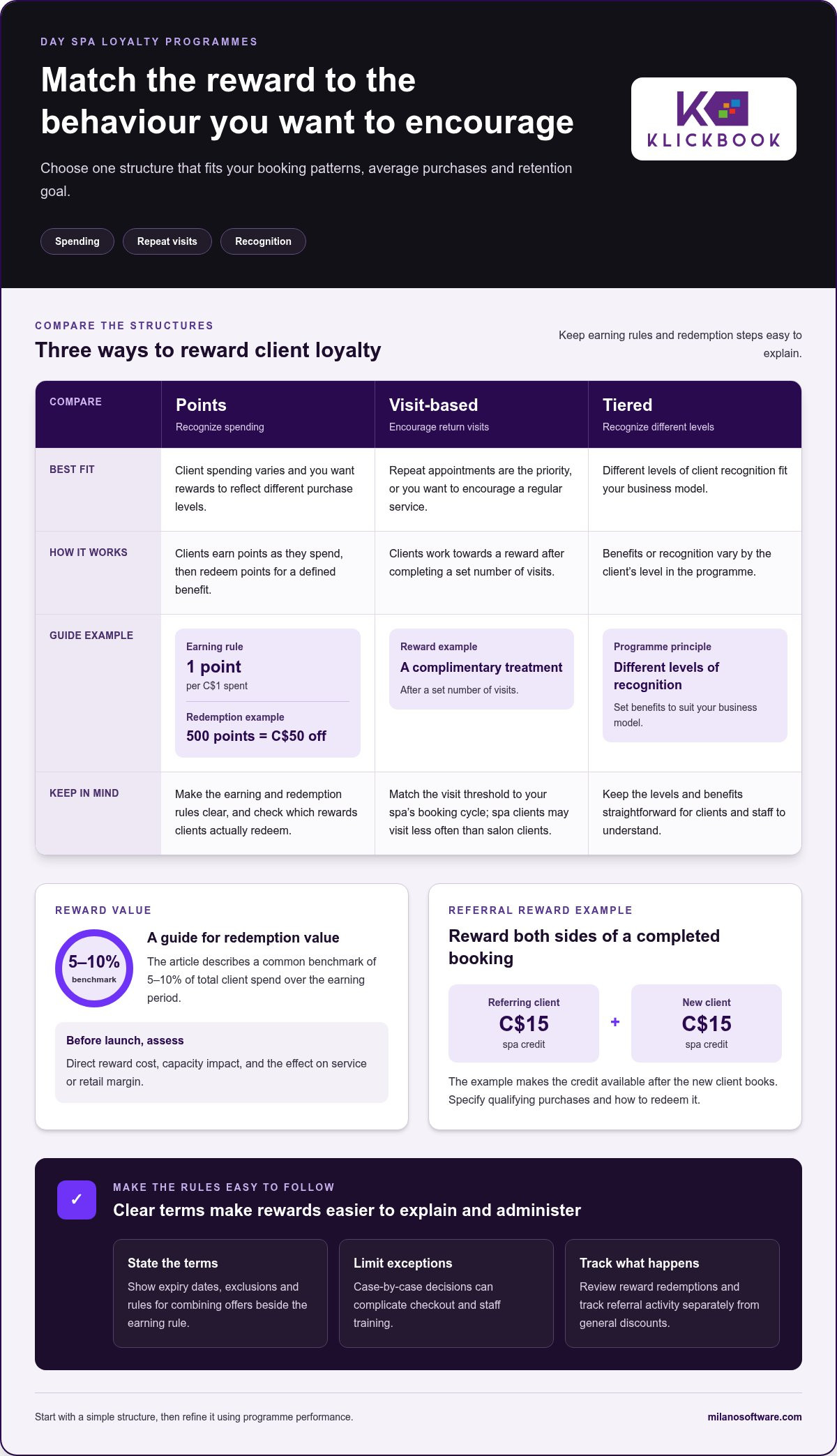
A strong day spa client loyalty program is easy for clients to understand and for staff to administer consistently. Choose points when client spending varies, visit-based rewards when repeat appointments are the priority, and tiers when different levels of recognition fit your business model. Digital tracking can replace paper cards and simplify reward management.
The structure matters: a reward that feels distant or complicated may not give clients a clear reason to return. Connect client activity to a relevant benefit without adding unnecessary steps at booking or checkout.
This guide compares points, visit-based, and tiered programs, then explains how to set practical earning and redemption rules. You’ll also learn what to consider when moving from paper cards to digital rewards, so the program supports retention and fits your spa’s daily operations.
Key Takeaways
- Match the reward structure to your spa’s business model and the client behaviour you want to encourage.
- Set referral rewards with clear eligibility and redemption rules so clients and staff can understand how they work.
- Track member growth, visit frequency, spending and lifetime value to assess whether the program is delivering business value.
- Plan a move from paper cards to digital rewards around ease of use and fit with your existing operations.
- Start with a simple earning rule and reward structure, then refine the program using performance data.
Which Spa Loyalty Program Ideas Work Best for Different Business Models?
Choose rewards that encourage the behaviour your spa wants to see. Keep earning rules, redemption steps, and client-facing terms easy to explain, and tie each reward to a clear retention goal.
-
Choose Rewards That Fit the Spa
Start with one reward structure, then match it to booking patterns and average purchases. A points model can recognize different spending levels: award one point per C$1 spent, then let clients redeem 500 points for C$50 off. A punch card suits a repeat service, such as a complimentary treatment after a set number of visits. Rebooking rewards can encourage clients to reserve their next appointment before leaving.
Clients may value discounts, upgrades, or complimentary treatments differently. Offer options that fit your service menu and retail inventory, then track which rewards clients redeem. Keep each benefit relevant to why clients return.
-
Build Referral Rewards into the Enrollment Process
Set a referral rule that rewards both advocacy and a completed booking. For example, give the referring client and the new client C$15 in spa credit after the new client books. State when the credit becomes available, which purchases qualify, and how clients redeem it. Promote the offer at checkout, in appointment follow-ups, and through referral messages clients can share.
Track referral marketing separately from general discounts. This helps show whether new bookings came from referrals or another campaign.
-
Personalize Rewards with Client Data
Use booking history and retail purchases to make rewards relevant. A client who regularly books facials may value a complimentary upgrade, while a retail purchaser may prefer product credit. Collect only the details needed to administer rewards, explain why you collect them, and make consent clear. Limit staff access to client records and avoid gathering sensitive information unrelated to the program.
For Canadian programs, publish plain-language terms and follow a consistent consent process. Explain offer conditions before enrolment, including how client information supports personalized rewards.
-
Set Reward Rules and Values
Calculate each reward’s direct cost, capacity impact, and effect on service or retail margin before launch. A common benchmark sets redemption value at 5-10% of total client spend over the earning period. Set a clear expiry date, exclusions, and rules for combining offers; show these terms beside the earning rule. Keep exceptions limited, since case-by-case decisions complicate checkout and staff training.
There is no single reward cost that suits every spa. Costs depend on the reward, its delivery, and whether redemption uses capacity that could otherwise be sold.
-
Promote enrollment at key moments.
Train front-desk staff to explain the program at checkout, while clients are reviewing their next booking. Add a concise invitation to appointment reminders and follow-ups, and display the earning rule at the point of sale. Track sign-ups by channel and refine the message if enrolment or redemption patterns reveal friction. These touchpoints make enrolment part of the existing client journey.
What Is a Spa Loyalty Program - and Why Does It Matter for Retention?
A spa loyalty program gives clients a defined reason to return through points, visits, or member benefits. Treat it as a retention tool: measure whether enrolled clients book again, spend, and refer others.
-
Compare Acquisition Costs with Retention Value
Map the work and expense required to attract a new client, including marketing, promotions, and staff time. Compare that investment with the value of a client who returns and refers friends. The North American salon and spa industry has a new-client retention rate of 23%, making follow-up after an initial visit a practical priority.
Use the comparison to set an objective, such as increasing repeat bookings or referrals. Do not measure success by enrolment alone: a sign-up matters when it leads to meaningful client activity.
-
Connect Retention with Spending and Revenue
Track repeat visits and spending together. The probability of selling to an existing client is 60-70%, compared with 5-20% for a new prospect. Existing clients also spend 31% more than new clients. These figures support a retention strategy, but they don't establish what one spa will earn.
Set a baseline before launch by reviewing booking frequency, average transaction value, and retail purchases. Then compare enrolled and non-enrolled clients over the same period. This helps distinguish increased activity from revenue that would have occurred anyway.
-
Account for spa visit patterns.
Spa clients may visit less often but spend more per appointment than salon clients. Recognize the longer interval between treatments: an aggressive visit threshold may not suit a spa’s booking cycle. A birthday benefit or tailored rebooking prompt can offer a timely reason to return without relying on broad discounts.
Record referrals separately from repeat visits. This shows whether the program is strengthening retention, acquisition, or both.
-
Set a measurable retention target.
Define the behaviour the program should change, then select a matching metric. For rebooking, measure the share of clients who return within your chosen service interval. For revenue growth, compare member spending and visit frequency with the baseline. A 5% increase in customer retention can increase profits by 25% to 95%, depending on the industry; use this as broader context, not a spa-specific forecast.
Review discounts, birthday rewards, and referral activity alongside repeat bookings. Keep the program’s purpose clear, and adjust its structure if client behaviour does not support that objective.
What’s the difference between a points system and a tiered membership?
A points system rewards eligible spending; a tiered membership unlocks benefits when clients reach defined thresholds. Compare reward costs with incremental revenue, then assess member visits, spending, growth, and lifetime value.
- Choose the structure that fits your revenue model. Use points when you want to recognize purchases across services and retail. One example awards one point per C$1 spent; its stated value example equates that earning rate with a 10% return. A tiered structure instead assigns status according to annual spending, giving clients a visible path to additional benefits.
For instance, a sample program sets Silver status at C$500 in annual spending and Gold at C$1,500. Treat these as design examples, not universal thresholds. Set your own levels against client spending patterns and the cost of each benefit.
- Define recurring membership benefits. A subscription model charges a recurring fee in exchange for a defined package of benefits. Specify what the fee covers, how clients use each benefit, and whether unused credits roll over. One example allows unused credits to roll over for 2-3 months.
Consider how appointment availability and service mix affect redemption. A complimentary massage may affect capacity differently from a retail benefit. Model both before setting terms, and keep redemption straightforward.
- Measure growth and behaviour, not sign-ups alone. Record member enrolment, active membership, repeat visits, average spending, redemptions, and revenue over a consistent review period. Compare those measures with the period before launch, then segment results by membership tier or points activity.
Estimate member lifetime value using the revenue associated with a client over their relationship with the spa. Include visit frequency and purchase value, then subtract reward and program costs to assess contribution. Apply the same calculation to member and non-member groups.
- Calculate program profitability before expanding benefits. Total the cost of redeemed rewards, administration, and promotion. Compare that amount with additional revenue linked to member activity, while separating incremental purchases from routine bookings. A sample break-even calculation uses C$100 in monthly program costs and C$500 in additional monthly revenue, leaving a C$400 net benefit.
Use your transaction and redemption records to test your assumptions. If redemptions rise without additional visits or spending, revise the reward value or eligibility rules.
- Review rollover and renewal rules. State whether credits expire, roll over, or reset when a membership renews. A 2-3-month rollover period can give clients a defined window to use credits, while helping the spa forecast outstanding benefits.
Track renewals, redemptions, visits, and spending together. This shows whether recurring benefits support ongoing activity or add costs without corresponding revenue.
Moving from paper punch cards to digital programs
- Audit the paper process before launch. Map how staff issue, stamp, replace, and redeem each card. The review should identify where a client’s progress can be missed, such as a forgotten card at checkout. One estimate says 80% of paper spa punch cards are lost before redemption. Use that risk to define what the digital version must record.
Set a clear transition rule for existing cards. For example, honour verified stamps during a stated transition period and record balances consistently.
- Choose a digital format clients will use. Compare wallet passes, a standalone app, and digital cards delivered through existing client communications. Wallet-pass adoption at spas is reported at 65-75%, while standalone spa loyalty apps have adoption rates of 10-20%. An app adds another download step; a wallet pass can keep a reward accessible alongside other mobile passes.
Branded loyalty apps also face ongoing engagement challenges: 83% are uninstalled within 30 days of download. Assess the client experience before selecting a format.
- Make earning and redemption visible. Show clients how to earn points, check progress, and redeem rewards without asking staff to reconstruct purchase history. For example, a digital card can display stamps after eligible visits, while a points ledger records qualifying purchases. State whether facial services, packages, or retail purchases qualify, and explain exclusions at enrolment.
Test a complete booking-to-checkout journey with a sample client account. Confirm that recorded activity follows the program’s written earning rules.
- Connect digital rewards to daily checkout. Staff should be able to identify eligible rewards and record redemptions during payment. A point-of-sale workflow can keep transactions and reward activity aligned, reducing the need for separate manual records. Test common scenarios before launch: earning points on a retail purchase, redeeming a benefit, and correcting a missed transaction.
Document who can adjust a balance and how corrections are recorded. These controls make reward histories easier to reconcile.
- Measure the first operating period. Track enrolment, earning activity, redemption, and repeat bookings after launch. Apple Wallet and Google Wallet push notifications have approximately 90% open rates, but an opened message does not itself demonstrate a booking. Compare message engagement with completed appointments and reward use.
Review results before changing earning rules. If clients join but rarely redeem, simplify access or clarify the next step. Keep terms consistent across digital cards, booking reminders, and checkout.
Choosing a simple points-based or visit-based program
Choose a structure that fits your service mix and checkout process. Points recognize eligible spending; visit-based rewards recognize completed appointments. Start with one model, then test whether clients and staff can follow its rules without extra calculations.
- Use a visit structure for repeatable appointments. A stamp or visit counter suits a spa where clients return for a consistent service. Define a completed visit, and exclude cancellations or refunded appointments from progress. Keep the reward tied to a service clients can readily understand, rather than creating several stamp categories.
Review the booking and checkout workflow: staff need a reliable way to record each qualifying appointment. Make client progress visible so the next eligible visit is easy to identify.
- Choose points when purchases vary. Points can account for different combinations of services, packages, and retail purchases. Set one earning rule, specify which transactions qualify, and explain how returns affect balances. Avoid layered multipliers at launch: they make progress harder for clients to estimate and incentives harder for staff to explain.
Decide whether points belong to the purchaser or the appointment. This matters when one person pays for multiple clients or a package is redeemed over several visits.
- Set an achievable first milestone. A suggested threshold is 3-4 visits, giving regular clients a visible early target. The first reward should be reachable within 60-90 days for a regular client. Match that threshold to the spa’s service cadence, not an assumed schedule that treats every appointment type alike.
Compare the threshold with booking history before publishing it. A client who returns for wellness services less frequently may need a different path to progress than a frequent visitor.
- Keep the design clear. Use one structure, one earning rule, and one or two rewards clients can explain back to staff. Put exclusions, redemption steps, and balance adjustments in the same terms clients see at enrolment. Clear terms help front-desk staff answer questions without interpreting overlapping offers.
During the first 30 days after launch, have staff introduce the program at checkout. Use the same concise explanation in booking communications and printed or digital program materials.
- Review results before adding rules. Track completed visits, point earning, redemptions, and repeat bookings against the program’s objective. Review these measures monthly for the first six months after launch, then quarterly once the program is stable. If activity does not shift, revise the threshold or reward before adding another mechanism.
Keep the review workflow connected to booking and checkout records. Spa operations planning can help frame the processes staff need to follow.
Milano Software: Spa Management
Milano Software supports spa operations with Spa Management, Online Booking, Reporting, and Point of Sale. These tools support the workflows around a loyalty program: clients can book appointments and service packages online, while staff process purchases and review operational results.
For a day spa moving beyond manual reward tracking, align program rules with booking and checkout procedures. Define how eligible purchases are recorded, how staff apply rewards, and which reports help evaluate client activity. Milano Software’s spa management platform supports the wider operational environment for these processes.
To discuss your spa’s operational requirements, contact Milano Software.
Turn Your Loyalty Strategy into an Operating Plan
Assign an operational owner before launch. This person can coordinate front-desk procedures, staff guidance, and routine reviews, while managers oversee business performance. Document how questions are escalated and how staff communicate decisions to clients. Clear ownership helps prevent inconsistent follow-through.
Use a launch-readiness review to walk through a typical client visit from arrival to checkout. Identify who handles enrolment, where staff find current program information, and how they resolve discrepancies. Gather staff feedback after rollout, then update internal guidance when recurring questions reveal a process gap. This creates a controlled improvement cycle without changing the program in response to every individual case.
Align the operating plan with the systems your spa already uses, so responsibilities and client communications remain coherent. Milano Software can discuss how its spa management capabilities fit your operational requirements. Contact Milano Software to discuss the next step. A well-owned process gives your team a practical foundation for delivering the program consistently.
Frequently Asked Questions
Do spa clients need to download an app to join a loyalty program?
No. A loyalty program can enrol clients without requiring an app download. Offer a simple sign-up process at checkout or during booking, then provide a way to access each client’s reward record. Before launch, test how staff can locate a member, confirm eligibility, and apply a reward. Fewer enrolment steps can make participation easier, including for clients who prefer not to install another app.
How do you prevent clients from gaming a loyalty rewards system?
Base rewards on verified transactions and clear eligibility rules. Award points only after a completed purchase, and define how refunds, cancellations, split payments, and duplicate accounts affect balances. Give staff a consistent process for correcting errors and recording each adjustment. Review unusual earning or redemption patterns before changing an account. Clear terms and consistent transaction records reduce ambiguity for clients and staff.
Should a small single-location spa run a loyalty program?
Yes, if repeat bookings matter to the spa and staff can administer the program consistently. A single location can start with a straightforward offer, track enrolment and completed redemptions, and review whether clients return. Consider the time needed to explain the offer and maintain accurate records. If administration disrupts checkout or client service, simplify the process before expanding the program or adding reward options.
What Is Spa Loyalty Software and When Do You Need It?
Spa loyalty software records member activity and supports reward administration alongside spa operations. It can help when staff struggle to reconcile paper cards, transaction records, or client reward balances. Before adopting it, map the workflow from a qualifying purchase to redemption. Identify where information is recorded, who can correct errors, and how managers can review activity. This helps define the operational problem the software needs to address.
What metrics should I track to know if my loyalty program is working?
Track how many enrolled clients become active members, how often rewards are redeemed, and whether membership corresponds with additional bookings. Compare client groups over equivalent periods, using a consistent definition of an active member. Also compare reward costs with the margin on qualifying purchases. Separating these measures distinguishes enrolment interest from behaviour change and shows whether operating costs align with the program’s purpose.
What are the most effective loyalty program ideas for a day spa?
Choose an incentive tied to a specific business objective. To encourage clients to explore an underbooked service category, offer a relevant upgrade after an eligible appointment. If increasing retail purchases is the goal, reward qualifying product purchases with a benefit clients can use on a future visit. Review performance by offer type, then keep incentives that support the objective without adding unnecessary checkout steps.
How should a day spa structure points, rewards, and membership tiers?
Set the earning rule first, then define redemption and membership terms around it. Clients should understand which transactions qualify, how refunds change balances, and whether rewards can be redeemed in part. For tiers, use actual client spending patterns to set thresholds and specify when status is reviewed. Put the rules in one accessible set of terms so staff can apply them consistently.
What software can Canadian day spas use to manage loyalty programs?
Canadian day spas can use spa management software that connects reward activity with operational records. Milano Software offers Spa Management, Online Booking, Point of Sale, and Reporting; the platform also includes rewards and promotions. Together, these tools can help operators relate client activity to bookings and transactions, then review results through reporting. Assess the workflow your spa needs to manage, including how staff record eligible purchases and process redemptions.


