

A spa membership program charges a recurring fee in exchange for defined benefits. A prepaid package covers a set of services, while a loyalty program can reward eligible activity without a recurring fee. The strongest spa membership program ideas pair clear member value with benefits the spa can deliver consistently. Set specific terms for included services or credits, discounts, and access instead of relying on price reductions alone.
Memberships can encourage repeat visits, but their structure needs to suit treatment capacity, retail priorities, and the client experience. This guide covers how to shape tiers and pricing, choose treatment and retail perks, review the program as performance and feedback evolve, and promote it through targeted communications and in-spa conversations. The goal is a program with clear benefits, workable terms, and a compelling reason for clients to enrol.
Key Takeaways
- Match membership pricing to the benefits provided, and assess each tier against treatment costs, capacity and expected redemption patterns.
- Choose a structure that fits client behaviour: included services, credits, defined access or a combination of benefits.
- Build treatment and retail perks around repeat bookings, while setting clear eligibility, expiry and combination terms.
- Review renewals, visit frequency, spending and benefit use to identify which offers need adjustment.
- Coordinate launch emails, staff conversations, social media and referral activity around a clear enrolment period and consistent program terms.
1. Exclusive pricing and limited membership
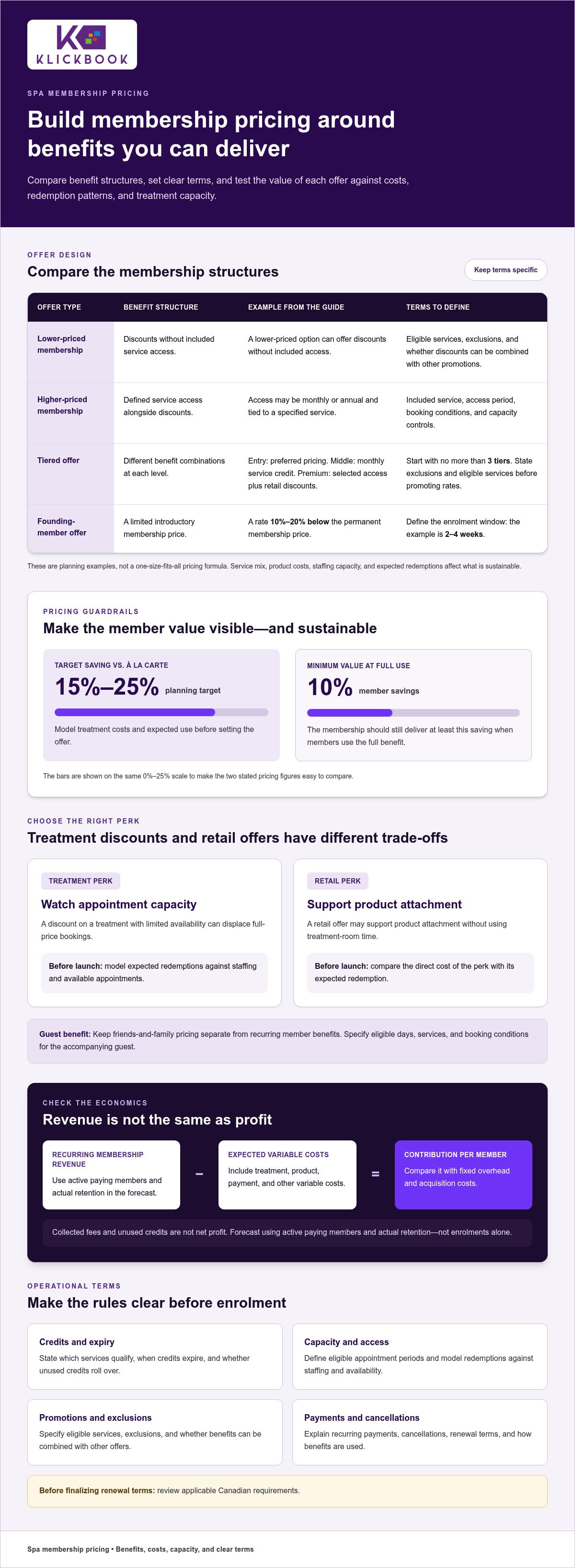
Exclusive pricing works when the membership offers clear value and defines what the spa commits to deliver. A curated offer can combine selected services and products for a specific group at a member rate. Treat that range as a planning reference, not a pricing formula: service mix, redemption patterns, staffing capacity, and product costs all affect what is sustainable.
Start with the benefit structure. Higher-priced memberships can include monthly or annual access to a defined service alongside discounts; lower-priced memberships can offer discounts without included access. Set a target saving of 15% to 25% against à la carte pricing, while modelling treatment costs and expected use. The membership should still deliver at least 10% savings when members use the full benefit.
Limit the initial offer to three tiers. For example, an entry tier could provide preferred pricing, a middle tier could add a monthly service credit, and a premium tier could include selected access plus retail discounts. A tiered example uses 10% off additional services in one tier and 15% in another. Define exclusions and eligible services before promoting either rate.
Friends-and-family pricing can add membership value without discounting every visit. Give each member a defined guest benefit, such as preferred pricing for one accompanying guest booking, and specify eligible days, services, and booking conditions. Keep the guest offer separate from the member’s recurring benefits. This makes the promotion easier to track and reduces uncertainty at checkout.
Match discounts to service mix. A discount on a treatment with limited appointment capacity can displace full-price bookings; a retail offer may better support product attachment without consuming treatment-room time. Compare the direct cost of each perk with its expected redemption. Founding members may receive a rate 10% to 20% below the permanent membership price, with the offer limited to a two-to-four-week enrolment window.
To assess profitability, subtract expected treatment, product, payment, and other variable costs from recurring membership revenue. Compare the contribution per member with fixed overhead and acquisition costs; collected fees and unused credits are not net profit. Forecast revenue using active paying members and actual retention, rather than enrolments alone.
Common risks include excessive discounts, unclear expiry terms, and unlimited access that exceeds available capacity. Model redemptions against staffing and appointment availability before promising benefits. Define whether credits roll over, which promotions can be combined, and how recurring payments and cancellations work. Review applicable Canadian requirements before finalizing renewal terms.
Use the spa’s service mix to set a manageable enrolment limit. For example, restrict membership access to appointment periods with available capacity, then track redemptions and any displacement of full-price bookings. These spa membership program ideas work best when each exclusive perk has a defined cost, eligibility rule, and operational owner. Revisit the model using actual payment, usage, and retention data.
2. What are spa membership programs?
A spa membership exchanges recurring payment for defined benefits over an agreed period. It can include monthly services, service credits, access, or a combination. For example, a monthly package might include one facial and one massage, while a credit plan lets members choose eligible treatments. Set the benefit rules before enrolment so clients know exactly what each payment covers.
Tiered service memberships organize benefits by level. An entry tier might include one customized skincare treatment per month, while a higher tier could add a body treatment each quarter. Distinguish tiers by changing the included service, access, or flexibility. This helps loyal clients choose a level that suits their booking habits without making the options hard to compare.
Credit-based memberships give members a set credit balance to allocate across eligible services. One client could use credits for a facial, while another chooses a massage. State which services qualify and when credits expire. A 30-to-60-day expiration window is one example; a defined period helps clients plan while giving the spa a clear liability timeline.
Unlimited memberships can cover specified amenities, such as sauna or pool access, or a defined treatment category. “Unlimited” still needs boundaries: name eligible services, booking conditions, and any capacity controls. Specialized memberships focus on a particular service group or client objective. For example, a seasonal skin-recovery membership could combine selected treatments with related skincare products.
Shared memberships extend benefits to more than one enrollee, such as household members or colleagues. Specify who can use the account, whether benefits are shared, and how bookings are attributed. Curated memberships can pair selected services and products for a defined client group. A Nordic spa, for instance, might package thermal-area access with selected retail items to suit its operating model.
Rollover rules determine what happens to unused services or credits. A 30-day rollover period gives members a short opportunity to reschedule a missed benefit; a no-rollover policy keeps monthly use and accounting periods clear. Explain the rule during enrolment and display it alongside renewal terms. Consistent wording across staff conversations and booking confirmations prevents avoidable disputes.
A membership differs from a loyalty program, prepaid package, or prepaid plan because it charges a recurring fee for defined benefits. A prepaid package covers a stated set of services, while a loyalty program rewards eligible activity without necessarily requiring recurring payment. Choose the model according to whether the spa wants ongoing enrolment, a fixed service commitment, or recognition of repeat visits.
Before launch, match each format to appointment capacity and member booking habits. Compare included services with actual demand, then define eligibility, expiry, and sharing rules. A simple comparison table can show monthly benefits, eligible services, credit use, and rollover terms side by side. This makes the structure easier for staff to explain and clients to assess.
3. Membership treatment and retail perks
Build treatment perks around services clients book repeatedly, not one-off attractions. A monthly facial membership, for example, could include a customized skincare treatment and a complimentary upgrade on a selected visit. Priority booking can help members access high-demand appointment periods. Members-only wellness events add experience-based value without discounting every treatment. Define eligible services and redemption conditions before publishing each benefit.
Personalize rewards using client preferences and booking history. A client who regularly books massage may value an upgrade, while a skincare-focused member may prefer early access to a new product. Match each reward to the client’s habits and record its eligibility rules. Relevant rewards feel more personal and help staff explain how a benefit suits each member.
A points structure can reward repeat visits without changing the core membership. For example, a bronze member could receive 50 points after three appointments; collecting 100 points could move that member into the next category. Set out qualifying activity, point value, redemption options, and expiry terms. Keep the reward cost within the margin established for the program.
Birthday perks can give members a timely reason to book. Offer a complimentary treatment upgrade or retail gift with a qualifying appointment during the member’s birthday period. Bonus points can also recognize a birthday booking without reducing treatment prices. State eligible services, the redemption window, and whether the offer can be combined with member pricing. Clear terms make the gesture easy to deliver consistently.
For VIP perks, prioritize access and recognition over blanket discounts. Repeat clients could receive early access to new treatments, an invitation to a members-only event, or a personalized gift package. These benefits strengthen the relationship while keeping standard treatment prices intact. Assign each perk a fulfilment process so front-desk and treatment teams deliver a consistent experience.
Retail benefits can connect treatment recommendations with at-home wellness routines. A member might receive a discount on one eligible product each month or early access to a skincare launch. Exclude products with tighter margins and define whether retail rewards can be combined with other promotions. Track redemptions by product category to see which offers support retail sales without excessive discounting.
Use a client profile to record preferences, past treatments, and redeemed rewards. Review the details before recommending a perk: a client who prefers quiet visits may value priority booking more than a social event. Keep birthday offers, points, treatment upgrades, and retail rewards visible in the same membership record. This supports a consistent service process and helps managers assess which benefits members use.
Measure each reward against repeat visits, treatment use, and retail purchases. If an upgrade draws members to an underused service, it can support capacity utilization; if it displaces full-price bookings, revise its eligibility. These spa membership program ideas work best when rewards feel personal and remain operationally manageable.
4. How often should a spa revisit or revise its membership offerings?
Review membership terms at least once a year, then use performance data to guide changes. Compare renewals, appointment frequency, benefit use, and average member spending. If facials are redeemed consistently but retail discounts go unused, adjust the benefit mix rather than applying a broader discount. Record the reason for each change so the next review can assess its effect.
Use tier pricing to distinguish access and savings, not simply to offer larger discounts. An entry tier at a day spa might focus on preferred pricing, while higher tiers add service access or stronger benefits. Set each tier’s fee against expected treatment costs, redemption patterns, and available capacity. Members should see clear value while the spa retains a viable contribution after variable costs.
Discount examples can help define the structure. One tiered model offers 10% off additional services, while another offers 15%. For services with constrained appointment capacity, apply member pricing to selected periods or eligible treatments. Elmwood Spa’s ESE membership uses 15% off à la carte spa services Monday to Thursday and 10% Friday to Sunday. This illustrates how day-of-week rules can manage discount exposure.
Review related offers as one combined value proposition. Elmwood Spa ESE members receive 20% off hair studio services, 15% off boutique, in-spa, and online retail products, and dining discounts at Bangkok Garden: 10% off lunch and 15% off dinner. These examples show how beauty, retail, and restaurant benefits can extend membership value. They also require clear eligibility and redemption instructions across departments.
During the annual review, assess each discount against actual use and contribution. A retail product discount may encourage purchases, but broad eligibility can cut margins on items members already buy. A restaurant offer can add value without using treatment-room capacity. Compare redemptions by tier, product category, and appointment period. Remove benefits that add complexity without supporting engagement or business objectives.
Also review billing and cancellation terms whenever the offer changes. Make renewal timing, payment frequency, eligible services, and the process to cancel easy to understand. If a promotion changes the member’s benefit mix, communicate the revised terms before enrolment or renewal. This keeps the program’s advertised offer aligned with what staff can deliver at checkout.
Use a simple revision process: examine usage and renewal data, model the financial effect, check service capacity, then update the terms and staff guidance. Test seasonal promotions as limited offers before making them permanent benefits. Record the promotion period and compare results with the standard tier. This evidence helps distinguish a useful perk from a discount that merely shifts full-price appointments.
5. Launching and promoting a membership program
A membership launch needs a defined offer, enrolment period, and operating plan. Set the subscription terms first: benefits, recurring payment schedule, booking rules, renewal process, and cancellation steps. Then prepare a concise offer summary for email, social media, and front-desk conversations. Keep the details consistent across every channel so prospective members hear the same proposition.
Set a founding-member window of two to four weeks to establish a clear enrolment period. Explain who the offer suits, what it includes, and when enrolment closes. A day spa could introduce a monthly facial membership to clients who already book facials regularly. Prepare staff to explain the offer at checkout without pressuring clients or interrupting treatment discussions.
Promote through targeted emails, in-spa conversations, social media, partnerships, and referral programs. Segment email audiences by previous bookings: a client who regularly books massage may value different benefits from a retail-focused client. Use social posts to clarify eligibility and booking steps. A wellness partner can introduce the program to a relevant audience, provided the offer and referral process are clear.
Make the financial value easy to understand. If members save 10% when they use the full benefit, show the eligible services and explain how savings apply. Avoid presenting a headline discount without its conditions. Include a simple example, such as the member benefit applied to one eligible appointment, and identify any exclusions before enrolment begins.
Referral activity should support enrolment without obscuring program economics. Give members a simple way to share the offer, then record which referrals lead to enrolment. Compare the cost of any referral reward with the contribution from the resulting subscription. Track cancellations and benefit redemptions alongside new sign-ups; enrolment volume alone does not show whether the launch produces sustainable profit.
Build a launch sequence with a pre-launch announcement, an enrolment-period reminder, and a post-launch follow-up. Give each message a distinct purpose: introduce the offer, address common booking questions, or explain how members access benefits. After the two-to-four-week window, review which channels generated qualified enquiries and completed enrolments. Use those results to adjust the next promotion.
Before opening enrolment, brief staff and run a sample transaction. Confirm that the membership description, recurring payment, benefit redemption, and point-of-sale records align. A test booking can reveal unclear instructions before clients encounter them. Review the workflow after launch, using member questions and transaction patterns to identify friction.
Connect promotion planning with the operational workflow that records appointments and payments. Review spa operations tools as you prepare a membership launch, so the offer’s booking and point-of-sale processes remain aligned.
Milano Software: Spa Management
Milano Software supports the operational workflows behind a spa membership program with spa management software, online booking, reporting, and point of sale. Members can schedule appointments and service packages online from any device, while point-of-sale capabilities support service and retail transactions. Reporting helps operators review performance and assess membership activity alongside the broader business.
Consider this approach when membership administration spans booking, service delivery, and sales, or when existing workflows make performance difficult to assess. Align the program’s benefit rules with booking and transaction processes so staff can apply them consistently. Explore Milano Software’s spa management platform to assess how these workflows fit your operation.
Turn the Membership Model Into an Operating Plan
The next step is to turn your chosen membership structure into a practical operating plan. Define who manages enrolment, how staff resolve benefit questions, and how managers review performance. A concise internal playbook can keep member communication consistent across booking, service delivery, and payment workflows.
Use the spa membership program ideas that suit your service model as design inputs, then test the operating process before promoting the offer widely. Map the member journey from initial enquiry through renewal. Identify where staff need clear instructions, when clients need information, and which performance measures will guide future decisions. This turns a membership concept into a managed business process.
Milano Software supports spa operations with Spa Management, Online Booking, and Reporting. If your next priority is aligning membership activity with the systems that support daily operations, contact Milano Software to discuss your needs. A deliberate operating plan gives your team a clear foundation for building a membership experience that fits the business and serves members consistently.
Frequently Asked Questions
What are spa membership programs?
Spa membership programs are paid arrangements that give enrolled clients ongoing access to defined benefits. Document how staff recognize active members, apply eligible benefits at checkout, and handle missed appointments. For example, a treatment benefit needs a clear rescheduling process. These procedures translate the written offer into consistent service throughout the client journey.
How much does a spa membership typically cost?
There is no single suitable price for every Canadian spa membership. The fee depends on the promised benefits and the costs of delivering them. To set a rate, calculate the cost of included services and account for expected use and payment processing. Align the price with the membership’s actual scope, not just a headline discount.
How often should a spa membership be billed: monthly, quarterly, or annually?
Monthly billing is a common approach; quarterly or annual billing can suit programs built around less frequent benefits. Choose a cycle that matches when members receive value and when the spa needs to collect payment. State the billing date, renewal process, and any proration method before enrolment. A clear payment calendar also helps staff answer account questions consistently.
How often should a spa revisit or revise its membership offerings?
Use the renewal cycle as a formal review point, and reassess sooner when the service menu, staffing, or appointment availability changes. Adding a treatment category, for example, may affect which benefits the spa can reliably deliver. Document the change, its effective date, and how it applies to existing members. This distinguishes operational updates from routine promotions.
What are popular spa membership program models and benefits?
Common models include service-based, credit-based, unlimited-access, specialized, and shared memberships. They differ in how clients receive value: through a defined service, flexible spending credit, access to specified amenities, or shared account privileges. Choose a model that suits the spa’s service environment, then ensure staff can explain how members use each benefit without relying on informal exceptions.
What membership tiers and pricing structures work best for a spa?
Effective tiers give clients a clear choice while making each level operationally distinct. Define what changes between tiers, such as eligible services, access conditions, or account-sharing privileges. Avoid adding a tier that differs only by name; it complicates staff explanations without clarifying the offer. Before launch, prepare a side-by-side comparison of benefits and exclusions in plain language.
What perks can spa memberships include, such as treatments, discounts, or guest passes?
Perks can include treatment access, service or retail discounts, and guest privileges. Make each benefit specific at the point of use: identify who qualifies, how staff verify eligibility, and what happens if a preferred appointment is unavailable. For a guest pass, specify whether the guest books independently or attends with the member. Clear redemption steps reduce uncertainty at reception.
How should a spa handle membership billing, renewals, freezes, and cancellations?
Maintain a consistent process for payment changes, renewals, pauses, and cancellations. Record the member’s request, its effective date, and any remaining benefit balance. Give members written terms before enrolment and an accessible way to submit account changes. In Canada, renewal requirements can vary by jurisdiction, so make sure membership terms reflect the rules that apply where the spa operates.


