

Pricing and capacity must respond to demand. Resort spa yield management aligns appointment availability and rates with guest booking patterns, resort occupancy, and seasonal shifts. The goal is to use capacity effectively while maintaining a clear, consistent guest experience.
Forecasting, guest segmentation, and transparent pricing rules give resort teams a practical basis for decisions. The sections ahead show how these methods connect to spa operations and how management software can support execution.
Key Takeaways
- Use historical booking patterns and current resort conditions to anticipate when treatment capacity is likely to tighten or soften.
- Distinguish yield management’s pricing and inventory decisions from broader revenue management’s focus on costs and longer-term performance.
- Match rates to demand periods while considering the effect of price changes on appointment flow and service capacity.
- Segment guests by booking behaviour and value preferences to shape offers without applying blanket discounts.
- Use booking, point-of-sale and reporting capabilities to connect pricing decisions with day-to-day spa operations.
Demand forecasting
Demand forecasting uses historical bookings and current trends to estimate when guests are likely to seek spa appointments. For Canadian resorts, forecasts connect seasonal guest patterns with therapist schedules and available treatment capacity.
Occupancy, Booking Trends, and Seasonal Demand
Occupancy, booking trends, and seasonality show how resort demand shifts across dates and appointment periods. Together, they help managers distinguish a quiet treatment schedule from a temporary gap in future bookings. For example, comparing winter weekends with summer weekdays can reveal when guest volumes and appointment requests tend to rise or soften.
Build the forecast using past booking patterns, current reservations, cancellations, and the resort’s occupancy outlook. Compare appointment demand by service, day, and time period. A Victoria Day long weekend may have a different booking curve from a midweek period in autumn; the useful signal is how guests at that property actually book. Hotel demand forecasting draws on historical data and current trends, giving spa teams a structured way to anticipate demand instead of relying on last-minute impressions.
Forecasting Challenges and Optimization
Forecasting becomes challenging when past patterns no longer reflect current booking behaviour. Changes in resort occupancy, cancellations, group arrivals, or local events can shift demand after schedules are set. Price fluctuations also complicate comparisons: an increase in bookings may reflect greater guest interest, a rate change, or both. Separating these drivers helps managers avoid treating every rise or dip as a lasting trend.
Mathematical optimization supports forecasting by matching expected appointment demand with limited resources, including therapist availability, rooms, and service durations. Managers can compare scenarios, such as adding a therapist shift during a busy arrival period or holding back appointment capacity during a quieter period. This helps expose trade-offs between availability, labour allocation, and expected demand. It cannot eliminate uncertainty, but it can make assumptions visible and decisions more consistent.
Demand-Based Pricing and Capacity
Demand-based pricing adjusts rates to reflect forecast demand and seasonal patterns, while capacity planning aligns appointments and staffing with that outlook. During peak periods, a resort might protect appointment availability for guests booking later or allocate more therapist hours to services with stronger demand. In quieter periods, targeted offers can encourage bookings without discounting every appointment.
To manage therapist staffing and appointment capacity, compare booking pace with occupancy forecasts, then adjust shift coverage and open appointment inventory for peak and off-peak periods. Keep enough flexibility to respond to reservation changes: even a fully booked schedule needs a plan for cancellations or service overruns. Dynamic spa pricing can align demand with available capacity, but abrupt or poorly explained changes may frustrate guests who expect consistent, transparent rates. Clear time-period rules and advance visibility help balance revenue decisions with the guest experience.
Yield management versus revenue management
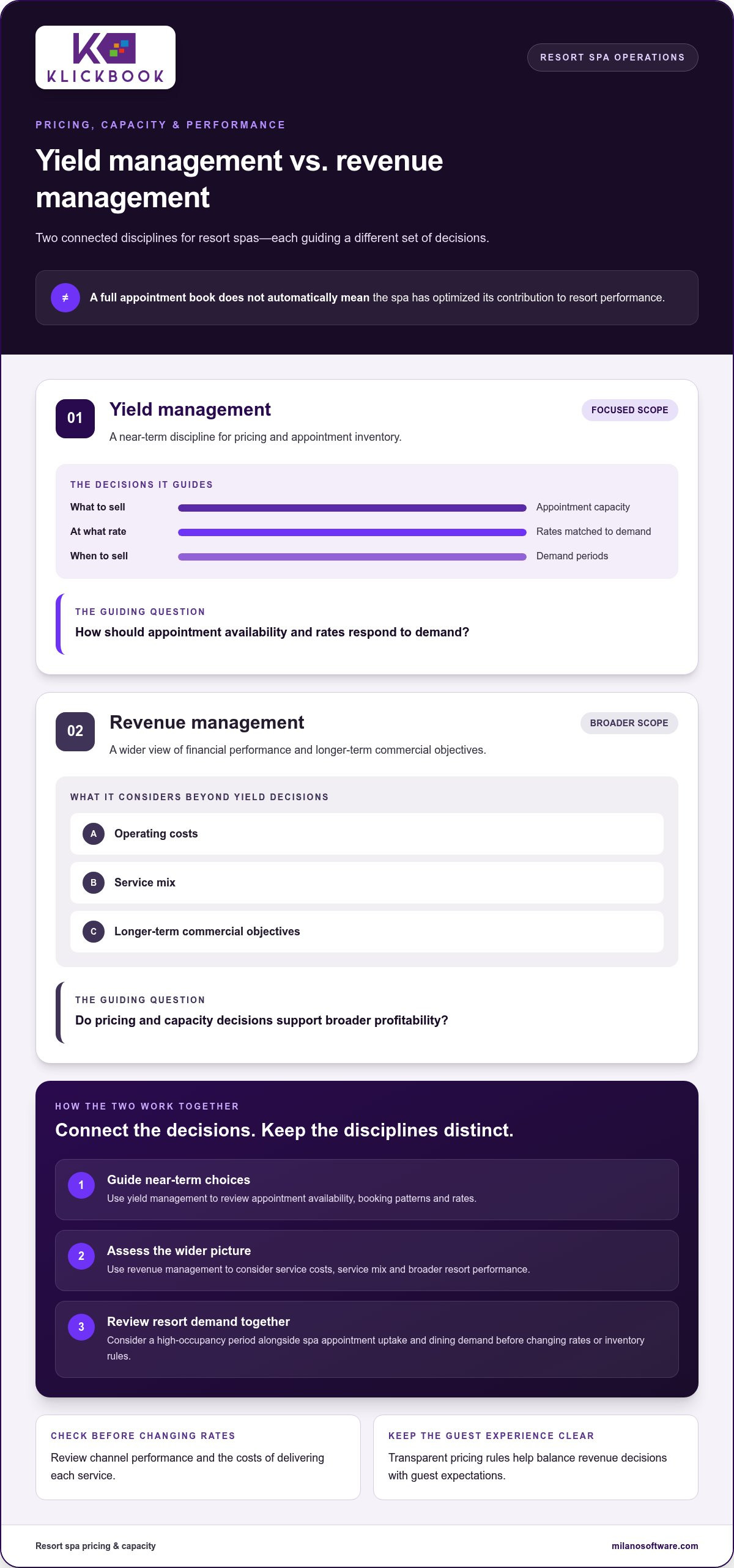
Yield management is a focused discipline for pricing and inventory; revenue management takes a broader view of financial performance. In a resort spa, yield decisions focus on which appointment capacity to sell, at what rate, and during which periods. Revenue management also considers operating costs, service mix, and longer-term commercial objectives. The distinction matters because a full appointment book does not necessarily mean the spa has optimized its contribution to resort performance.
For accommodation properties, hotel yield management primarily adjusts room prices and availability as demand changes. Revenue management includes those decisions, then adds cost analysis and longer-term planning. A hotel might restrict lower-rate room inventory on a high-demand weekend; its wider revenue plan could also consider whether dining and spa services can attract guest spending during the same stay. Occupancy is one input, not the whole financial picture. Managers also need to assess what is being sold, through which channels, and at what operating cost.
Resort revenue diversification connects accommodation with dining and spa services without treating them as interchangeable inventory. A guest may book a room but not a treatment, while a spa appointment may appeal to local visitors who are not staying overnight. These demand streams have different capacity constraints, booking patterns, and service costs. A management system can help operators review performance across departments, but decisions still depend on clear definitions of room revenue, dining revenue, spa sales, and the costs of delivering each service.
Channel management technology supports revenue decisions by organizing how accommodation inventory and rates appear across booking channels. A resort can compare channel contribution, booking pace, and occupancy trends, then adjust availability or pricing according to its commercial priorities. Hotel yield-management experts typically claim incremental revenue gains of 3% to 7%, but that claim describes hotel yield practices, not a guaranteed spa result. For spa operations, the useful parallel is disciplined inventory control: monitor appointment availability and booking patterns, then align offers with the capacity the spa can actually deliver.
Keep the two disciplines connected but distinct. Use yield management to guide near-term pricing and capacity decisions, then use revenue management to assess whether those decisions support broader profitability. For example, a resort can review a high-occupancy period alongside spa appointment uptake and dining demand, then coordinate promotions or inventory rules across departments. Review channel performance and service costs before changing rates. This avoids optimizing room occupancy in isolation while overlooking other revenue centres, staffing needs, and the guest experience.
Dynamic pricing for resort inventory
Dynamic pricing changes rates as booking conditions shift, rather than keeping one rate for every date and demand period. For resort inventory, decisions should reflect booking pace, available capacity, seasonal demand, and the service or room being sold. A weekend with limited availability may call for a different rate strategy from a quieter weekday. The objective is to align price with inventory, not to change prices simply because technology allows it.
Hotels use rate rules to shape accommodation demand. For example, a property may offer discounted rates for guests booking five or more nights during slower periods. During stronger periods, it may set a minimum stay to cover shoulder days around a high-demand date. An advance-purchase window of at least 30 days can also help secure bookings. These controls show how dynamic pricing includes restrictions and booking conditions, not just rate increases.
Resort spas can apply the same inventory logic to appointments while accounting for treatment capacity and guest expectations. A high-demand evening may call for a different rate approach from an underused daytime appointment, provided the terms are clear before booking. A consistent rule, such as a peak-period rate for a defined time window, is easier for guests to understand than a rate that changes unpredictably. Staff can then explain the reason for the rate.
Spa pricing strategies can support revenue without undermining guest satisfaction when they use clear time periods, advance visibility, and offers aimed at genuinely low-demand capacity. For example, a resort can present a defined peak-period rate while using a quieter appointment window to encourage bookings. Guests see the conditions before committing, and the spa avoids applying broad discounts to every appointment.
Price changes also need context. A resort should compare its booking pace and service availability with relevant local alternatives, then decide whether its rate reflects the experience and capacity offered. A competitor’s listed rate alone does not reveal appointment availability, service inclusions, or booking conditions. Seasonal events and travel patterns can shift local demand, so Canadian resorts should account for the specific date and guest mix when setting rates.
Use a controlled review cycle: define the inventory, set rate rules for demand periods, monitor booking response, and adjust when patterns change. Record each rule and its intended outcome. If a higher rate slows bookings without improving the value captured from scarce capacity, revise it. This makes dynamic pricing a managed commercial decision rather than an automatic reaction to every reservation.
Customer willingness to pay and market segmentation
Willingness to pay is the rate a guest accepts for a particular spa experience, booking time, and perceived value. Segmenting guests by travel purpose, booking behaviour, and visit history helps a resort identify different purchase priorities. A guest on a short stay may value a convenient appointment, while a repeat visitor may respond to a loyalty benefit. These segments can guide offers, but they should not be treated as assumptions about every individual guest.
Market segmentation groups guests with shared booking characteristics so pricing and promotions can address a defined need. Resort operators can compare overnight guests with local visitors, advance planners with late bookers, and first-time clients with returning guests. Each group may respond differently to appointment availability, package contents, and booking windows. Reviewing actual booking patterns by segment helps managers target offers instead of discounting the entire treatment menu.
Targeted offers should connect a guest segment with a specific commercial objective. For example, a resort could use a quieter weekday appointment to encourage local bookings while preserving peak-period availability for guests seeking limited-time slots. Specify eligible services, dates, and booking conditions. This makes the offer easier to assess against occupancy and revenue, and helps prevent a low-demand incentive from becoming the expected price.
Memberships can encourage repeat visits and support occupancy in quieter periods. Promotions can fill available appointments, while bundled packages can increase perceived value. However, each can reduce revenue per visit if the benefits replace bookings guests would have made at standard rates. Track redemption timing, repeat booking behaviour, and capacity used. For example, evaluate a package combining a treatment with another resort experience based on its contribution across the included services.
A promotion can also shift demand between dates rather than create a new visit. In one example, a spa offers a 10% discount to encourage a guest to return the next day for a Balinese Massage. The operator should assess whether that return uses otherwise idle capacity or replaces a booking at a stronger rate. This distinction matters: increased appointment volume alone doesn’t establish that the offer improved yield.
Loyalty benefits work best when their conditions fit the resort’s operating pattern. A returning guest might receive priority access during a quieter period, while peak appointments remain available under standard booking terms. Monitor redemption by date and guest segment, then compare repeat visits with appointment occupancy. If a benefit consistently brings demand into underused periods, it can support a more balanced schedule without broad price reductions.
For Canadian resort operators, travel seasons and local visitor patterns can create distinct guest segments. Review booking origin, visit timing, lead time, and repeat activity together. Then match each offer to a measurable objective, such as filling a low-demand period or encouraging another visit. This disciplined approach helps maximize the value of guest relationships while protecting capacity for existing demand.
What is yield management for resort spas?
Yield management means selling the right inventory to the right customer at the right price and time. For a resort spa, inventory includes treatment appointments, therapist hours, rooms, and service availability. Each has limits: an unused appointment expires when its time passes, while an overloaded schedule can strain service delivery. Yield management connects pricing and availability decisions to expected demand, so managers assess both the revenue opportunity and the capacity needed to fulfil each booking.
Apply the principle across the booking lifecycle. First, define sellable inventory by service, therapist, room, and appointment period. Next, compare booking pace with capacity and identify where demand may exceed available slots or fall short. Then adjust rates, availability, or booking conditions to suit the situation. A Saturday evening treatment and a quiet weekday appointment are different inventory opportunities, even when the service is identical.
Resort operations add another layer: spa appointments interact with accommodation, dining, and guest itineraries. A room booking may create an opportunity to offer a treatment, but the spa still needs an available therapist and suitable appointment slot. Coordinating these conditions helps prevent promotions from generating demand the operation cannot serve. It also helps managers determine whether a booking fills otherwise idle capacity or displaces a guest willing to book under existing terms.
Overbooking is sometimes used in hospitality to protect against revenue loss from cancellations, but it involves operational trade-offs. If everyone arrives, the property may face extra costs and service disruption. For a spa, selling beyond available therapist or room capacity can cause delays, reassignment pressure, or a poor guest experience. Capacity protection should reflect cancellation patterns and the practical ability to accommodate arrivals, not room-based assumptions applied without adjustment.
Measure yield using more than appointment volume. Review booked capacity, realized sales, cancellations, service mix, and whether staffing matched the schedule. A full day can still underperform if demand is concentrated in periods with limited capacity or requires inefficient staffing. A quieter period can contribute more effectively when appointments attract bookings without displacing stronger demand. Consistent definitions let resort leaders compare performance across dates and operating periods, then refine pricing and inventory rules based on observed results.
For resort teams, yield management is a repeatable operating discipline: define inventory, align availability and pricing with demand, then assess the result against capacity and guest experience. Explore spa operations tools to support coordinated resort spa management.
Milano Software: Spa Management
Milano Software supports resort spa operations with management tools that connect booking, sales, and performance reporting. For teams applying yield management, coordinated operational data helps keep appointment availability, guest bookings, and transaction records aligned.
Online Booking lets spa clients schedule appointments and service packages from any device, while Point of Sale supports transaction processing. Reporting tools help managers review booking and sales performance and assess whether pricing and capacity decisions are working as intended. These capabilities are useful when resort teams need clearer visibility across daily spa workflows rather than disconnected records.
Explore Milano Software’s spa management solutions to see how they fit your resort’s operational needs, or contact Milano Software to discuss your requirements.
Make pricing a managed operating discipline
For resort leaders, the next step is to establish who owns, reviews, and communicates pricing decisions. Resort spa yield management is most useful when commercial rules align with operating capacity and resort priorities, rather than changing rates in isolation. A clear decision framework also helps teams explain pricing consistently while responding to local demand patterns.
Define which roles can adjust rates, which booking and occupancy signals inform a review, and how changes are communicated to spa staff. Record the rationale for each adjustment so future planning can build on operational experience instead of assumptions. This governance creates a repeatable process while allowing for seasonal variation and distinct guest segments.
Technology can support the workflow by keeping bookings, sales activity, and performance information accessible for operational review. Explore Milano Software’s spa management platform to assess how it could fit your resort’s operating model. Set a clear objective for your next pricing review, and give your team a practical foundation for continuous improvement.
Frequently Asked Questions
Can yield management improve operational efficiency?
Yes. Coordinating booking decisions and staffing plans around the same operating assumptions can reduce avoidable work. For example, a manager can flag appointment blocks that require a particular room setup before assigning therapists. Front-desk teams then have clearer expectations, and supervisors can spend less time resolving scheduling conflicts. Efficiency comes from better handoffs and fewer mismatches, not simply from raising rates or filling every slot.
How does yield management influence customer booking behaviour?
Guests respond to the choices and conditions presented during booking. A clearly defined package helps them compare options, while a visible appointment calendar lets them choose a time that fits their stay. Booking conditions also shape decisions: advance-purchase requirements suit planners, while flexible options can work for guests with changing itineraries. Reviewing which choices guests complete, abandon, or change helps teams refine the booking experience without assuming everyone values the same benefit.
What is a yield management system or software?
For spa leaders, a yield management system can help teams document who changed an availability or pricing rule, when it took effect, and what operating objective it served. That record supports consistent approvals and post-period review. Managers can distinguish a deliberate commercial adjustment from a routine schedule change, then use the decision history to improve governance across departments.
How do resort spas forecast demand and optimize treatment availability?
Make the forecast useful to the appointment book by accounting for service duration, room setup, and turnover requirements. A treatment that occupies a room longer than its booked service time can affect the start of the next appointment. Review those constraints before releasing slots, then compare the schedule with guest itineraries and arrival patterns. This reduces avoidable gaps and prevents a calendar from appearing open when suitable operational capacity is limited.
How should resort spas use dynamic pricing for treatments and packages?
Use pricing boundaries that guests can understand and staff can explain consistently. Keep package inclusions and eligibility conditions distinct so a bundled offer does not obscure which services contribute its value. Before changing a rate, consider the effect on repeat guests who booked under earlier terms. A documented transition policy can reduce confusion at checkout and help staff respond consistently, especially when guests compare an existing reservation with a new offer.
What spa booking and revenue management software supports yield management?
Choose a system that fits the resort’s decision process, including who maintains availability, who reviews sales information, and how managers compare operating periods. Milano Software’s Enterprise Wellness Edition is a cloud-native platform for resort and hotel spas. It includes online booking, point of sale, and reporting, with PMS connectivity through INFOR PMS, OPERA, MAESTRO, CLOUDBEDS, and WEBREZ. Map the current booking workflow and reporting needs, then assess how the platform supports them.
Which KPIs measure resort spa yield management performance?
For resort spa yield management, assess whether a pricing decision created incremental contribution or simply shifted an existing booking. Compare service mix and appointment timing before and after an offer, while accounting for the labour and room resources used. Review booking lead time by offer type as well: a change may affect how early guests reserve even if total appointments remain stable. These measures reveal effects that a headline revenue figure can conceal.
How do seasonality, holidays, and local events affect resort spa demand in Canada?
In Canada, resort demand around holidays and local events can change the mix of overnight guests and other visitors. A property may see strong accommodation activity without matching spa interest, or event attendees may create appointment demand outside usual guest patterns. Track booking origin and visit purpose where available, then compare those patterns with the resort calendar. This prevents room occupancy alone from serving as a proxy for treatment demand.


