
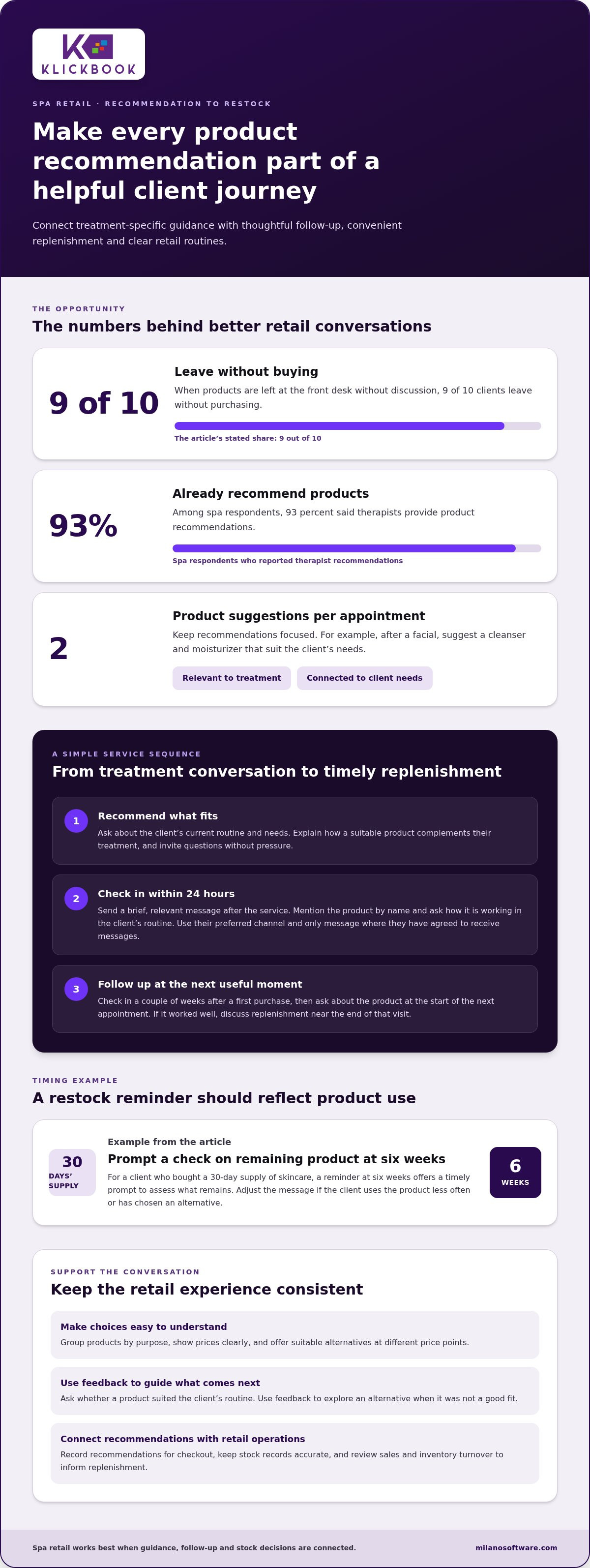
Spa retail sales depend less on shelf space than on a connected recommendation-to-restock process. A practical answer to how to increase spa retail sales is to make personalized product recommendations during the client journey, then support follow-up and convenient repeat purchases. When products sit at the front desk without discussion, 9 of 10 clients will leave without purchasing.
Clients need relevant guidance, and spa teams need a consistent way to connect recommendations with retail operations. Product conversations should feel helpful, not pressured. Online access can also make it easier for clients to restock between visits.
Build the process around focused recommendations, timely follow-up, loyalty offers, clear boutique displays, and practical staff training. Coordinating in-spa guidance with online purchasing helps create a consistent retail experience across channels.
Key Takeaways
- Connect each product recommendation to the client’s treatment, needs, and at-home routine to make guidance relevant.
- Use thoughtful post-purchase follow-up to learn whether a product worked and support timely replenishment.
- Structure loyalty rewards around retail purchases, service bookings, and referrals to encourage ongoing engagement.
- Make the boutique easier to navigate with clear product groupings, visible pricing, and well-maintained testers.
- Build staff product knowledge and consistent sales routines, then use spa management, point of sale, and reporting tools to support retail operations.
1. Educating clients through specific product recommendations
Personal recommendations turn a treatment conversation into a practical home-care plan. Ask about the client’s current routine, identify a relevant need, then explain how a product complements their service. After a facial, for example, discuss a cleanser or moisturizer that fits the treatment rather than presenting unrelated items. To increase spa retail sales, connect each recommendation to the client’s needs, not simply to the products you want to move.
What spa retail products sell best in Canada? Products that complement a spa’s treatments, including pre-care and post-care items, are useful candidates for the retail mix. Identify your own best sellers by comparing transactions and inventory across products, service types, and client needs.
Keep recommendations focused. Limit suggestions to two products per appointment, such as a cleanser and moisturizer after a facial. Explain each product’s purpose and use, then invite questions without making the conversation feel like a checkout script. Among spa respondents, 93 percent said therapists provide product recommendations. Make each recommendation more useful by connecting the product to the client’s stated concern and recording it for checkout.
How can spas use consultations and product sampling to encourage retail purchases? Ask about the client’s routine and preferences, explain why a suitable product complements their treatment, then offer a sample when appropriate. Sampling gives clients a chance to try the product at home. During a later visit, staff can ask how it worked for them.
Choose products to suit different needs and budgets. Organize options by purpose, such as pre-care, post-care, or products that complement specific treatments. When clients compare options, offer suitable alternatives at different price points. Refine the range using local purchase patterns and regular sales reports. Track retail revenue, average transaction value, inventory turnover, and top-selling items. Comparing results by service type can show what to replenish or reassess. These measures connect product selection with purchasing patterns.
What are the risks of overstocking spa retail products, and how can inventory be managed? Excess stock ties up cash, takes up display space, and can leave slow-moving or expired products on shelves. Review inventory turnover and sales, maintain accurate stock records, and reorder in line with demonstrated demand. Keep testers clean, full, and unexpired, and display prices clearly so clients can make informed choices.
2. Following up with clients after a first purchase
A first retail purchase creates a clear reason for a relevant follow-up. Send a brief message within 24 hours of the service, while the experience remains fresh. Refer to the product by name, explain its intended role in the client’s routine, and invite a reply about its use. For example, after a facial, ask whether the cleanser feels comfortable and easy to use. Keep the message focused on support, not an immediate second sale.
WhatsApp can provide a direct follow-up channel when the client has agreed to receive messages there. Use the client’s preferred channel, identify the spa, and make the message relevant to their purchase. For example, ask whether the sample or full-size product suited their routine and offer a simple way to respond. Avoid repeated promotional messages. An unanswered product check-in should not automatically lead to another sales pitch.
Plan the timing of follow-up. Check in a couple of weeks after a client’s first product purchase, then ask about the item at the start of their next appointment. If it worked well, staff can discuss replenishment near the end of that appointment. If it was not a good fit, use the client’s feedback to explore an alternative. This makes follow-up a service conversation and helps the team learn which products suit different routines.
At-home care can connect appointments by giving clients a practical way to maintain their routine between visits. A reminder should explain how the purchased product fits into that routine, rather than making broad claims about results. For a client who bought a 30-day supply of skincare, a restock reminder at six weeks offers a timely prompt to assess remaining inventory. Adjust the message when the client reports using the product less often or choosing an alternative.
A loyalty program can recognize product purchases alongside service bookings and referrals. Set out the qualifying actions and reward terms plainly, then make it easy for staff to explain how clients earn and use rewards. One example is awarding double loyalty points on retail purchases during the first 30 days after a colour service. Track participation and repeat transactions to assess the program’s success, rather than assuming a reward drives retention. At checkout, a point-of-sale workflow can support consistent retail transactions; explore point-of-sale capabilities as part of that process.
3. Including retail purchases in loyalty programs
A loyalty program can make retail purchases part of the client relationship rather than a separate checkout decision. Set out how clients earn rewards for products, appointments, and referrals, then explain the terms consistently at booking and checkout. For example, a client could earn points on an eligible retail purchase and redeem them on a later visit. Clear rules help staff explain the program and clients understand how to earn each reward.
Keep the offer simple. For example, after a client buys three retail products, their next eligible product could be free. This gives clients a clear purchase target, but product selection and reward cost still matter. Choose eligible items carefully and calculate whether the offer supports revenue after product costs. Explain exclusions, expiry terms, and redemption conditions before launch.
Membership discounts provide another route. A standard salon or spa membership might offer a 10% discount on retail products, while a premium membership might offer 20%. Treat these figures as example structures, not automatic defaults. Model each tier against product margins and expected purchasing behaviour. A higher discount may suit a premium tier only when its membership benefits and terms remain financially sustainable. Explain whether the discount applies to every product or selected categories.
Referrals can extend a loyalty program beyond existing appointments. Invite clients to recommend products or services to friends and family, then define the reward for a successful referral. For example, grant a reward after the referred guest completes an eligible purchase or booking. State the qualifying action clearly, so clients know when a referral earns a reward. A transparent process builds trust and gives staff a consistent way to record results.
Review program performance using transaction records, redemptions, and repeat visits. A point-of-sale system or loyalty software can help staff apply rewards consistently and identify which offers clients use. Compare retail purchases with appointment activity, then adjust the program if clients earn rewards but rarely redeem them. Keep it manageable: clear earning rules, relevant rewards, and reliable tracking are more useful than overlapping promotions that clients and staff struggle to understand.
4. What layout and display strategies boost retail sales in a spa boutique?
Make product discovery easy from arrival through checkout. Organize shelves by need, treatment, or routine instead of grouping unrelated items. For example, arrange facial products in the order clients use them: cleanser, treatment product, then moisturizer. This helps clients see how products work together. Keep shelves uncluttered, prices visible, and best sellers at eye level.
Plan display placement around the client journey. A waiting-room sign can introduce a seasonal product or relevant category before an appointment. A small point-of-sale display can feature seasonal or sale items, while a display beside a treatment area can show products connected to that service. Give every placement a clear purpose, and avoid filling every surface with merchandise.
Lighting and ambience should make products easy to see without competing with the spa’s service environment. Check displays under the lighting clients encounter at reception and checkout. Reduce glare on packaging, keep labels readable, and use consistent lighting across each product group. Clear sightlines, considered spacing, and legible signs help clients browse in a calm, organized setting.
Make each display useful. Use concise signage to explain a product’s purpose or identify a best seller, and keep testers full, clean, and unexpired. Place each tester beside the product it represents, with the price easy to find. Staff can then guide clients to the right display instead of searching through mixed stock. Include regular replenishment in the routine so empty spaces do not make the boutique look neglected.
Refresh displays when the spa changes its seasonal focus, promotions, or service emphasis. Move featured items into visible positions, update signage, and remove materials for expired offers. For example, display a seasonal skincare group together with a simple explanation of its intended use. Keep familiar categories in place so regular clients can still find their usual products while new features stand out.
Review retail sales reports to see how the layout performs. Compare product sales before and after a display change, and record which placement supported each item. Point-of-sale records can connect transactions with products, while staff observations can flag frequently requested items or unclear signage. Use these findings to adjust shelf positions, display content, and replenishment priorities. A good display helps clients find, understand, and purchase relevant products without friction.
5. Staff training for upselling and cross-selling
Retail performance depends on clear responsibilities and a consistent client-facing message. Among spa respondents, 95 percent said front desk staff or spa concierges were responsible for closing retail sales; 83 percent used service providers to conduct or close sales. Train both groups to share the same product information, so a recommendation during treatment carries through checkout without pressure or confusion.
Use weekly team meetings to practise brief, client-led conversations. One staff member can play a client asking about a product while another explains its purpose and use. Practise an upsell by presenting a suitable premium alternative, then a cross-sell by suggesting a complementary item. If a client is considering moisturizer, for example, staff can explain a relevant serum as another option. Make clear that clients can choose, including declining.
Build product knowledge into the routine. Ask team members to explain a product’s intended use, key features, and the client needs it may suit. Practise introducing it during a service instead of saving the entire conversation for checkout. Staff who understand the inventory can make recommendations based on the treatment and the client’s stated preferences. This keeps selling relevant and makes each interaction more useful.
Track retail conversion by staff member alongside service type and appointment activity. Define conversion consistently, such as retail transactions divided by eligible client appointments, and review the same measure across the team. The research gives a 5 percent retail conversion rate as a lower example and 30 percent as a higher example. Use those figures to identify coaching opportunities, not to rank staff without context. Differences in schedules, client mix, and service types can affect results.
Incentives can encourage participation, but design them around service quality and sustainable sales. Options include commission strategies, cash rewards, or extra time off. Recognize top retail sellers each month or year, while monitoring whether recommendations suit client needs. Avoid rewarding transaction volume alone. Include product knowledge, consistent recommendation habits, and client feedback in coaching conversations. This creates a balanced measure of success and reduces pressure to sell unsuitable items.
Connect training to transaction records so managers can review performance and coach with specific examples. A point-of-sale workflow can help structure retail transactions and support consistent reporting. Explore spa point-of-sale tools to support a more consistent retail process.
Milano Software: Spa Management
Milano Software supports spa operations with spa management software, online booking, reporting, and point of sale. These tools help operators connect appointment activity with retail transactions and review sales performance. Clients can book appointments and service packages online from any device, while the integrated point of sale supports in-spa retail transactions. Reporting helps managers assess sales activity, identify patterns, and inform inventory decisions.
This operational foundation is useful when recommendations, checkout, and sales tracking need to work together more consistently. Milano Software supports the systems behind a retail strategy; product selection, staff guidance, and display choices remain management decisions shaped by your clients and spa.
Visit Milano Software’s website to learn more about its spa management platform.
Turn retail recommendations into an operating discipline
A sustainable approach to increasing spa retail sales starts with clear ownership. Assign a manager to review performance, identify process gaps, and coordinate follow-through across the team. Set a baseline using existing sales and inventory records, then document changes to recommendations, displays, or promotions. This creates a practical record of what changed and what deserves attention, rather than relying on isolated impressions.
Make this review part of regular spa operations. Use the findings to set priorities for the next period, clarify staff responsibilities, and connect retail decisions with the client experience. Milano Software’s spa management, online booking, and reporting capabilities support the broader operations behind that work.
For a discussion about your spa’s operational needs, contact Milano Software to discuss your needs. A disciplined process gives your team a clear foundation for developing retail performance over time.
Frequently Asked Questions
How can I integrate online and in-spa retail channels for greater reach?
Connect channels with consistent product information and clear purchasing options. Keep product names, descriptions, and prices aligned across the online catalogue and boutique, then make it easy for clients to buy in person or arrange a restock. A post-appointment message, for example, can direct a client to the product they discussed with their therapist. Review online and in-spa sales separately to identify channel preferences.
How can I use email and SMS marketing to promote spa retail items?
Send relevant messages based on a client’s treatment, previous purchase, or stated product interest. An email can explain how a product fits into a routine, while a short SMS can prompt a restock. Keep each message focused on one useful action, such as viewing product details or replying with a question. Respect communication preferences and make it easy to stop promotional messages.
Should I offer product bundles or tiered pricing to improve retail revenue?
Bundles and tiered pricing can encourage clients to consider complementary products together, but assess the margin before introducing either offer. Pair items that serve a coherent routine, such as a cleanser and moisturizer, rather than grouping unrelated stock. Compare bundle sales and profitability with individual-item results. Keep the terms simple, and avoid discounts that reduce the transaction’s contribution without supporting repeat purchases or product discovery.
What layout and display strategies boost retail sales in a spa boutique?
Assess the boutique from the client’s route, from arrival to departure. Make sure displays do not obstruct reception, seating, or accessible pathways, and that product labels are readable from a comfortable viewing position. Ask staff to observe where clients pause or turn away, then adjust the layout. A simple floor plan can help teams document display changes and compare client movement with product interest.
What metrics should I track to measure the success of my spa retail strategy?
Track retail revenue, average transaction value, inventory turnover, top-selling products, and sales by channel. Add product sales by service type and staff member to understand where recommendations lead to purchases. Compare results across consistent reporting periods, and record changes to promotions, stock, or displays. This context helps distinguish a genuine performance shift from one caused by a temporary stock shortage or seasonal demand.
What retail ideas work best for salons and spas?
Choose ideas that connect products to existing client needs, such as sampling a relevant item, featuring seasonal products, or pairing complementary items in a routine. A limited promotion can test interest, but record its terms and compare sales with a similar period without the offer. Keep product availability and staff explanations aligned. The best-fit idea is one clients understand and the business can deliver consistently.
How can spa staff recommend retail products without being pushy?
Make recommendations optional and connect them to something the client has raised. A therapist might say, “You mentioned your skin feels dry after cleansing; would you like to hear about a moisturizer?” If the client declines, acknowledge their choice and continue the service conversation. This gives the client control, keeps the exchange relevant, and helps staff avoid treating every appointment as a sales opportunity.
What sales training and incentives improve spa retail sales?
Use role-play to practise real situations, such as answering a product question or explaining a complementary option. Review recent transaction examples and coach staff on clarity, relevance, and client response. Incentives can recognize retail contributions, but balance sales outcomes with product knowledge and client feedback. This reduces pressure to recommend unsuitable items and helps managers identify training needs across the team.


