

Preventing spa staff burnout starts with support built into daily operations. Managers can reduce strain by setting realistic workloads, noticing changes in staff wellbeing, and making support accessible. Effective prevention improves working conditions rather than relying on resilience alone.
Spa teams balance guest care with precise, time-sensitive tasks. Leaders need a clear way to spot pressure points and respond before they affect staff wellbeing or service delivery.
This article covers practical ways to support mental health, recognize warning signs, connect daily work to the spa’s purpose, and make employee wellbeing part of workplace culture.
Key Takeaways
- Build realistic recovery time into treatment schedules, and make it straightforward for staff to raise workload concerns confidentially.
- Watch for changes such as irritability, low motivation, reduced productivity, absences, and disengagement; address patterns through direct manager conversations.
- Connect routine responsibilities to the guest experience so employees can see how their work contributes to the spa’s purpose.
- Make wellbeing part of daily operations through regular workload discussions, meaningful time off, and spaces that support recovery and connection.
- Use scheduling and reporting tools to improve operational visibility, spot pressure points, and support more consistent staffing decisions.
1. Promoting mental health at work
Workplace mental health depends on how leaders organize work, respond to concerns, and allocate recovery time. In 2025, 40% of employees worldwide experienced significant stress the previous day, while 23% experienced sadness. These figures are not spa-specific, but they underscore why managers should address workplace conditions directly. A practical plan for how to prevent spa staff burnout starts with reviewing the demands staff face during each shift.
Set staffing levels according to appointment volume, treatment length, room turnover, and other required duties. Build realistic reset periods between treatments instead of filling every available slot. Before publishing a roster, check that therapists have time for preparation, cleaning, documentation, and breaks. If demand rises or someone is absent, reassign work before the remaining team inherits an unmanageable schedule.
Make it straightforward for employees to raise concerns. In private check-ins, ask what is creating pressure and what specific change would help. Employees whose manager is always willing to listen to their work-related problems are 62% less likely to be burned out. Record agreed actions, assign responsibility, and follow up. Listening has practical value when it leads to changes in workload, priorities, or shift coverage.
Train supervisors to recognize distress, hold confidential conversations, and explain available support without attempting to diagnose. The National Standard of Canada for Psychological Health and Safety in the Workplace identifies 13 psychosocial risk factors affecting organizational health and workforce wellbeing. Use this framework to review workload, role clarity, and workplace relationships. The Government of Canada says people can call or text 9-8-8 to reach the Suicide Crisis Helpline, available 24 hours a day, 7 days a week. The Government of Canada also states that the helpline offers support 24 hours a day, 7 days a week.
Training and career development offer practical support. Set role-specific learning goals, schedule coaching, and discuss opportunities to build skills. For example, a therapist interested in mentoring can agree on development steps with a supervisor. Follow through with feedback and opportunities to practise. This gives employees a clearer sense of how their capabilities can grow in their role.
Work-life balance also depends on predictable scheduling. Publish shifts with notice, apply shift-change processes consistently, and encourage staff to use accrued time off. Ask whether current hours and appointment patterns fit with employees’ personal responsibilities. For leaders considering how to prevent spa staff burnout, recurring fatigue after late finishes and early starts points to a scheduling issue to review, not simply an individual stress-management problem.
Close the feedback loop. Track recurring concerns, look for patterns across duties or shifts, and assign a manager to address each issue. At the next check-in, explain what changed or why a proposed adjustment wasn’t made. Following through makes mental health support part of daily operations and shows employees how their input informs workplace decisions.
2. Recognising workplace burnout symptoms
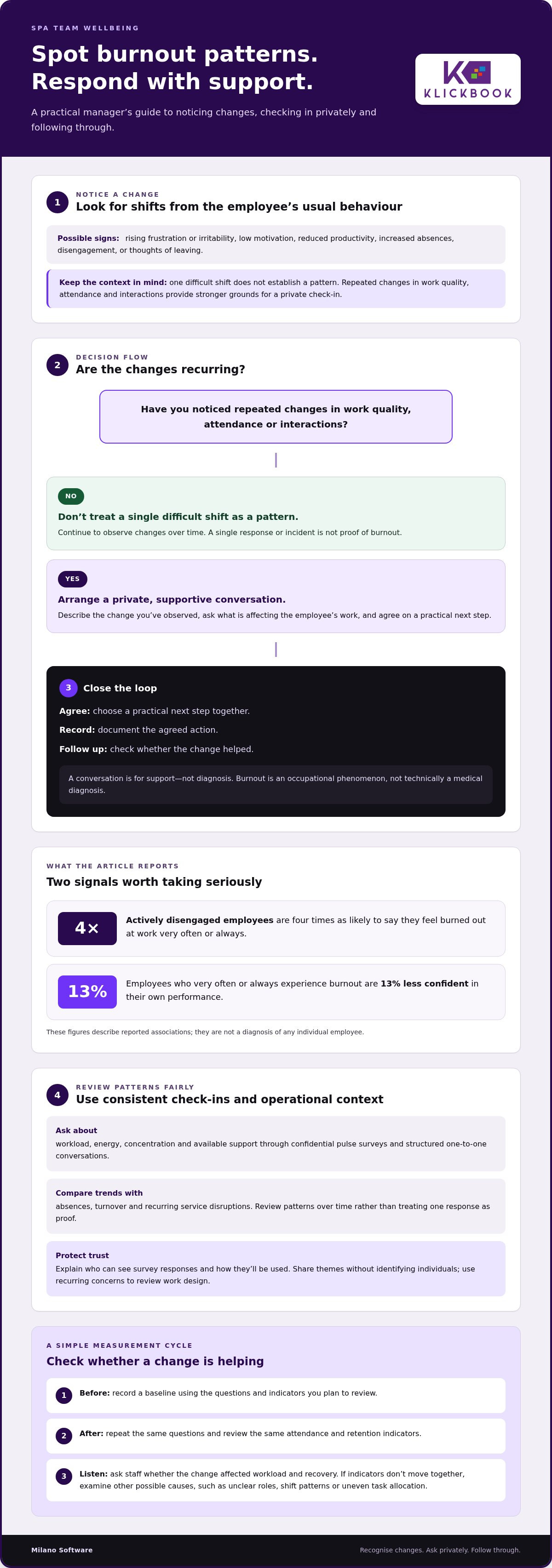
Burnout can develop even when an employee continues showing up for work. Look for changes from their usual behaviour, such as rising frustration, irritability, low motivation, reduced productivity, increased absences, or thoughts of leaving. One difficult shift does not establish a pattern. Repeated changes in work quality, attendance, and interactions give managers stronger grounds for a private check-in.
The World Health Organization classifies job burnout as an occupational phenomenon resulting from chronic workplace stress. In spa settings, sustained strain may appear as difficulty concentrating between appointments, less patience during guest interactions, or withdrawal from team communication. These signs should prompt a supportive conversation, not a diagnosis. Burnout is not technically a medical diagnosis, and anxiety or depression may also be involved.
Pay attention to disengagement as well as visible distress. Actively disengaged employees are four times as likely to say they feel burned out at work very often or always. Employees who very often or always experience burnout are 13% less confident in their own performance. A therapist who stops contributing to team handovers or repeatedly doubts routine decisions may need support, even while meeting scheduled appointments.
Managers can monitor staff burnout through consistent, confidential pulse surveys and structured one-to-one conversations about workload, energy, concentration, and support. Compare responses with operational indicators such as absences, turnover, and recurring service disruptions. Review trends over time rather than treating a single response as proof.
Evaluate prevention efforts by recording a baseline before making changes, such as adjusting appointment spacing or adding supervisor check-ins. Later, repeat the same questions and review the same attendance and retention indicators. Ask staff whether the change affected their workload and recovery. If feedback improves but absences keep rising, examine other possible causes, including unclear roles, shift patterns, and uneven task allocation.
Protect trust when measuring wellbeing. Explain who will see survey responses, how managers will use them, and which concerns require follow-up. Share themes with the team without identifying individuals. For example, if several therapists report rushed transitions, review the schedule design rather than labelling particular staff as unable to cope.
Address immediate concerns with a direct, private conversation. Describe the change you’ve observed, ask what is affecting the employee’s work, and agree on a practical next step. Document the action and arrange a follow-up discussion. If an employee describes distress beyond the scope of workplace support, help them access appropriate professional or crisis resources in Canada.
3. Connecting daily tasks to organizational purpose
A spa’s purpose should be clear in the work behind every guest interaction. Leaders can connect routine duties to outcomes employees recognize: a prepared treatment room supports a calm arrival, accurate booking notes ease handovers, and careful cleaning helps prepare for the next appointment. Explain these connections during onboarding and reinforce them in team discussions. Tasks feel less arbitrary when their contribution is clear.
Turn broad values into specific workplace behaviours. If the spa promises attentive service, define what that means at reception, during treatment preparation, and at checkout. For example, a front-desk employee can confirm a guest’s booked service and relay relevant preferences to the therapist. This shows how accurate information supports continuity without asking staff to deliver an abstract mission statement.
Give employees context for tasks that happen out of sight. Explain how laundry readiness affects room turnover, how inventory checks support service continuity, and how clear closing notes help the next shift. Managers can use a brief weekly team update to highlight one operational connection. A concrete example, such as resolving a supply gap before appointments begin, makes the purpose tangible.
The American Psychiatric Association states that burnout requires a systemic organizational response, and that organization-based interventions are more effective than individual-level interventions. For spa leaders, this means purpose cannot replace workable systems. If staff repeatedly face competing priorities, clarify which task comes first and adjust the process causing the conflict. A motivational message alone won’t fix a poorly designed handover.
Ask staff where procedures support or hinder the guest experience. Invite a therapist to trace the steps from room setup through post-treatment reset, noting unnecessary duplication or unclear ownership. Assign a manager to review each issue and report back on decisions. This closes the loop: employee expertise informs the operating model, and staff see that their input can shape how work gets done.
Recognize contributions with specific, credible feedback. Instead of saying “great work,” describe the action and its effect: “Your clear handover helped the next therapist prepare for the guest’s needs.” Share examples across roles in team meetings, including housekeeping, reception, and treatment teams. Recognition should reinforce good practice, not reward speed at the expense of care or safe procedures.
Purpose also requires room for professional judgment. Where service protocols allow, involve employees in decisions about task order, preparation methods, or team handovers. A therapist who suggests a more reliable room-reset sequence contributes operational insight, not just compliance. Managers should explain which decisions are fixed and where staff can shape the process. That clarity connects individual expertise with shared service standards.
4. Employee wellbeing as part of workplace culture
Workplace culture is reflected in the decisions staff experience repeatedly. A spa can offer practical support through fair scheduling, clear compensation practices, meaningful recognition, and predictable access to time off. Treat these as operating standards, not occasional morale initiatives. Managers should review whether everyday policies support sustainable work across reception, treatment, and housekeeping roles.
Retention signals the strength of that culture. Among employees who voluntarily left their organization, 42% said their manager or organization could have done something to prevent their departure. Another 45% said no manager or leader proactively discussed how their job was going in the three months before they left. Schedule purposeful conversations before concerns become resignation decisions.
Pay and benefits should be transparent and administered consistently. Explain how compensation is structured, how performance is assessed, and which benefits apply to each role. Where business conditions permit, set clear training goals and connect demonstrated skills with advancement or compensation reviews. Employees need a visible process, not vague assurances that strong performance will eventually be recognized.
Recognition should identify the contribution and its impact. A manager might acknowledge how a therapist supported a smooth handover or how a receptionist resolved a booking issue. Pair that feedback with fair access to preferred shifts, development opportunities, and accrued time off. Employees who strongly agree they feel supported by their manager are about 70% less likely to experience burnout regularly.
Give staff appropriate control over how work gets done. Employees are 43% less likely to experience high levels of burnout when they have choice over their tasks, timing, and time allocation. In a spa, managers can offer input into task sequencing or shift preferences while maintaining service coverage and role requirements. Explain where flexibility exists and apply the same criteria across the team.
Connection between colleagues also matters. Employees with access to spaces that help them connect with coworkers are 26% less likely to feel burnout frequently. A staff room or shared break area can support informal peer contact, while structured handovers help employees exchange practical knowledge. Protect these opportunities from being absorbed by routine operational demands.
Build wellbeing into management routines. Review workload feedback, time-off use, absence patterns, and employee departures together; then identify where policies or coverage need adjustment. Employees who very often or always feel burned out are 74% more likely to be looking for another job. Retention discussions should therefore include role sustainability, development prospects, and recognition, not only immediate scheduling concerns.
Make each commitment observable. Publish the process for requesting time off, explain how shift preferences are considered, and set consistent review points for compensation and development. Ask employees whether the process works in practice, then communicate any changes. Consistent follow-through turns wellbeing from a stated value into an operating expectation.
5. What are the common causes and early warning signs of burnout in spa workers?
Burnout often develops when workplace demands remain high without effective recovery or control. The World Health Organization classifies job burnout as an occupational phenomenon resulting from chronic workplace stress. In a spa, contributing conditions may include sustained appointment pressure, repeated emotional demands, unclear priorities, and limited influence over daily work. Managers should examine how these conditions combine across shifts, rather than attributing strain solely to an employee’s resilience.
Workload involves more than total hours. Gallup research found that burnout risk increases as weekly work hours rise, while employees’ experience of workload has a stronger influence than hours alone. For example, a therapist’s schedule may feel unmanageable when treatments run back to back, cleaning time is compressed, or responsibilities change without notice. Review actual task demands alongside recorded hours.
Perceived unfairness and uncontrollable performance measures also matter. Employees who strongly agree they are often treated unfairly at work are 2.3 times more likely to experience high burnout. Employees who strongly agree their performance metrics are within their control are 55% less likely to experience burnout frequently. Check whether standards are clear, resources are available, and employees can influence the measures used to assess their work.
Early warning signs can appear in small operational changes. A previously reliable employee may become unusually irritable, lose motivation, or struggle to maintain normal productivity. Watch for a pattern across attendance, teamwork, and service execution rather than reacting to one isolated mistake. Employees who very often or always experience burnout are 63% more likely to take a sick day, making attendance changes useful context, not a diagnosis.
Disengagement can signal that work strain is affecting connection to service quality. Employees who very often or always feel burned out are 32% less likely to feel great responsibility for their organization’s products or services. In a spa, this might appear as reduced participation in handovers or less attention to shared standards. Treat these changes as prompts to investigate workload, fairness, and role expectations.
Use a consistent review process when warning signs appear. Record observable changes, ask the employee which work conditions are contributing, and compare their account with shift demands and assigned tasks. Then address the cause, such as competing priorities or uneven task allocation, and agree on a follow-up point. This turns early observations into operational action without making assumptions about an employee’s health.
Addressing these contributing conditions involves practical scheduling changes and follow-up. Excessive workload is identified as a key contributor to an organization’s risk for burnout, so booking patterns deserve attention. The guidance notes that spas should avoid booking therapists back to back because it can leave them exhausted and distracted by the next client. A massage therapist commenting on the topic reported working 6 days a week with 1 day off. A spa owner commenting on the situation said therapists may receive no downtime after a 2-hour massage. These accounts underline the importance of checking recovery time between demanding appointments, a strategy often optimized through reliable scheduling tools like Milano Software.
Milano Software: Spa Management
Milano Software’s spa management platform supports operational coordination when scheduling pressure and fragmented workflows affect staff capacity. Online Booking helps manage appointment demand, while Reporting gives operators visibility into daily performance. The integrated Point of Sale supports transactions within spa operations.
These tools can help leaders identify workflow pressure points and make informed operational decisions. They complement, rather than replace, fair staffing practices, recovery time, manager support, and employee feedback. Consider this approach when manual coordination makes it difficult to understand demand or maintain consistent spa processes.
Explore Milano Software’s spa management platform to see how it fits your operation.
Make wellbeing an operating commitment
A lasting answer to how to prevent spa staff burnout is to include workforce wellbeing in operational decisions. Assign someone to review staff feedback, set follow-up actions, and assess whether changes are working. This creates continuity beyond a single manager conversation or seasonal initiative.
Start with one practical improvement your team can see, such as clarifying task ownership or making shift planning more predictable. Explain what will change, who is responsible, and how employees can share feedback. Consistent follow-through helps turn a stated priority into a credible workplace standard.
For spas refining their operational systems, Milano Software offers Spa Management, Online Booking, and Reporting. These capabilities can support clearer coordination of bookings and operational activity while managers focus on the workplace conditions shaping staff experience. Contact Milano Software to discuss your spa’s operational needs. Thoughtful changes, applied consistently, can help build a more sustainable workplace for your team.
Frequently Asked Questions
What Is Burnout?
Burnout describes an occupational pattern associated with prolonged work stress that hasn’t been effectively managed. In spa operations, use the term to examine how working conditions interact, not to judge an employee’s commitment. Before treating a change in performance as an individual issue, consider whether workload peaks, role ambiguity, or repeated emotional demands are contributing. This framing keeps attention on workplace causes and appropriate operational responses.
What are the most effective ways to prevent burnout among spa staff?
Match the response to the pressure staff identify instead of applying the same initiative to every role. A front-desk team may need clearer escalation procedures during booking surges, while therapists may benefit from more control over treatment preparation. Involve affected employees in designing the change, assign someone to implement it, and review staff feedback afterward. Targeted adjustments are easier to assess than a broad wellbeing campaign.
How can spa managers reduce workload and provide adequate breaks between appointments?
Set procedures for disruptions before the service day begins. Define who handles late arrivals, treatments that run over, and urgent room changes, so those tasks don’t automatically fall to the next therapist. Protect breaks from becoming overflow capacity, and include relief coverage in the daily plan. If coverage isn’t available, limit new appointments to what the team can deliver without taking away recovery time.
How can spas support staff mental health and stress management?
Give teams practical ways to recover after emotionally demanding interactions, such as a brief peer debrief or access to a quiet space. Train supervisors to recognize when workplace concerns are beyond their role and direct employees to appropriate professional support. Managers can also review whether staff routinely carry emotional demands without adequate team support. These steps complement individual care by addressing how the work environment affects mental health.


