
At spas, 69% of bookings are not rebooked at checkout. Spa client retention software for 2026 can help close that gap by connecting booking activity, client history, reminders, membership visits, and retention reporting. The value is not another calendar; it’s a clearer view of who is returning, who is drifting, and where follow-up can support the next visit.
That operational challenge is familiar: a full appointment book doesn’t necessarily mean clients are building a consistent relationship with the spa. Retention depends on relevant communication, convenient rebooking, and an experience that gives clients a reason to return. Software can organize these signals and make follow-up more deliberate.
This guide explains how retention tools can support loyalty, reduce no-shows, encourage membership visits, and personalize client relationships. It covers the operational capabilities behind those outcomes, including online booking, automated reminders, client and visit records, and reporting. You’ll learn how to assess spa software for your retention strategy and how Milano Software coordinates booking, point of sale, and operational reporting.
Key Takeaways
- Use rebooking behaviour and time between visits to identify when client follow-up can support retention.
- Automated reminders and convenient rescheduling can help reduce preventable appointment gaps.
- Track membership activity and package usage to understand whether clients are returning at the intended frequency.
- Connect booking, client records, communication, and reporting to make retention activity easier to manage.
- Use service history and client preferences to make follow-up more relevant and support a consistent guest experience.
Automated loyalty programs and client retention
Automated loyalty programs connect repeat-visit activity with relevant rewards and follow-up. For spa owners comparing spa client retention software 2026, the operational priority is consistent recognition without reducing the guest relationship to a transaction.
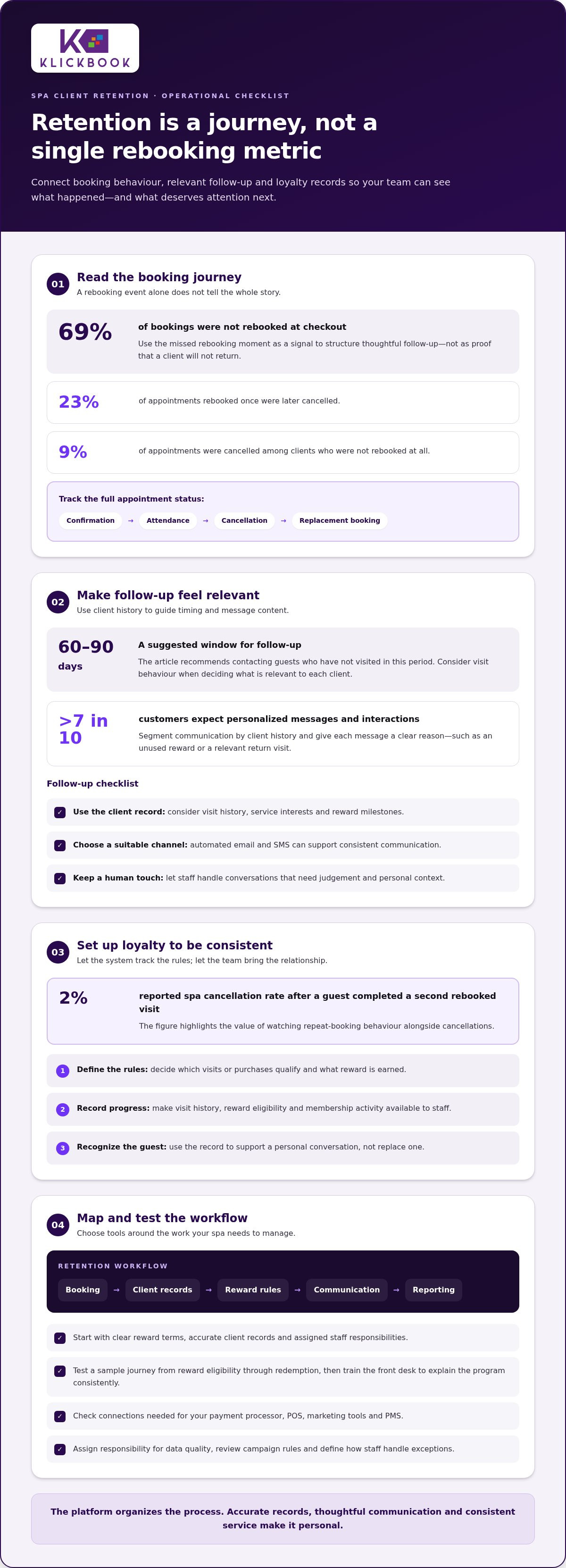
At spas, 69% of bookings were not rebooked at checkout. Software can help teams structure follow-up around that missed rebooking opportunity.
Automated Loyalty Programs
An automated loyalty program records qualifying visits or purchases and applies the reward rules your spa sets. Staff can recognize eligible clients consistently without manually tracking each visit.
For example, a spa could define a reward after a set number of visits, then use client records to show progress and eligibility. The report recommends contacting guests who have not visited in 60 to 90 days. After a guest completes a second rebooked visit, the spa cancellation rate was 2%, highlighting the value of supporting repeat booking behaviour.
Rewards should complement personal service. Staff can discuss a client’s preferences, while the system makes visit history and reward status available for the next interaction.
Marketing Tools for Loyalty
Marketing tools use client and booking information to organize messages around visit behaviour, service interests, or reward milestones. Relevance matters: a message timed to a client’s expected return window is more useful than a generic promotion sent to every contact.
More than 7 in 10 customers say they expect personalized messages and interactions. A spa can segment communication by client history, then tailor the message to a clear reason for returning, such as an unused reward. Automated email and SMS campaigns support the workflow, while staff handle conversations requiring judgement.
Platform capabilities differ. Assess whether a system supports the loyalty, membership, and reward functions your spa needs rather than assuming every platform includes the same tools.
Choosing and Implementing Retention Software
Map the retention workflow before choosing software: booking, client records, reward rules, communication, and reporting. This sequence helps you prioritize capabilities against your spa’s actual operating requirements.
Begin implementation with clear reward terms, accurate client records, and assigned staff responsibilities. Test a sample journey from eligibility through redemption, then train the front desk to explain the program consistently. Check that the platform supports the connections your spa needs, including its payment processor, POS, marketing tools, and PMS. Test relevant workflows as part of the zero-downtime rollout plan.
Retention Software Features and Limitations
Useful features include booking history, client profiles, automated reminders, loyalty tracking, membership records, and repeat-visit reporting. Together, they give your team a structured view of client activity and follow-up.
Software cannot replace consistent service or a genuine client relationship. In evaluating spa client retention software 2026, account for risks such as inaccurate records, irrelevant messaging, disconnected systems, and inconsistent reward balances. Assign responsibility for data quality, review campaign rules, and define how staff handle exceptions. The platform organizes the process; the team supplies context and service judgement.
Automated reminders and reducing appointment no-shows
Automated reminders connect booking records with timely client communication before and after an appointment. A well-designed workflow also gives clients a clear way to reschedule, helping staff respond to changes while appointment details stay current.
Appointment Reminders and Follow-Ups
Appointment reminders are scheduled messages that restate essential booking details and prompt clients to confirm or manage their visit. Spa software can send reminders by email or SMS, reducing reliance on staff to contact every client manually. A client portal can also support self-booking or rescheduling at any time, 24 hours a day, 7 days a week.
Follow-up communication serves a different purpose: it continues the relationship after the service. For example, a message can thank a client, invite feedback, or share relevant booking information for a future visit. Keep each message specific to the appointment and the client’s relationship with your spa. Automation supports consistency, while staff judgment keeps communication personal.
Rebooking and Cancellations
Rebooking records whether a client schedules another visit, while cancellation tracking captures changes to an existing appointment. Both signals help managers distinguish a one-time booking from a visit pattern that may need attention.
At spas, 23% of appointments rebooked once were later cancelled. Among clients who were not rebooked at all, 9% of appointments were cancelled. These figures show why a rebooking event alone doesn’t describe the full appointment journey. Track booking status through confirmation, attendance, cancellation, and any replacement booking.
When a cancellation arrives, staff can use the open time slot and current availability to coordinate rescheduling. Online booking lets clients view available appointments and choose a suitable option without waiting for a staff response. Clear cancellation records also help your team spot recurring scheduling friction, such as repeated changes to appointment times.
Connected client records make these workflows more useful. A profile combining appointment history, service preferences, and communication history helps staff decide whether a reminder needs context. For example, a returning client who often reschedules may benefit from a direct scheduling conversation rather than another generic notification. Consistent records also reduce duplicate outreach when multiple team members manage the same booking.
AI-generated appointment summaries can condense relevant booking and communication details for staff before a client arrives. A summary might surface the selected service, prior appointment changes, and outstanding follow-up. Treat it as an operational aid, not a substitute for reviewing the underlying record. Staff should correct errors and use their judgment, especially when a summary omits context or misstates a client’s request.
For Canadian spas, configure reminder timing, message content, and rescheduling paths around the business’s actual booking workflow. Review cancelled appointments alongside completed visits, then adjust communications where the records show avoidable confusion. The objective is a controlled process: accurate appointment data, useful reminders, accessible booking options, and informed staff follow-through.
Membership spa revenue and visit frequency
Memberships can turn planned repeat visits into a clearer operating pattern, but enrollment alone doesn’t prove engagement. In 2025, existing guest visits declined 2% at membership spas, while membership sales grew 7% year over year.
Memberships and Ongoing Engagement
A spa membership sets out recurring benefits or services that give clients a continuing reason to return. Its structure matters because clients need to understand what they receive and how to use it.
Track membership status, visit history, benefit usage, and renewal dates together. A client with unused credits may need a reminder about booking options, while a frequent visitor may value member pricing or early access. Digital records make these differences visible and help owners distinguish active use from passive enrollment.
Membership spas generated at least 30% of revenue from memberships, as defined for the report’s segment. That figure makes engagement operationally material, not merely a marketing measure. Review visit activity alongside renewal behaviour to see whether membership benefits support repeat attendance. A membership count alone cannot show whether clients are using the program or returning at a sustainable cadence.
Treatment Packages and Memberships
Treatment packages sell a defined set of visits or services, while memberships typically organize ongoing benefits or recurring participation. Keeping these records separate helps staff explain what remains available and prevents package use from being confused with membership activity.
Maintain digital records of package sessions, usage, expiry dates, membership status, and renewal timing. At intake or booking, staff can review a client’s remaining sessions and clarify which booking applies. A point-of-sale record can also connect a purchase with the client profile, supporting accurate follow-up and operational reporting.
Memberships and packages serve different planning needs. A package may suit a client seeking a finite series; a membership may fit someone seeking ongoing engagement. Compare redemption and visit patterns across each group before adjusting benefits. In 2025, membership spas’ same-store revenue growth fell from 5% to 2%, reinforcing the need to assess participation and revenue together.
Membership Engagement
Membership engagement measures whether members use benefits and maintain visits, rather than simply remaining enrolled. Visit frequency is an actionable signal because a change in cadence can precede a lapse in participation.
In 2025, new guest visits fell 11% at membership spas, while existing guest visits declined 2%. Compare those cohorts separately: new members may need a clear first booking path, while established members may need follow-up tied to their prior visit pattern. A single overall visit figure can obscure these different retention needs.
Use reporting to review member visits, package redemption, and renewals together. Membership spas’ total revenue growth declined from 7% in 2024 to 2% in 2025, while membership sales still grew 7% year over year. These measures describe different parts of performance. Pairing them helps spa leaders see whether sales growth is translating into regular visits and ongoing member use.
Beyond the Calendar: What is Spa Client Management Software in 2026?
Spa client management software connects booking activity, client information, and communication workflows beyond the appointment calendar. The strongest platforms for 2026 support coordinated scheduling, relevant follow-up, and clear reporting; the right fit depends on how each spa manages those functions.
Automated Client Communication
Automated client communication uses booking and client records to trigger messages at defined points in the guest journey. This helps staff maintain consistent contact without manually tracking every upcoming appointment or completed visit.
For example, a system can send a booking confirmation and schedule a reminder before the visit. Email and SMS are established reminder channels in spa software. Conversational texting needs a different workflow: staff should see the client’s message, booking context, and response history before replying.
After-hours messages can be acknowledged through a defined communication process, with staff handling requests that require judgment. Choose software that supports a workflow your spa can reliably operate; an automated reply does not resolve a booking change or service question.
Communication Between Visits
Between-visit communication keeps the relationship active after checkout and before the next appointment. Its value comes from matching the message to useful client context, such as a prior service, stated preference, or upcoming seasonal offering.
Consider a client who previously booked a thermal experience and has no future appointment. An update about related services may be more useful than a broad promotion covering the entire menu. Keep messages concise, explain why you’re contacting the client, and offer a clear next step, such as viewing available booking times.
Personalization also calls for restraint. Using a client’s history without a clear service connection can feel intrusive rather than attentive. Set communication rules around relevant preferences and booking activity, then review how clients respond.
Rebooking Campaigns
A rebooking campaign is a planned sequence of client communications designed to prompt a future appointment. It aligns follow-up with visit history instead of relying on a single general promotion.
Build a campaign around a clear segment, such as clients without an upcoming booking or guests whose visit history suggests a return window is approaching. Then choose the message, channel, and booking destination. A direct online booking path removes an extra step between reading the campaign and choosing an appointment.
Measure campaign performance through bookings and completed visits, not message volume alone. If clients open a message but don’t schedule, review its timing, offer relevance, and booking path before expanding the campaign.
Data-Driven Client Communications
Data-driven communication uses client and booking records to determine who receives a message and why. Spa management software can bring appointment history, communication activity, and reporting into a useful operating view.
For example, owners can compare rebooking behaviour across service patterns and identify groups that need different follow-up. First-time clients and returning guests may need distinct messages; a single campaign can miss that difference. Review results by segment, then refine message timing and content based on observed booking activity.
Data quality sets the limits. Incorrect contact details or outdated preferences can undermine even a well-designed campaign. Assign staff to maintain client records and review campaign outcomes regularly, keeping communications relevant, manageable, and connected to actual appointments.
Client relationship management and personalized guest experiences
Client relationship management connects service patterns, preferences, and operational reporting. For Canadian spas, a shared view can help teams deliver a consistent experience across locations while preserving the context that makes each guest interaction personal.
Client History and Preferences
A client profile gives staff a working record of preferences and prior service patterns. Before a guest arrives, a team member can use it to prepare a relevant welcome or tailor a conversation to the client’s stated interests.
Personalization should guide service, not turn every recorded detail into a marketing prompt. One study cited in the research reports that 80% of consumers are more likely to return to and recommend a business offering personalized experiences. Use that insight to shape thoughtful interactions, while keeping staff judgement central.
Separate client-provided preferences from staff observations. Clearly labelled notes help the next team member understand their context and relevance. Review records regularly so outdated details don’t shape a future interaction.
Client Management Databases
A client management database organizes profiles and operational records in a structured system. That structure matters because four separate apps for booking, payments, and marketing can create data silos and human error.
Centralized records let managers examine relationships between client activity and business performance. For example, reporting can identify service patterns associated with repeat visits, giving teams a basis for refining the guest experience. Accurate data also supports useful segmentation and consistent staff handoffs.
Establish clear record practices: assign responsibility for updates, use consistent fields, and review duplicate entries during routine administration. These controls help keep information reliable as your business grows. A database supports decisions only when staff can interpret and maintain its records.
Multi-location operators need shared standards alongside location-level context. A group can use consistent profile fields and reporting categories across properties, while preserving relevant differences in each spa’s service model. This enables leaders to compare trends without assuming every location serves the same audience or operates identically.
Staff roles also shape which information supports a guest interaction. Define who updates each record and how relevant context moves between teams. For resort and hotel spa operations, this coordination supports continuity when guests interact with multiple teams during their stay.
To align client information with operational workflows, spa management capabilities can help teams coordinate activity across their operation.
Milano Software: Spa Management
For operators assessing spa client retention platforms, Milano Software is a relevant option for coordinating core spa workflows.
- Milano Software: Spa Management combines Online Booking, Point of Sale, and Reporting to support client scheduling, sales, and operational oversight.
Consider this platform when your team needs those functions aligned within its spa operations. Explore Milano Software’s spa management platform to assess its fit for your business.
Build retention into the operating model
Make retention an operational decision, not an isolated marketing initiative. Define the experience returning clients should receive across booking, service delivery, and follow-up. Assign ownership for the workflows behind each interaction, giving spa leaders a practical basis for assessing whether their systems support the experience they intend to deliver.
Selecting spa client retention software for 2026 means aligning platform capabilities with your spa’s service model, team structure, and growth priorities. Prioritize workflows staff can maintain consistently, then use reporting to evaluate whether they support repeat visits. A well-designed system makes retention activity more manageable while leaving personal connection where it belongs: with your team.
Milano Software can help you assess spa management options for your operating requirements. Contact Milano Software to explore options and identify a clear next step for your spa.
Frequently Asked Questions
What IS Spa Software?
Spa software is a digital operating system for coordinating the business activities behind spa services. Milano Software’s Enterprise Wellness Edition combines online booking, staff scheduling, client records, point of sale, and reporting. More than a display of open appointment times, it connects transactions and operational information so teams can work from consistent records. Assess the platform against your service model and day-to-day workflows.
How do spa booking and CRM tools automate follow-ups and rebooking reminders?
Booking and client relationship management tools can trigger communications when a defined event occurs, such as a completed appointment or an approaching return window. Teams can set message rules by client group, channel, or booking status, then review exceptions that need personal attention. For example, a system can exclude clients who have already booked again, reducing unnecessary prompts and keeping follow-up aligned with current appointment records.
How do spa software options compare for solo practitioners, small spas, and multi-location businesses?
Solo practitioners generally need a straightforward workflow connecting their schedule, client records, and transactions without unnecessary administration. Small spas benefit from shared staff access and clearer oversight of daily operations. Multi-location businesses need consistent processes, consolidated reporting, and a way to compare performance across properties while preserving location-specific workflows. Evaluate each option against your current operating complexity and the coordination you expect to manage as the business grows.
How can a spa measure retention software ROI using repeat-visit and client churn metrics?
Measure repeat visits and churn for a defined client cohort over comparable periods. Calculate repeat-visit rate as returning clients divided by eligible clients, and churn as clients lost divided by active clients at the period’s start. Compare results before and after implementation, then assess whether changes align with software costs and other operational changes. Segment by location or service type to identify where performance shifts instead of relying on one overall figure.


