

A spa schedule is more than a list of appointments. It is an operating plan that shapes how effectively the day runs. To manage spa appointments and staff reliably, operators need a clear view of booking demand, staff availability and service requirements. When those details fall out of sync, double-bookings, schedule conflicts and last-minute changes can disrupt service delivery.
Appointment volume alone does not show whether the team can deliver each service smoothly. Staff capacity, room availability, booking changes and checkout all affect the day’s flow. A coordinated process connects these moving parts and gives managers a dependable basis for daily decisions.
This guide explains how to build that process, from setting scheduling rules and matching staff capacity to appointment demand, to communicating changes and reviewing operational information. It also covers how connected booking, staff scheduling, client profiles, point of sale and reporting can support a consistent workflow. The goal is a reliable view of appointments and team schedules, with better coordination from booking through service delivery and checkout.
Key Takeaways
- Coordinate appointment demand, staff availability and service delivery through one scheduling workflow to reduce conflicts and improve operational visibility.
- Map service requirements, staff capacity and room availability before configuring booking rules.
- Assign clear ownership for schedule creation, updates and daily reviews so teams work from consistent information.
- Use a structured daily review to identify staff changes, upcoming appointments and unresolved conflicts before service delivery.
- To manage spa appointments and staff more effectively, connect booking, schedules, client profiles, checkout and reporting in a shared operational view.
Why managing spa appointments and staff requires one coordinated workflow
Appointment administration records who is booked and when. Operational scheduling goes further by aligning demand with staff availability, service requirements and the capacity to deliver each booking. A full calendar can still hide a service gap if the assigned staff member is unavailable, the required room is occupied or a schedule change has not reached the people responsible for delivery.
A coordinated spa scheduling workflow connects appointment demand, staff availability and service requirements to the capacity needed to deliver each booking.
To manage spa appointments and staff effectively, distinguish booking activity from capacity decisions. Booking administration handles reservations and changes. Capacity planning determines which services the team can deliver, with which staff and in which spaces. Treating these as separate but connected responsibilities makes it easier to spot a problem before it reaches the service floor.
Where appointment and staff coordination breaks down
Double-bookings are obvious failures, but less visible breakdowns can be just as disruptive. If a change is recorded in one calendar but not another, the front desk may work from one version while service staff use a different one. The front desk could confirm a time the team cannot support, or staff could prepare for an appointment that has been moved or reassigned.
An isolated error can be corrected. Repeated errors point to a process weakness, such as unclear ownership, multiple schedule records or no defined method for communicating updates. Assign responsibility for making changes and sharing the current schedule so teams are not relying on assumptions or informal handoffs.
What a dependable scheduling process must connect
A reliable schedule brings together the appointment, the staff member’s availability, the service requirements and relevant client information needed to prepare for delivery. Each detail has a distinct purpose. Availability indicates when a team member can work; service requirements help determine whether that person and the assigned space are suitable; client information supports continuity at the point of service.
Teams also need one consistent source for current schedule information. The Mandara Spa business model provides a reference point for considering how staffing and treatment-menu decisions fit within broader spa operations. Across spa formats, the practical principle is the same: booking data should inform the operating plan, not sit apart from it.
Managers can assess coordination by tracing a booking from reservation to delivery. Can the front desk see the current appointment? Can staff identify their assigned services? Can the relevant team access the information needed to prepare? A “no” signals a workflow gap, even if the calendar appears complete. Clear ownership and consistent records turn scheduling from a collection of entries into an operational control.
How to set up a spa appointment and staff scheduling workflow
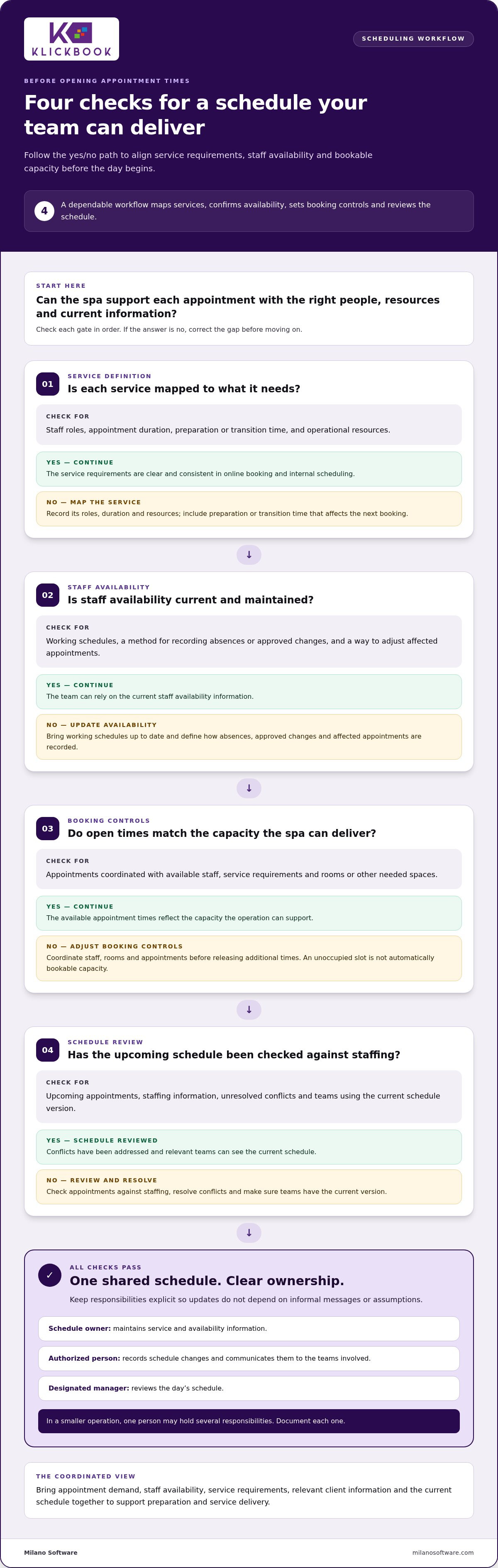
A dependable schedule starts with defined inputs, clear ownership and a controlled review process. Map services, confirm staff availability, configure booking rules, then review the schedule against operational capacity. This sequence helps managers manage spa appointments and staff with fewer conflicting records and a clearer view of the day ahead.
Map services and the information needed to schedule them
Start by grouping services according to the staff roles and operational resources they require. For each service, record its appointment duration and any preparation or transition time that affects when the next booking can begin. Keep these definitions consistent across online booking and internal scheduling. If a service name or duration differs between the two, staff may plan from assumptions instead of a shared operating standard.
Set staff availability and booking controls
Enter working availability before opening appointment times for booking. Define how managers record approved changes and staff absences, and how they adjust affected appointments. Decide who updates the schedule and who communicates changes to the teams involved. Set booking controls around the capacity the spa can actually deliver. Coordinate staff, rooms and appointments before releasing additional bookable times.
With service and availability data in place, establish a sequence for daily scheduling:
- Map services. Record the staff roles, duration and operational resources associated with each service.
- Define staff availability. Maintain current working schedules and document how to record absences or approved changes.
- Configure booking rules. Open appointment times in line with available staff and service requirements. Do not treat every unoccupied time slot as bookable capacity.
- Review the schedule. Check upcoming appointments against staffing information, resolve conflicts and make sure relevant teams are working from the current version.
Assign explicit ownership for each control point. A schedule owner maintains service and availability information, an authorized person records changes, and a designated manager reviews the day’s schedule. In a smaller operation, one person may handle several responsibilities, but document each one. This prevents updates from depending on informal messages or assumptions about who is handling them.
Finally, reduce duplicate record-keeping wherever possible. When online bookings synchronize with the spa’s internal calendar, reservation information can flow into the schedule teams use to plan service delivery. Milano Software’s platform provides this synchronization alongside staff schedule coordination, helping managers maintain a consistent operational view. Teams still need to follow the same update process: a synchronized calendar supports sound scheduling, while clear ownership ensures changes are reviewed and acted on.
How to match spa appointments with staff and room capacity
A time slot may look open even when the resources needed to deliver the service are already committed. Bookable capacity depends on having the right staff and room for the service, not simply an open appointment time. Review these constraints together to identify overcommitment before releasing additional appointments.
Keep three measures distinct. Staff availability shows when team members are scheduled and able to work. Room availability shows whether a suitable space is free for the required period, including preparation and transition time. Appointment availability is the time offered for booking after those requirements are considered. An open room does not resolve a staff conflict, and an available staff member does not make an occupied or unsuitable room available.
Allocate appointments using service and resource requirements
For each service, identify the required staff role and room, then compare them with the schedule before assigning or opening a slot. Include service duration, room preparation and transitions between bookings. A service that ends at the same time the next begins may still create pressure if the space needs to be reset or the staff member must move elsewhere.
A concise comparison can make constraints visible:
- Service requirement: the staff role, service time and operational resources needed.
- Staff capacity: the team member’s availability and existing assignments.
- Room capacity: a suitable space, including preparation and transition needs.
- Scheduling decision: open, adjust or hold the appointment time based on the combined capacity.
Use this comparison during planning, not only after a conflict appears. If the service has no matching staff member or suitable room, hold the slot or adjust the schedule rather than treating unassigned capacity as available.
Handle competing demand without overloading the schedule
Client choice matters, but offering every preferred time can create commitments the operation cannot support. Review peak periods for clusters of appointments that depend on the same staff role or room type. A schedule may have open time overall and still be overcommitted in one resource category.
Before opening more slots, compare demand with the staff and room capacity required at that time. Look for repeated overlaps, tight transitions and concentrated assignments. If a bottleneck appears, consider distributing appointment availability across less congested periods or preserving a slot for a service with fewer compatible resources. This makes capacity decisions deliberate rather than reactive.
To manage spa appointments and staff without compromising delivery standards, assess capacity by service and resource, not by calendar gaps alone. A clear view of assignments and room use gives managers a practical basis for balancing client preferences with what the spa can reliably deliver.
How to manage schedule changes and daily spa operations
Schedule control depends on a repeatable operating rhythm, not on correcting conflicts only when they surface. A daily review should confirm that the schedule reflects current appointments, staff availability and unresolved exceptions. Clear ownership of changes gives front-desk and service teams a common basis for action.
Create a consistent process for schedule changes
Designate who records appointment changes, who updates staff availability and who communicates changes to affected teams. Record approved updates in the shared schedule promptly, rather than relying on a message or separate personal calendar as the final record. The handoff is complete when the relevant front-desk and service staff can see the same current information and understand what action is required.
Use a defined path for each exception: capture the change, update the schedule, notify the teams affected and confirm any resulting conflict has been addressed. For example, a staff absence may require reassessing appointments assigned to that person, not just marking the shift unavailable. Documenting these steps clarifies responsibilities and gives managers a consistent way to check that changes were carried through.
Review daily activity and recurring scheduling patterns
Begin the daily check with upcoming appointments. Review staff changes, identify schedule gaps and conflicts, and flag periods where assignments may create capacity pressure. Then verify that unresolved exceptions have an owner and a next action. This helps managers distinguish a calendar that looks complete from a day that is operationally ready.
Use available reporting to examine staff performance and operational patterns over time. Managers might compare scheduled activity with service delivery information in their reports, then look for recurring gaps, concentrated demand or repeated schedule adjustments. Treat the findings as signals for further review, not proof of a cause. A pattern may reflect how appointments are allocated, a change in demand or another operating factor. Investigate before changing staff plans.
Reviewing the same measures consistently across comparable periods makes this process more useful. Milano Software’s operational reporting includes insights into staff performance, supporting informed review of scheduling patterns. Connected spa management operations can put those insights alongside the booking and staff schedule information used in daily planning.
Use the review to make controlled adjustments: refine appointment availability, clarify a handoff or investigate a recurring conflict. Then assess the next review cycle to see whether the pattern changes. This measurement-based approach helps teams manage spa appointments and staff without assuming that one schedule adjustment will resolve every capacity issue.
Milano Software connects staff schedules, client profiles and online booking in its spa management platform. Learn more about Milano Software’s spa management platform.
Connect spa appointments and staff management with broader operations
Scheduling becomes more useful when booking information informs the work that follows. A connected operating view brings appointments, staff schedules, client profiles, checkout and reporting into the same workflow. Teams can prepare for scheduled services, reference relevant client information, record transactions at checkout and review operational activity without treating each step as an isolated task.
Use connected information to support consistent operations
Centralized online booking that synchronizes with the internal calendar gives staff and managers a shared appointment record. That connection supports daily coordination: booking details inform staff assignments, while the internal schedule provides a reference for service delivery. Client profiles add relevant context to the appointment, helping the team access information associated with the visit.
Checkout also contributes to the operational record. Point of sale can process service charges, gift cards and retail transactions, keeping these activities within the broader business workflow. Reporting can then provide operational and financial information, including staff performance, for management review. The data can help leaders examine activity and identify questions for follow-up; it does not by itself establish why a pattern occurred or guarantee a particular result.
For operators assessing how spa booking connected to operations can support their workflow, the central consideration is continuity: information should remain useful from the initial reservation through service delivery, checkout and review. Klickbook by Milano Software coordinates staff schedules, client profiles, online booking, point of sale and reporting in a spa management platform.
Apply the workflow across different spa operating models
The operating context varies by spa. A day spa may plan around its service appointments and available team; a resort spa may coordinate its schedule within a hospitality environment; a Nordic spa may need to account for services alongside broader spa operations. These differences affect how managers define service requirements, staff roles, spaces and appointment availability.
The core controls remain consistent: align each booking with the staff and resources needed to deliver it, keep the schedule current, and review activity using relevant operational information. Adapt service and resource rules to the actual operating model rather than applying one template to every location. This gives managers a structured basis for coordinating demand while preserving the distinctions that shape each spa’s daily plan.
To manage spa appointments and staff as part of a connected operating process, assess where booking, scheduling, client information, checkout and reporting need to inform one another. Explore Milano Software’s spa management platform.
Make scheduling a deliberate operating discipline
Turn scheduling standards into a management practice the team can sustain. Select one recurring point of friction, such as late changes or concentrated demand, and define how it will be recorded, assigned and reviewed. A consistent review cycle gives managers a basis for refining procedures as operating needs evolve, rather than relying on informal workarounds.
Keep the process practical: document the decision owner, set a regular review point and use available information to assess whether the adjustment addressed the issue. This creates a measured path from operational observation to informed action. The aim is not simply to fill the calendar, but to make decisions that support reliable service delivery and responsible use of team capacity.
To strengthen how you manage spa appointments and staff, evaluate a platform that supports your operating model and management needs. Explore Milano Software’s spa management platform and consider how a structured scheduling foundation can support your team’s operations.
Frequently Asked Questions
Can spa scheduling software manage appointments and staff schedules together?
Yes. Spa management software can coordinate appointment bookings with staff schedules so managers can assess assignments alongside demand. If a booking is moved, for example, the team can review the affected staff member’s schedule and related appointments before confirming the revised plan. Milano Software’s platform coordinates staff schedules and client profiles, helping operators manage spa appointments and staff within a connected workflow.
How should a spa handle last-minute staff absences on the appointment calendar?
Record the absence in the shared schedule, then review the affected appointments against the remaining team’s roles and availability. Assign one person to coordinate any reassignment or client communication, and document the resolution so the front desk and service team follow the same plan. If no appropriate coverage is available, escalate the affected bookings for a manager’s decision rather than leaving them assigned to an absent employee.
What information should spa staff see when preparing for an appointment?
Staff should have the appointment time, booked service, assigned team member and relevant client profile information needed to prepare for that visit. For instance, a staff member may need to know which service is scheduled and whether the appointment has changed. Keep access focused on operationally relevant details, and follow the spa’s established practices for handling client information so preparation does not depend on informal messages or memory.
Can online spa bookings synchronize with an internal staff calendar?
Yes. Milano Software’s online booking synchronizes with the spa’s internal calendar, giving teams a shared reference for reservations. When reviewing a new online booking, for example, managers can use the calendar to see how it fits with existing assignments and planned availability. Synchronization helps reduce conflicting records, while a defined process for staff changes and exceptions remains necessary to keep the schedule operationally accurate.
How can spa managers identify appointment and staff schedule conflicts?
Compare each appointment’s timing and service assignment with the relevant staff member’s schedule, then check whether changes or overlapping commitments affect the plan. A practical review can flag two appointments assigned to one person at overlapping times, or a booking left with an employee who is no longer available. Record the conflict, assign someone to resolve it and verify the revised schedule before teams act on it.
Is a shared calendar enough to manage appointments across a spa team?
A shared calendar helps, but it is not a complete operating process on its own. Teams also need clear rules for who can make changes, how staff availability is recorded and how affected colleagues receive updates. A calendar may display a booking without showing whether the assigned staff member or required service resources are suitable. Pair the shared view with documented ownership and routine exception review.
How can spa reporting help managers review staff scheduling patterns?
Reporting can help managers examine staff performance and operational activity across the periods and measures available to them. They can look for recurring patterns, such as repeated schedule adjustments or uneven assignment distribution, then investigate the circumstances before changing staffing plans. Treat reports as decision-support information, not a complete explanation. Compare findings with operational context and use consistent measures when reviewing whether a scheduling change affected the pattern.


