

A software launch is an operational redesign, not a data-upload exercise. Effective spa software implementation planning starts with how bookings, service delivery, checkout, and reporting work today, then defines how those workflows should function in the new platform.
Spa operators know the risks: unclear ownership between operations, finance, and technology teams can stall decisions; inaccurate client or appointment data can undermine confidence; and a poorly timed transition can disrupt bookings or checkout. A structured plan makes these risks visible before launch, with accountable owners, decision points, and practical ways to manage exceptions.
This guide shows how to plan around operational requirements, configuration, data migration, integrations, and staff readiness. It also explains how to sequence testing and launch decisions to protect service continuity and align the platform with day-to-day workflows and reporting needs. The goal is a controlled transition, not a last-minute scramble to reconcile systems and retrain teams.
Key Takeaways
- Start spa software implementation planning by agreeing on scope, outcomes, and accountable owners before configuring the platform.
- Map booking, appointment changes, staff schedules, checkout, gift cards, retail, and reporting workflows, including handoffs and exceptions.
- Choose a phased or single-stage rollout by weighing operational scope, dependencies, and the trade-offs of each approach.
- Sequence implementation through data preparation, configuration, testing, staff training, and launch, with clear evidence of completion at every phase.
- Separate launch completion from adoption, then review booking accuracy, checkout processes, staff workflows, and report usefulness.
Why spa software implementation planning must start with operational scope
Configuring a platform before teams agree on workflows and outcomes turns unresolved operating questions into system decisions. The front desk may expect appointment changes to follow one process, while service teams or finance depend on another. That mismatch can lead to rework, inconsistent checkout, unclear reporting, and avoidable disruption at launch.
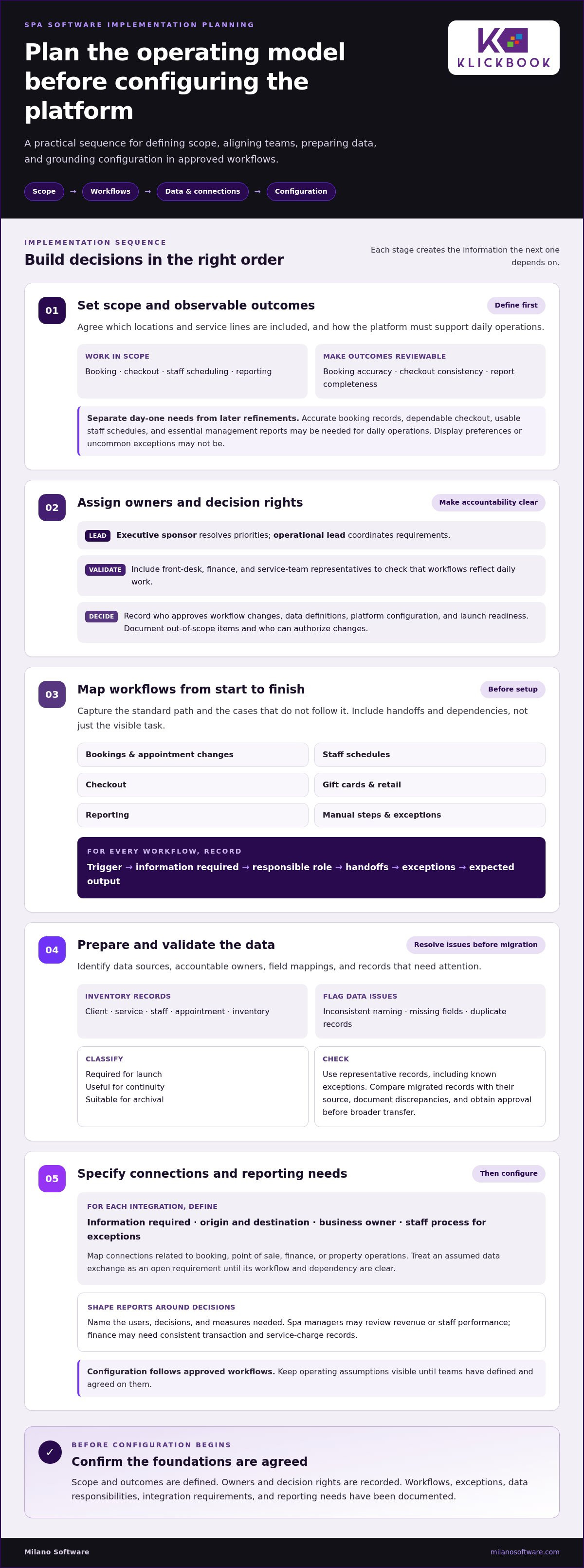
Spa software implementation planning aligns business requirements, system setup, data, and launch readiness. Start by defining the project boundaries: which locations and service lines are included, and how booking, checkout, staff scheduling, and reporting must work. For each area, document the workflow the platform needs to support, the team accountable for it, and the outcome leaders will use to assess readiness.
Separate launch-critical requirements from later refinements. Accurate booking records, dependable checkout processes, usable staff schedules, and essential management reports may be necessary for daily operations. A display preference or an uncommon exception may not be. Treating every request as day-one scope adds dependencies and makes testing less focused. Process redesign can help teams assess whether existing steps still serve the business; Business Process Re-engineering (BPR) describes the broader practice of re-evaluating and redesigning business processes.
Set measurable objectives before selecting implementation priorities
Turn broad goals into observable indicators. Review booking accuracy against appointment records. Assess checkout consistency by checking whether staff follow the agreed transaction process. Check reporting completeness against the information managers need to review operations. Document current friction, such as duplicate entry or unclear handoffs, without assuming new software alone will resolve it. Leadership should agree on a focused set of post-launch outcomes, define how each will be reviewed, and assign an owner to interpret the results.
Define stakeholders, decisions, and implementation boundaries
Establish an executive sponsor to resolve priorities, an operational lead to coordinate requirements, and representatives from the front desk, finance, and service teams to validate daily workflows. Record decision rights explicitly: who approves workflow changes, data definitions, platform configuration, and launch readiness? Document what is out of scope, who can authorize a change, and how its effect on timing, testing, or staff procedures will be assessed.
For resort operations, include the relationship between spa activity and the wider guest journey. The guide Resort Spa Software: Guide for Hotel and Resort Leaders provides related context for leaders defining hotel and resort spa requirements. A clear boundary keeps implementation decisions tied to the spa’s operating model while bringing cross-team dependencies into view before configuration begins.
Map spa workflows, data, and integrations before configuring the platform
Configuration should reflect documented operations, not assumptions about how teams work. Inventory each current workflow, from booking and appointment changes to staff schedules, checkout, gift cards, retail, and reporting. For each one, record the trigger, information required, responsible role, handoffs, exceptions, and expected output. For example, an appointment change may affect the internal calendar, staff availability, and checkout records. Mapping those dependencies helps expose gaps before they become configuration or testing issues.
Configure a spa platform against approved workflows, not assumptions about how teams operate. Map each process from start to finish, including manual steps and cases that do not follow the standard path. Then inventory data sources for client, service, staff, appointment, and inventory records. Identify the system or team responsible for each source, along with issues such as inconsistent naming, missing fields, or duplicate records. Assign an owner to resolve each issue before migration.
Document the data migration and validation approach
Classify records by operational purpose: required for launch, useful for continuity, or suitable for archival. Define field mappings between source records and the new platform, including who approves each mapping, resolves duplicates, and validates results. Start with representative records that cover common cases and known exceptions. Compare migrated records with their source, document discrepancies, and obtain approval before proceeding with a broader transfer. A reconciliation record gives teams evidence that the data is ready for use.
Specify integration and reporting requirements
List the systems that exchange information with booking, point of sale, finance, or property operations. For each connection, document the information required, its origin and destination, the business owner, and how staff will handle exceptions. Treat an assumed data exchange as an open requirement until the workflow and dependency are defined. Resort teams can use Resort Spa Software: Guide for Hotel and Resort Leaders as related context when mapping spa processes alongside hotel operations.
Define reporting needs by the decisions they must support, not by dashboard layouts. Name the users, the decisions they make, and the measures they need. A spa manager may review revenue or staff performance, while finance may need consistent transaction and service-charge records. Milano Software’s reporting provides operational and financial insights, including revenue, staff performance, and inventory metrics. Its online booking synchronizes with the spa’s internal calendar, while point of sale supports transactions, service charges, gift cards, and retail records. These requirements give configuration a clear operational basis.
For a spa-focused view of booking, point of sale, and reporting capabilities, explore Milano Software’s spa management platform as you document system requirements.
Evaluate implementation decisions against spa operating realities
A rollout model should match operational dependencies, not a preferred project format. A phased launch can isolate readiness gaps, but it adds coordination between stages. A single-stage launch gives teams one coordinated transition, but concentrates risk if a critical workflow or integration is not ready. Spa software implementation planning should make these trade-offs explicit and connect the decision to the spa’s locations, teams, and process dependencies.
| Decision factor | Phased rollout | Single-stage rollout |
|---|---|---|
| Scope | Introduces defined locations, departments, or workflows in stages. | Moves the agreed operational scope together. |
| Dependencies | Requires sequencing, stage-entry criteria, and coordination between groups. | Requires shared ownership and cross-workflow dependencies to be ready together. |
| Operational trade-off | Limits each transition’s scope but may require teams to manage different processes during rollout. | Creates one transition point but concentrates change and testing across the operation. |
Choose a rollout model that fits operational complexity
Consider a phased approach when locations, departments, or workflows have distinct readiness conditions, such as a location needing additional data validation or a service team requiring more process testing. A broader launch may fit when ownership, integrations, staff preparation, and end-to-end testing are coordinated. Record the rationale, sequence, decision gates, and safeguards for the selected model. Include who can pause a stage and how teams will maintain booking and checkout continuity if a test fails.
Separate essential requirements from preferences
Classify each request as launch-critical, operationally valuable, or deferred for review. Test exceptions against the standard workflow by identifying the business need, affected roles, training impact, reporting consequences, and ongoing maintenance complexity. A different process for a rare appointment case, for example, should be justified by an operating requirement rather than an untested preference. Booking decisions can also be considered alongside Spa Booking Software: Connect Guest Reservations to Spa Operations, a related guide to connecting reservations with spa processes.
Assess booking, point of sale, reporting, and integrations against actual staff actions. Confirm that appointment changes are handled as intended, checkout records reflect the agreed transaction process, and reports support the decisions managers need to make. Each integration should have a defined purpose, owner, and test case, not just a place on a technical diagram.
Manage disruption risk through controlled scope, named decision-makers, realistic testing, and contingency planning. Set acceptance criteria for each critical workflow, test exceptions as well as routine transactions, and document the fallback process if a launch issue affects bookings or checkout. The aim is not to eliminate every variation before launch. It is to know which variations matter, who owns them, and what the operation will do if the expected process does not hold.
Build a practical spa software implementation plan and readiness checklist
A useful plan turns spa software implementation planning into a sequence of owned decisions, not just a calendar of activities. For every phase, record the accountable owner, approval required, inputs, dependencies, and evidence that work is complete. Adapt the checklist below by location or service line. Make the evidence specific enough that teams can confirm readiness without relying on verbal updates.
- Scope. Owner: executive sponsor and operational lead. Decision: which locations, service lines, and workflows are included at launch? Input: approved objectives and boundaries. Dependency: stakeholder alignment. Evidence: signed scope and named decision-makers.
- Map workflows. Owner: operational lead with front-desk, finance, and service representatives. Decision: which current processes will be standardized or retained? Input: documented workflows and exceptions. Dependency: approved scope. Evidence: process maps reviewed by the teams who perform the work.
- Prepare data. Owner: designated data lead. Decision: which records move, remain available for continuity, or are archived? Input: source data, field definitions, and ownership. Dependency: approved mappings and duplicate-handling rules. Evidence: representative records validated against their source.
- Configure. Owner: platform lead with workflow approvers. Decision: how will approved processes be represented in the platform? Input: workflow maps and data definitions. Dependency: scope and data decisions. Evidence: configuration review against documented requirements.
- Test. Owner: test lead and relevant process owners. Decision: does each critical scenario meet its expected result? Input: test cases, representative records, and agreed acceptance criteria. Dependency: configuration. Evidence: recorded results, resolved defects, and successful retests.
- Train. Owner: operational lead and team supervisors. Decision: are staff ready to perform their role-specific tasks? Input: approved procedures and training materials. Dependency: stable workflows and tested configuration. Evidence: attendance, practice completion, and a recorded route for unresolved questions.
- Launch. Owner: launch lead, with final authority assigned to the executive sponsor. Decision: proceed, defer, or pause? Input: test results, training readiness, communications, and contingency procedures. Dependency: go-or-no-go criteria met. Evidence: recorded approval and a published escalation route.
- Review. Owner: operational lead with reporting stakeholders. Decision: which adoption issues require action or refinement? Input: agreed operational indicators and staff feedback. Dependency: launch and assigned review ownership. Evidence: documented findings, owners, and follow-up decisions.
Set testing and training gates before launch
Test representative bookings, appointment and schedule changes, checkout, gift cards, retail transactions, and reports. Assign an owner to each test scenario and record expected results, defects, resolution decisions, and retest outcomes. Training should follow actual job responsibilities, not take the form of a generic platform tour. Schedule sessions around operational coverage, explain what changes and when, and give staff a clear way to submit unresolved questions.
Prepare a controlled cutover and contingency plan
Specify launch timing, staff communications, support ownership, and escalation procedures before cutover. Document how teams will handle booking or checkout exceptions during the transition, including who makes the decision and how the issue is recorded. Set go-or-no-go criteria around critical workflow tests, staff readiness, and continuity procedures. The named launch authority should be able to pause deployment when those conditions are not met.
For a platform perspective on the operational workflows in this plan, explore Milano Software’s spa management platform.
Launch, measure, and refine the spa software operating model
Go-live confirms that the platform has been deployed; it does not establish that teams have adopted the operating model. Assign separate owners: a launch lead accountable for deployment issues and an operational lead accountable for staff adoption and workflow performance. This helps leaders spot friction in daily use instead of treating technical completion as the only measure of readiness.
Review the indicators agreed during planning. Assess each result against its defined acceptance criteria and gather feedback from staff and managers who use the workflows. A variance may point to a training need, data issue, configuration decision, or process-design gap. Identify the likely cause before deciding on corrective action.
Stabilize workflows after go-live
Maintain a centralized issue log with operational impact, accountable owner, status, and resolution decision. Review recurring friction with the staff performing the affected workflow; their experience can help clarify whether the cause is technical or procedural. Prioritize issues by their effect on service continuity and business records, then assign a follow-up date and document whether the resolution has been verified.
Keep lower-impact refinements visible without letting them distract from critical adoption issues. For each proposed change, record the rationale and identify who approves it. This creates a controlled route from observation to decision and helps teams avoid local adjustments that introduce inconsistent practices.
Connect implementation planning to the right platform
Evaluate platform fit against the requirements approved by spa leadership and the teams responsible for daily operations. Confirm that configured workflows support the intended processes, users can complete their assigned tasks, and management information answers the decisions it is meant to support. Base the assessment on documented criteria rather than assumptions about performance.
Klickbook by Milano Software is a spa-focused platform for operators assessing how software aligns with their defined requirements. The Spa Management Software: An Executive Guide to Connected Operations offers further context for evaluating operational fit. Effective spa software implementation planning carries approved requirements into adoption reviews, where accountable owners can identify issues and make evidence-based refinements.
Explore spa management software from Milano Software to assess platform fit against your operating requirements.
Make your next implementation decision with confidence
Move from planning to a decision by identifying the next approval your organization needs. Confirm who has authority, what evidence they need, and which unresolved assumption could change the project’s direction. Recording the decision gives teams a clear mandate for the work ahead and a reference point if priorities shift.
Assess Milano Software’s Klickbook platform against your approved requirements, focusing on operational fit, decision ownership, and the criteria leadership will use to proceed. A disciplined next step turns planning into accountable action without committing teams to unresolved scope.
Explore spa management software from Milano Software to assess the platform against your organization’s operating requirements.
Frequently Asked Questions
How long does spa software implementation planning take?
There is no universal planning duration; the schedule depends on how quickly the organization can resolve project decisions. Once the initial scope is agreed, estimate time by listing decision deadlines, approval steps, and the people needed for each. Build in review time for leadership and operational teams, then revisit the estimate if approvals stall or a new requirement changes the work. This creates a project-specific timeline without relying on an industry benchmark.
Can a spa keep operating during a software implementation?
Yes. Select a transition window around the spa’s service calendar and staffing coverage. If the team can choose another time, avoid cutover during a known peak operating period. Before the change, make sure supervisors know which staff are on duty, how to direct operational questions, and who can make time-sensitive decisions. Clear timing and communications help teams focus on guest service as the new process is introduced.
What should a spa include in a software implementation plan?
Make the plan a controlled project record, not just a task list. Include a decision log with the question, options considered, approver, date, and any resulting change to the agreed work. Keep the current approved version accessible to project participants, and assign someone to maintain it. This helps distinguish an approved change from an informal request and gives leaders a traceable record of how project direction evolved.
What data should a spa prepare before implementing new software?
Prepare records with consistent definitions, not just complete fields. Agree how the spa names services, identifies staff roles, labels appointment statuses, and records inventory units. Inconsistent values can make records harder to interpret even when the information is present. Create a short data dictionary documenting these conventions, then review samples with the teams who rely on them to ensure the terminology reflects actual spa operations.
Who should be involved in spa software implementation planning?
Include people who can represent different operating conditions, not only department leadership. A front-desk representative from another shift or a supervisor responsible for a distinct service area may identify requirements missed in a central planning meeting. Name alternates for key approvers so decisions can continue when someone is unavailable. Clarify who contributes expertise, who must be consulted, and who has final approval for each decision.
How should a spa measure whether new software is working after launch?
Check whether teams can complete representative work in the live operating environment without relying on unapproved side processes. Ask staff where they pause, repeat information, or need help, and compare feedback across roles rather than relying on one team’s experience. Review whether managers can interpret the information they receive and act on it. Record observations as specific examples, not general impressions.


