

A staff survey is most useful when it identifies what supports or undermines performance, not just whether employees feel satisfied. The most effective spa staff satisfaction survey questions cover workplace culture, engagement, growth, compensation and wellbeing, with a consistent rating scale to make responses easier to interpret. For an overall measure, ask employees to rate how happy they are at work on a scale of 1 to 10.
In a spa, staff experience is closely tied to daily operations. Workload, team communication and opportunities to develop can all affect how consistently employees deliver service. Spa staff satisfaction survey questions give employees a structured way to identify what’s working and where friction affects their experience.
This guide offers practical questions about culture and inclusion, engagement, career development, pay and wellbeing. It also explains how to keep a survey focused, protect the usefulness of responses and turn recurring feedback into clear priorities for action.
Key Takeaways
- Measure satisfaction across culture, engagement, development, compensation and wellbeing to identify where staff experience needs attention.
- Pair consistent rating scales with open-ended prompts to capture both comparable results and the reasons behind them.
- Ask focused questions about inclusion, recognition, workload and access to learning to surface practical areas for improvement.
- Keep the survey concise and mobile-friendly so staff can respond without adding unnecessary friction to their workday.
- Share the findings, prioritize recurring concerns and use a follow-up pulse survey to assess whether changes are making a difference.
1. What Can You Measure with Employee Satisfaction Surveys?
An employee satisfaction survey measures how staff experience their work and what affects it. In a spa, this can include workload, communication, recognition, resources and confidence in leadership. A sample staff survey identifies staff surveys or focus groups as indicator 1.6.8.3 for assessing work-environment quality. These measures help leaders distinguish isolated concerns from issues affecting several roles or shifts.
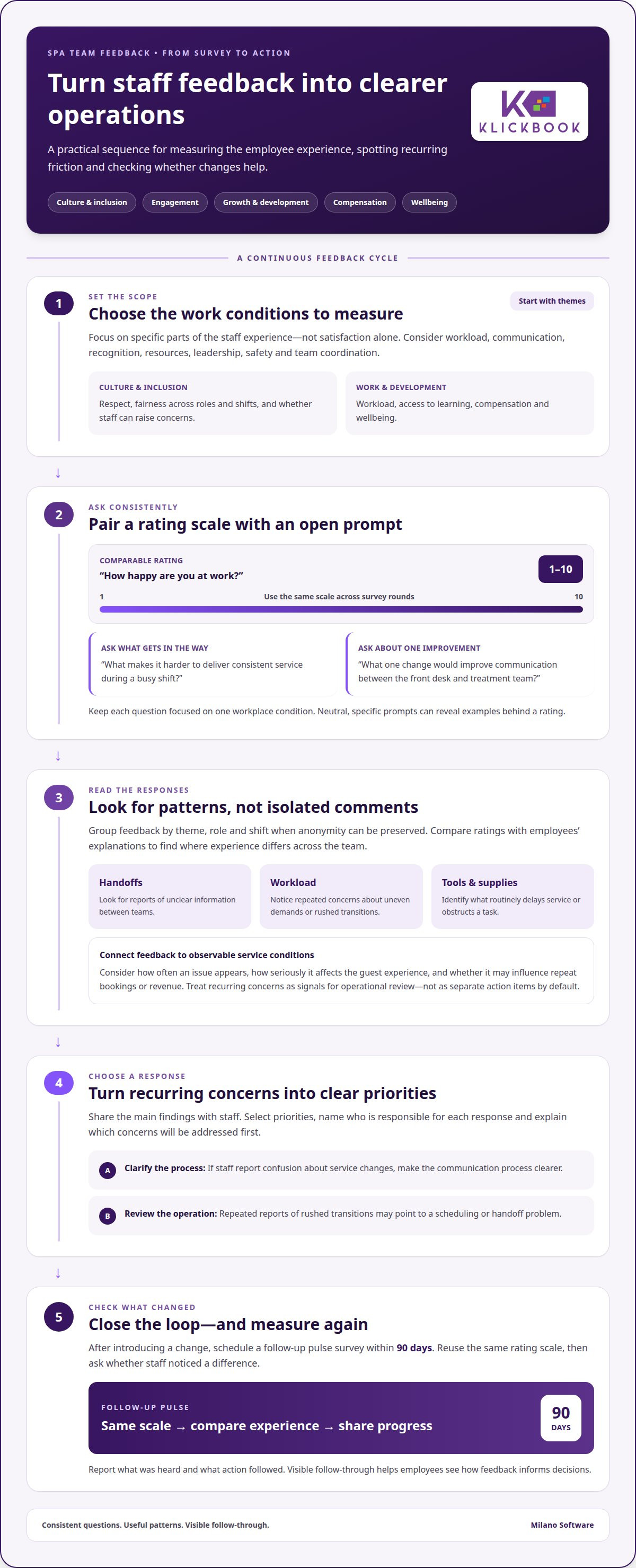
Spas can conduct regular pulse surveys throughout the year, rather than relying only on annual feedback, according to the Urban Institute. After introducing a change, schedule a follow-up pulse survey within 90 days to assess whether staff noticed a difference. Use the same rating scale across survey rounds. For example, employees can rate their happiness at work from 1 to 10, then explain their score.
Open-ended feedback provides the operational detail behind a rating. Ask, “What makes it harder to deliver consistent service during a busy shift?” or “What one change would improve communication between the front desk and treatment team?” These neutral prompts invite specific examples. Responses may reveal patterns such as unclear handoffs, uneven workloads or limited access to supplies.
Connect employee feedback to observable service conditions rather than treating every comment as a separate action item. Group responses by theme, role and shift when anonymity can be preserved. Then consider how often an issue appears, how seriously it affects the guest experience and whether it may influence repeat bookings or revenue. Repeated reports of rushed transitions, for example, may point to a scheduling or handoff problem that needs operational review.
Ask direct questions about leadership decisions and follow-through. For example, do managers communicate changes clearly, respond constructively to concerns and apply expectations consistently across teams? Ask employees to name one leadership practice that helps them do their work well. Compare those answers with open-ended comments to identify gaps between management’s intentions and employees’ daily experience.
Close the feedback loop by sharing the findings, selected priorities and planned actions with staff. Explain which concerns will be addressed first and who is responsible for each response. If employees report recurring confusion about service changes, leaders can clarify the communication process and later ask whether it helped. This shows staff that their feedback informs decisions, while the next survey provides a structured way to assess progress.
Questions about workplace culture and inclusion
Culture becomes measurable when employees rate specific workplace behaviours. Ask whether colleagues communicate respectfully, managers apply expectations consistently, and staff can raise concerns without being dismissed. A reported benchmark finds that 71% of employees rate workplace morale as excellent or good. Treat that figure as context, not a target; spa teams need feedback tied to their own working conditions.
Employees can rate management, communication and culture using the same scale for each statement. For example, use a 1-to-10 rating to assess how well leaders share operational changes. A separate 1-to-10 question can assess perceived support for diversity and inclusion. Consistent scales help leaders see which workplace conditions staff rate positively and where responses diverge.
- How consistently do managers explain changes affecting your role?
- Can you raise a concern and receive a respectful response?
- Do team members treat colleagues fairly across roles and shifts?
- How well does the workplace support diversity and inclusion?
These questions make workplace culture easier to assess without reducing it to general sentiment. Pair each rating with an open-ended prompt, such as, “What would help you feel more included during team discussions?” Specific examples can clarify whether concerns involve meeting practices, shift handovers or access to information.
Safety, respect and equipment all shape the employee experience. Ask whether staff feel comfortable reporting a workplace concern and whether shared work areas support their daily tasks. You might ask employees to identify equipment or supplies that routinely delay service. Separate safety concerns from general resource requests so leaders can direct each issue to the appropriate operational review.
Questions about tools and systems should focus on the work employees need to do. Ask whether booking information, point-of-sale processes and internal instructions are accessible when needed. If front-desk staff report recurring gaps in appointment details, that points to a specific handoff or information-access issue. Rather than asking whether a system is simply “good,” ask which task it supports or obstructs.
Assess team alignment with clear statements about priorities and coordination. Ask whether employees understand service expectations, know who handles a guest concern and receive consistent direction across shifts. Differences between front-desk and treatment-team responses, for example, may indicate unclear ownership. Comparing feedback by role can reveal that disconnect while keeping the focus on processes, not individual blame.
A useful survey combines closed-ended questions for comparison with open-ended questions for context. Keep each item focused on one workplace condition, then group responses under themes such as culture, inclusion, safety, tools or team coordination. Share the main findings with staff, assign an owner to each priority and report on the actions taken. This turns employee feedback into visible operational follow-through.
Growth, development, compensation and wellbeing
Questions about growth, pay and wellbeing should focus on workplace conditions employees can describe. Keep these themes separate so responses show whether dissatisfaction relates to compensation, workload, recognition or career prospects. Ask employees to rate each area independently, then invite one practical suggestion. This helps leaders distinguish a pay concern from limited development opportunities or unpredictable scheduling.
To assess workload, scheduling and work-life balance, ask whether shifts allow enough time for assigned duties, whether schedules support personal commitments and how often last-minute changes disrupt plans. Add an open-ended prompt: “What scheduling change would make your workweek more manageable?” Responses can help leaders pinpoint whether pressure comes from shift patterns, appointment flow or uneven task distribution.
Use clear, neutral wording. “I can complete my responsibilities within my scheduled hours” measures workload fit, while “I receive enough notice about schedule changes” focuses on predictability. Invite employees to explain a low rating with a specific example, such as overlapping appointments or insufficient time between duties. Review patterns by role or shift to locate operational strain without treating one response as representative of the whole team.
To measure satisfaction with training and career development, ask whether employees can access the learning needed for their current role, whether feedback helps them build relevant skills, and whether they understand potential career paths. Culture Amp reports a 71–76% benchmark agreement range for employees who say they have access to the learning and development needed to do their jobs well. Use this as context, then assess local responses.
Training questions should connect learning to the work. Ask which skill would improve an employee’s confidence, what training would support their next career step and whether recent instruction helped them perform a specific task. A new service protocol, for example, may call for demonstration, practice and manager feedback. A follow-up question can reveal what needs more reinforcement.
Compensation questions should separate pay satisfaction from appreciation and fairness. Ask whether employees understand how compensation decisions are communicated, and whether recognition reflects their contributions. In a survey cited by Staffbase, 72% of employees said they would rather work in a job where they feel appreciated than one with higher pay. That finding supports measuring recognition alongside compensation, not as a replacement for pay feedback.
Wellbeing questions can focus on recovery, energy and access to support. Ask whether employees have enough time between demanding duties, which workplace factors affect their energy and what change would help them sustain their work. Avoid requesting sensitive personal details. Keep the focus on work conditions employees can describe and management can address.
Review responses by theme, then assign each priority a practical next step. If staff report limited access to training, leaders can clarify the learning options and how employees can use them. If schedule predictability scores poorly, review how changes are communicated. Tracking these actions alongside future responses helps connect employee experience with retention and skills development.
5. Survey design and question themes
Survey design determines whether employee engagement feedback can guide operational decisions. Start with a defined purpose, such as assessing workload, communication or development. A baseline employee survey can use 20–25 questions, while a pulse survey can use 5–10. Keep each question tied to one work-environment topic so responses remain interpretable.
For rating questions, use a consistent Likert scale. Common options are 1 to 5 or 1 to 7, with clear labels such as “strongly disagree” and “strongly agree.” The same range lets leaders compare responses across survey rounds or teams. A separate three-question Employee Satisfaction Index approach uses a 1–10 rating scale.
Keep completion time controlled. A recommended employee survey takes 10 to 15 minutes, and Culture Amp advises engagement surveys stay within that range. Surveys exceeding 7 to 8 minutes tend to see response rates drop by 5% to 20%. The average employee survey response rate is 30%, so concise wording and mobile access can reduce participation friction.
Build survey themes around decisions managers can act on: work environment, culture, scheduling, resources, leadership, development and wellbeing. Use one rating item per theme, followed by an optional prompt for context. For example, pair “I have the information needed to complete my work” with “What information would improve this process?” This approach captures comparable results and specific explanations.
Protect anonymity in both survey setup and reporting. Avoid collecting names, and report results in grouped categories rather than exposing individual responses. The sample survey recommends having at least eight staff in each position category to help support anonymity. Review written comments for identifying details before sharing summaries with managers.
Survey length should support completion without sacrificing useful coverage. Keep the questionnaire within 10 to 15 minutes, and use a short pulse format when tracking one operational change. The average response rate is 30%; treat it as context, then monitor participation across your own survey cycles. Share the purpose, explain how feedback will be reported, and tell employees when findings will inform decisions.
Before launching the survey, test it on a mobile device and check that each item has one clear interpretation. Remove duplicate questions, define the rating scale and group items by theme. After collecting responses, compare like-for-like questions, summarize recurring comments and assign an owner to each priority. This makes survey data a repeatable management tool.
For spa teams, feedback can also ask how satisfied clients were with the way staff handled concerns. Spa businesses can organize survey feedback into categories including staff friendliness and professionalism. The sample staff survey is estimated to take 10-12 minutes to complete. The page recommends making employee surveys accessible on mobile devices.
5. What questions should a spa staff satisfaction survey include?
A useful spa staff survey connects employee experience to the work staff do each day. Group questions by theme, combining rating statements with a few prompts for examples. A baseline survey can cover responsibilities, team coordination, guest interactions and operational support without asking employees to repeat the same concern in different words.
Start with daily responsibilities. Ask employees to rate their satisfaction with their duties on a scale of 1 to 10, then explain the rating. Follow with questions about whether responsibilities are clear, whether employees have the resources to complete them, and which task creates avoidable friction. These answers help distinguish role clarity from workload or process issues.
- How satisfied are you with your daily responsibilities? Explain your rating.
- Do you have the information and resources needed to complete your work?
- What part of your workday creates the most avoidable friction?
Include questions about service delivery, framed around staff observations. Ask whether front-desk colleagues are welcoming and professional, whether service providers listen carefully to client preferences and concerns, and whether clients receive clear answers before, during and after appointments. These prompts connect employee perspectives to service moments they directly observe.
Questions about recommendations and problem resolution can reveal service-quality gaps. Ask whether product or service recommendations feel helpful rather than pushy, and whether staff can respond effectively when a client raises a concern. A follow-up prompt, such as “What would help you handle client concerns more effectively?”, can uncover training, communication or process needs.
Keep rating questions specific. “I can answer common client questions clearly” measures confidence in communication, while “I know how to escalate a concern” measures process clarity. Avoid combining both ideas in one statement. If a question covers two separate tasks, an employee may agree with one and disagree with the other, making the result harder to interpret.
Open-ended prompts should invite actionable examples, not personal disclosures. Ask, “What change would improve coordination between the front desk and service team?” or “Which information would help you prepare for appointments?” Use responses to identify recurring handoff issues, unclear instructions or resource gaps. Leave room for staff to raise issues the fixed questions may have missed.
Use the same core questions across survey cycles to compare changes, then rotate a small number of focused prompts. A consistent template makes patterns easier to interpret; targeted questions can examine a recent process change. To connect staff feedback with spa operations and service workflows, keep each question tied to a decision managers can act on.
Milano Software
Milano Software helps spa operators connect employee feedback to the operational workflows it can inform. When survey responses point to scheduling friction, inconsistent processes or gaps in day-to-day visibility, spa management tools can support a more structured operating model. Online booking, Point of Sale and reporting help organize core activities and give managers operational information to review.
This is a practical next step when staff feedback identifies issues that depend on clearer coordination across bookings, transactions and daily performance. Survey design and follow-through remain management responsibilities; operational systems can support the processes those decisions affect. Explore Milano Software’s spa management platform as part of that operational response.
Contact Milano Software to discuss your spa’s operational priorities.
Turn staff insight into operational progress
Survey results matter when leaders connect employee input to decisions, assign clear ownership and communicate what happens next. Treat the next survey cycle as a management checkpoint: review whether the original concern persists, whether a process changed and whether employees notice a difference in their work. This keeps staff feedback connected to operational priorities rather than leaving it as a one-time exercise.
Use spa staff satisfaction survey questions to build a consistent understanding of employee experience as your spa evolves. Milano Software supports spa operations with management tools, online booking and reporting, helping operators organize workflows and review business performance. The right operational approach depends on your team’s needs and the decisions you’re prepared to act on.
For a practical discussion about aligning spa operations with your priorities, contact Milano Software today. Build on employee insight with a clear next step, and keep progress visible to the people who make service delivery possible.
Frequently Asked Questions
What Can You Measure with Employee Satisfaction Surveys?
Employee surveys can show how staff assess the conditions that shape their work. Separate overall satisfaction from specific factors such as schedule predictability, role clarity, access to supplies and confidence raising concerns. This helps show whether a low overall rating reflects one operational issue or several. Compare results across survey cycles using the same core items, and interpret team-level differences only when responses can be reported without identifying individuals.
What Should You Do After the Survey?
Turn findings into a decision record that tracks each issue, response and status. Sort concerns into immediate operational adjustments, matters requiring manager review and topics needing further analysis. A recurring complaint about unclear shift handovers, for example, may call for a revised process, while conflicting comments may warrant a focused discussion. Communicate which actions are moving ahead and which need more review so employees can see how their input informed decisions.
How can a spa measure staff satisfaction with pay, benefits, and tips?
Measure pay, benefits and tips as separate areas rather than asking one broad compensation question. Ask whether employees understand how pay decisions are communicated, whether available benefits meet their needs, and whether tip allocation is explained clearly and applied consistently. Invite optional comments on how to improve transparency. Avoid requesting personal financial details; the survey should assess workplace perceptions and identify communication or process concerns.
How should a spa survey assess safety, ergonomics, and workplace stress?
Ask about specific tasks and settings rather than relying on a general “I feel safe” rating. Employees could assess whether work areas allow comfortable movement, whether equipment setup supports their duties and which routine tasks create avoidable physical strain. To understand stress, ask which work conditions make it difficult to maintain focus during a shift. Provide an optional comment field for describing the situation without requesting sensitive health information.


