

Improving spa client experience takes more than a polished treatment. It depends on consistent service standards, responsive feedback processes, relevant rewards, convenient booking and systems that help staff deliver reliably. When these elements work together, clients encounter fewer points of friction before, during and after a visit. A well-designed experience is an operating standard, not an isolated gesture.
Personal attention matters, but it can be hard to sustain across busy schedules, different staff members and multiple locations. Clear protocols, useful client records and straightforward ways to book and share feedback help teams deliver consistent service without relying on memory alone.
This article covers practical ways to strengthen staff practices, collect and act on feedback, design repeat-visit rewards, simplify appointment booking and build continuity into daily operations. Together, these steps help align the client journey with the realities of running a spa.
Key Takeaways
- Set clear service standards and train staff to apply them consistently across each stage of the visit.
- Collect feedback through simple, accessible channels, then use recurring themes to guide service improvements.
- Design repeat-visit rewards around meaningful client preferences and a clear reason to return.
- Offer convenient booking options and make appointment information easy to manage.
- Use consistent client records and operational systems to help teams deliver a more reliable experience.
1. Maintaining consistent service standards and staff training
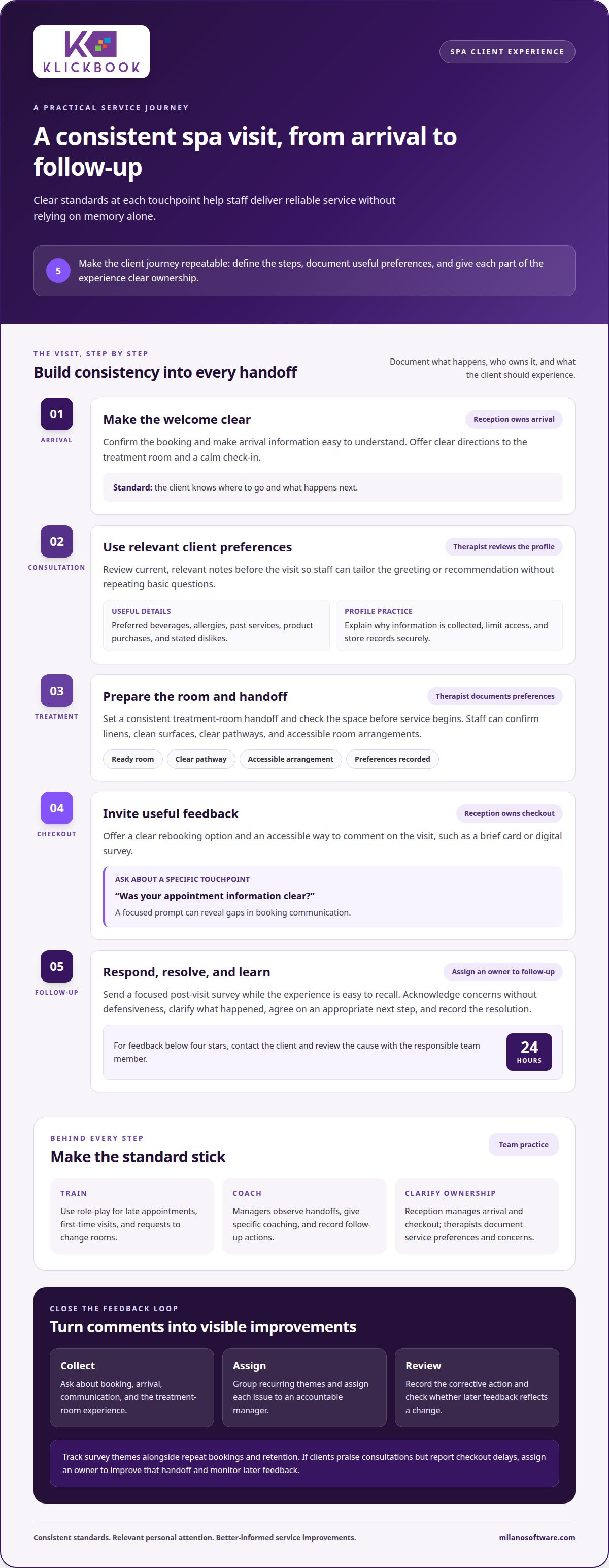
Improving spa client experience starts with service standards every employee can follow. Define the arrival, consultation, treatment-room handoff, checkout and follow-up processes. Established wellness centres, such as Hollywood Body Wraps & Wellness, demonstrate how consistent consultation and structured care protocols help deliver reliable quality. Document each step so service quality does not depend on who is working.
Useful client profiles help staff make relevant recommendations without repeating basic questions. Record details such as preferred beverages, allergies, past services, product purchases and stated dislikes. Before a visit, the assigned team member can review the profile and tailor the greeting or recommendation. Keep notes factual, current and relevant to the client’s visit.
In Canada, privacy obligations vary by province and business context, so one rule does not apply identically to every spa. Use a prudent profile process: explain why information is collected, limit access to staff who need it, and store records securely.
Training turns written standards into observable behaviours. Use role-play for situations such as a late appointment, a first-time client or a request to change rooms. Managers can observe handoffs, give specific coaching and record follow-up actions. Assign clear ownership: reception manages arrival and checkout, while therapists document service preferences and concerns.
Feedback cards and post-service surveys give clients a direct channel for comments they may not share face-to-face. Ask focused questions about booking, arrival, staff communication and the treatment-room experience. Review responses at regular team meetings, assign an owner to recurring issues, and document the action taken. The Bank of Canada, for example, invites phone callers to complete a short satisfaction survey and uses feedback to improve service quality.
For cleanliness, safety and accessibility, set practical checks for each treatment room and shared area. Before service begins, staff can check linens, sanitized surfaces, clear pathways and accessible room arrangements. Train the team to identify barriers, offer assistance respectfully and escalate hazards through a defined process.
Small touches should reflect recorded preferences, not assumptions. A preferred beverage, clear directions to the treatment room, a comfortable robe option and a calm check-in can help clients feel recognized. Make each touch part of the service routine rather than an inconsistent personal gesture.
Service recovery needs a defined response. Acknowledge negative feedback without defensiveness, clarify the concern, agree on an appropriate next step and record the resolution. Contact clients who submit feedback below four stars within 24 hours, then review the cause with the responsible team member.
Measure satisfaction alongside operational outcomes. Track survey themes, repeat bookings and retention by service, staff member or location. If clients praise consultations but report checkout delays, assign an owner to improve that handoff and monitor later feedback.
2. Collecting and implementing client feedback
Build feedback collection into specific moments in the client journey instead of relying on unsolicited comments. At checkout, invite each client to share an observation about arrival, communication, treatment delivery or follow-up. Offer a brief card or digital survey, and allow written responses for clients who prefer not to raise concerns face-to-face. A specific prompt produces more actionable feedback than a general request to rate the visit.
Keep surveys short and focused on operations. Ask clients about a specific touchpoint, then leave space for one open comment. For example, “Was your appointment information clear?” can reveal gaps in booking communication. “What would improve your next visit?” can surface issues that closed ratings miss. Send the survey soon after the appointment, while details about the treatment and wellness experience are easy to recall.
Spas should collect feedback at checkout, through a post-visit survey and from public review channels. Respond to online reviews with a concise acknowledgement, address the specific concern without exposing personal details, and state the practical next step. For private concerns, move the conversation to an appropriate direct channel. The European Commission recommends sending clients a brief feedback survey before asking them to leave an online review.
Turn comments into a managed improvement process. Group responses by themes such as scheduling, staff communication, room readiness and checkout. Assign each recurring issue to an accountable manager, record the corrective action, and review whether later feedback reflects a change. For example, repeated confusion about arrival instructions calls for clearer pre-visit messaging, not just another apology at reception.
Feedback can also inform marketing, but use it to improve relevance rather than pressure clients. If clients want clearer treatment descriptions, revise service information before promoting wellness packages. If comments identify a popular visit feature, highlight it accurately in communications. Use social media responses to acknowledge general themes, while keeping individual service matters private. This connects client input to retention and operational performance.
Separate individual service recovery from broader process improvement. When a client reports a problem, acknowledge it, establish what happened and agree on a practical resolution. Then record the underlying cause, such as unclear instructions or a delayed handoff, without making the record a judgement about the client. A manager can review unresolved cases at a regular service meeting and assign follow-up responsibility.
Assess feedback alongside repeat bookings and retention patterns. Compare survey themes across services, teams and locations, then look for operational links: recurring booking confusion may coincide with fewer return appointments. Treat that relationship as a signal to investigate, not proof of cause. After making an adjustment, monitor subsequent comments and booking behaviour to see whether it addresses the original concern.
3. Loyalty programs and repeat-visit rewards
Design loyalty around behaviour the spa wants to encourage: repeat visits, advance rebooking or retail purchases. Returning-client retention in the salon and spa industry averages around 60-70%, while loyalty programs are associated with an average retention-rate increase of 10-20%. Use these figures as context, then assess program performance against your own client and booking records.
Choose a reward structure clients can understand before enrolling. A points program can award points for eligible purchases, which clients can redeem for a defined service credit or retail reward. A punch-card model is simpler: after a set number of qualifying visits, the client receives a stated benefit. Explain how points accrue, what they can be used for and when they expire.
Memberships suit clients who value a predictable schedule of visits. For example, a spa could offer a monthly treatment credit for a fixed monthly fee, with clear redemption terms. Match each membership benefit to available services and appointment capacity. A reward that is difficult to book creates friction instead of encouraging return visits.
Make rewards relevant to clients’ actual choices. If a client regularly books thermal experiences, offer a related upgrade or a benefit tied to another visit. If they purchase skincare, consider a product reward rather than a discount on an unrelated treatment. Tailored rewards can feel more valuable than broad discounts while preserving the spa’s positioning and service mix.
Set transparent rules before launch. Define eligible purchases, redemption limits, exclusions and how returns affect points. Train reception staff to explain the program consistently at enrolment and checkout. Keep the terms easy to find in confirmation messages or printed materials so clients can understand their balance without asking staff to interpret it.
Measure the program through enrolment, redemption, repeat bookings and revenue by reward type. Compare members’ visit patterns with their own previous activity, and review which benefits they use. If points accumulate without being redeemed, simplify the catalogue or clarify the reward threshold. If discounts drive bookings but reduce revenue per visit, test service-based benefits instead.
Review the program as part of a regular operating cycle. Use booking and point-of-sale records to identify inactive members, popular rewards and redemption bottlenecks. A targeted reminder can explain the client’s available reward and how to use it. Keep the message useful and specific: a clear prompt to book a preferred service gives clients a practical reason to return.
4. Streamlined, multi-channel appointment booking
Booking access shapes the client journey before arrival. Offer a consistent route through online scheduling and staff-assisted booking by phone or at reception. Online booking lets clients schedule appointments and service packages 24/7 from any device. Keep service descriptions, availability and confirmation details aligned across each channel.
Remove unnecessary steps from the booking flow. Present services with clear durations, preparation details and available appointment times. Let clients choose the right service before selecting a time, then review the booking before submission. A concise confirmation should identify the service, date, time and location, with a straightforward way to manage the appointment.
Forty percent of appointments are booked after business hours, while 67 percent of people prefer online booking. Accessible self-service supports clients who plan outside reception hours and reduces dependence on live staff availability. Keep phone-assisted booking available for clients who want help, and ensure staff can see the same appointment schedule.
Send appointment confirmations promptly and make the next action clear. Include the information clients need to prepare, along with a direct way to reschedule or cancel. If confirmation messages support calendar additions, clients can save appointment details immediately. Keep information consistent across booking channels to prevent confusion about service timing or location.
Use reminders to reduce avoidable missed appointments. For medical spa bookings, a reminder sequence can include a message 72 hours before, another 24 hours before, and a final reminder on the morning of the appointment. SMS reminders reduce missed appointments by up to 38 percent. Make each message concise, relevant and easy to act on.
Make payment a natural part of booking or checkout. Show clients what the payment covers and provide a clear receipt after the transaction. Keep appointment changes and payment records connected operationally so staff can resolve questions without searching disconnected systems. A predictable checkout supports a smooth return visit.
Track booking performance by channel, appointment completion, cancellation and repeat booking. Clients who book their next appointment before leaving have a 30-40 percent higher retention rate. Use checkout prompts to support advance rebooking, while preserving a low-pressure choice for clients who prefer to decide later.
Connect appointment prompts with relevant loyalty programs without making booking harder. For example, show an eligible reward during checkout or include a clear benefit in a return-visit reminder. Review where clients abandon bookings, then simplify the step causing friction. Consistent channels, useful reminders and straightforward appointment management make bookings easier to repeat.
5. Systems for consistent client experiences
A reliable client journey depends on connected operating steps, not isolated service gestures. Map the path from initial booking through arrival, treatment, checkout and follow-up. For each stage, identify the staff role, information required and handoff to the next team member. For example, reception can flag a first visit so the assigned practitioner knows to allow time for an introductory conversation.
Keep relevant client context in a structured record. Appointment notes, contact logs and alerts can capture past services, preferences and product purchases. A practitioner can review the latest note before a visit, while reception can see relevant arrival information. Use consistent fields and plain language so teams at different locations interpret records in the same way.
Separate operational details from clinical documentation when the spa’s service model requires it. For example, a medical aesthetics team may use SOAP notes for clinical records, while a contact log captures scheduling conversations. Set access according to staff responsibilities, and record only what is needed to support service delivery. These controls help keep client context useful and appropriately managed.
Standardize pre-visit communication with a welcome email covering directions, what to expect and practical arrival details. A spa might include its beverage options and explain where reception is located. Use the same approved information across channels, then tailor relevant details to the client’s appointment. This reduces conflicting instructions and gives staff a consistent reference.
Give every handoff a clear owner and completion cue. Reception marks arrival, the practitioner records the service outcome, and checkout confirms the next operational step. If a client requests follow-up, assign responsibility and record the agreed action. A shared process prevents requests from being lost between teams, especially during shift changes or multi-location operations.
Use reminders and post-visit messages to guide the client journey, not as generic broadcasts. A message can refer to the booked service, share relevant preparation information or invite the client to arrange suitable follow-up. Keep timing and content consistent with the service protocol. Track delivery and client responses to identify communication gaps and improve the sequence.
To improve the journey from booking to follow-up, connect appointment details, staff handoffs, service records and relevant communications in one repeatable workflow. Then review client retention, completed follow-ups and recurring service issues to find breaks in the process.
Make operational data part of a regular management routine. Review a sample of completed client journeys with staff, note where information was missing and assign corrective actions. For example, repeated questions about arrival may point to unclear directions in the welcome email. Assess the revised message against later client comments, then update the shared standard so clients receive a consistent experience.
Milano Software
Milano Software helps spas coordinate the operational systems behind a consistent client journey. Its spa management platform brings online booking, point of sale and reporting together, helping teams manage appointments, transactions and performance information with greater continuity.
For day spas, resort and hotel spas, Nordic and thermal spas, and operators with multiple locations, connected workflows can align booking activity with front-desk processes and management oversight. Reporting gives leaders a structured view of operational performance to inform decisions about where to refine the client experience.
When your spa is ready to strengthen the systems behind client service and loyalty, contact Milano Software to discuss your operational priorities.
Make client experience an operating priority
Turn service principles into an operating plan: assign an owner, define client-journey standards and set a regular performance review. Start with one process where inconsistent execution creates friction, then use staff observations and client responses to guide the next adjustment. This disciplined approach makes improving spa client experience an ongoing management practice, not a one-time initiative.
Milano Software offers Spa Management, Online Booking and Reporting to support the operational workflows behind client service. These capabilities help spa teams coordinate booking activity and review business performance as they refine their approach.
When you’re ready to align your operational systems with your service priorities, contact Milano Software to discuss your spa’s needs. A clear next step can help your team build a more consistent experience with confidence.
Frequently Asked Questions
What do spa clients value most in their customer experience?
Spa clients value attentive service, clear expectations and control over their visit. They should understand what a service involves, how long it takes and what happens next. For example, staff can explain a treatment sequence before beginning and check that the client is comfortable proceeding. Consistency matters: clients should receive the same clarity whether booking one appointment or visiting as part of a retreat.
What booking and payment technology improves the spa client experience?
Useful technology connects appointment selection with accurate availability and straightforward checkout. Online booking lets clients schedule appointments and service packages from any device, while syncing with the spa’s internal calendar to help minimize double-bookings. An integrated point of sale processes service charges, gift cards and retail purchases in one checkout workflow. Together, these tools reduce handoffs between booking and payment.
How can spa staff personalize treatments and recommendations?
Staff can personalize recommendations by connecting clients’ stated goals with relevant service options, then explaining the differences clearly. For example, offer a choice between a shorter service and a longer sequence, describing what each includes without assuming the client’s priorities. Invite the client to guide the decision and record their choice for continuity. Recommendations should support informed choice, not turn every consultation into an upsell.
How can spas reduce wait times and improve appointment scheduling?
Spas can reduce delays by matching appointment durations to service requirements and coordinating practitioner and room availability before confirming bookings. Build schedules around realistic setup and turnover needs instead of filling every open minute. If an appointment runs late, update affected clients promptly and offer a clear choice, such as waiting or selecting another available time. Review recurring delays by service and shift to identify avoidable bottlenecks.
How can spas improve the experience for first-time clients and clients with accessibility needs?
Give first-time clients a clear orientation before arrival: explain check-in, what to bring and how staff will guide them through the visit. Ask how the spa can support their access needs, and provide a discreet way to share preferences when booking. Confirm practical arrangements directly, such as the best entrance or preferred communication method. Staff should offer assistance without making assumptions or drawing unnecessary attention.


