
A full calendar is not the same as operational control. When bookings, client information, checkout and reporting sit in disconnected workflows, teams spend time reconciling records instead of coordinating service. Spa management software can connect these handoffs, helping leaders follow activity from appointment to transaction and management review.
Fragmented systems can make it harder to see what is happening across the business. An integrated platform coordinates core workflows: online booking synchronizes with the spa’s internal calendar, point of sale records transactions and retail activity, and reporting brings revenue, staff performance and inventory metrics into view.
This guide explains how those capabilities work together across day spas, resort spas and Nordic spas. It also offers practical ways to identify workflow gaps and assess whether a platform fits your operation. The goal is to understand what the system coordinates, where records can lose continuity and what information managers need to make informed decisions.
Key Takeaways
- Map handoffs across booking, staffing, checkout, inventory and reporting to find where coordination breaks down.
- Assess spa management software by how well it supports continuity and visibility from appointment booking through reporting.
- A connected platform can support day spa, resort spa and Nordic spa workflows without requiring each operation to work the same way.
- Set clear objectives for administrative workload, record consistency, appointment visibility and reporting cadence before changing systems.
- See how Milano Software connects online booking, point of sale and reporting to support operational oversight.
Why spa management software matters when operations span multiple workflows
Spa management software coordinates core administrative and commercial workflows, including booking, point of sale and reporting. Its value is not simply having these functions available. It is helping information carry through the appointment, checkout and management-review stages instead of requiring staff to re-enter it in separate records.
This approach reflects the integrated management of main business processes associated with enterprise resource planning, applied to spa operations. A spa platform focuses on spa-specific activity and the administration around service delivery. It does not perform treatments or replace a hotel property management system. That distinction matters in resort environments, where spa operations are part of a broader hospitality business.
What does spa management software coordinate?
Depending on the platform, workflows can include appointment availability, staff schedules, client profiles, transactions and related records. Booking captures appointment details for service preparation. At checkout, staff record applicable charges and retail purchases. When these steps are coordinated, teams have less need to reconstruct a client or transaction history from separate sources.
Milano Software connects online booking with the spa’s internal calendar to help staff maintain appointment visibility and minimize double bookings. Its point of sale processes transactions, service charges, gift cards and retail merchandise, while its reporting tools provide insight into revenue, staff performance and inventory metrics.
Where fragmented spa workflows create operational friction
Separate calendars, checkout tools, inventory records and reporting processes can force staff to enter the same information more than once. Every handoff creates a chance for records to diverge. An appointment change may not be reflected in each system, or a retail sale may be recorded at checkout but not consistently reflected in inventory and management reports. Reconciliation takes time, and leaders have less confidence in a single view of operations.
Consider a client who books a service, buys retail merchandise and pays for both at checkout. If appointment details, payment records and inventory information are held in disconnected workflows, staff may need to match them manually before reporting is complete. Coordinating booking, point of sale and reporting gives managers a clearer basis for reviewing activity and deciding where follow-up is needed.
How connected spa management software supports the appointment-to-reporting lifecycle
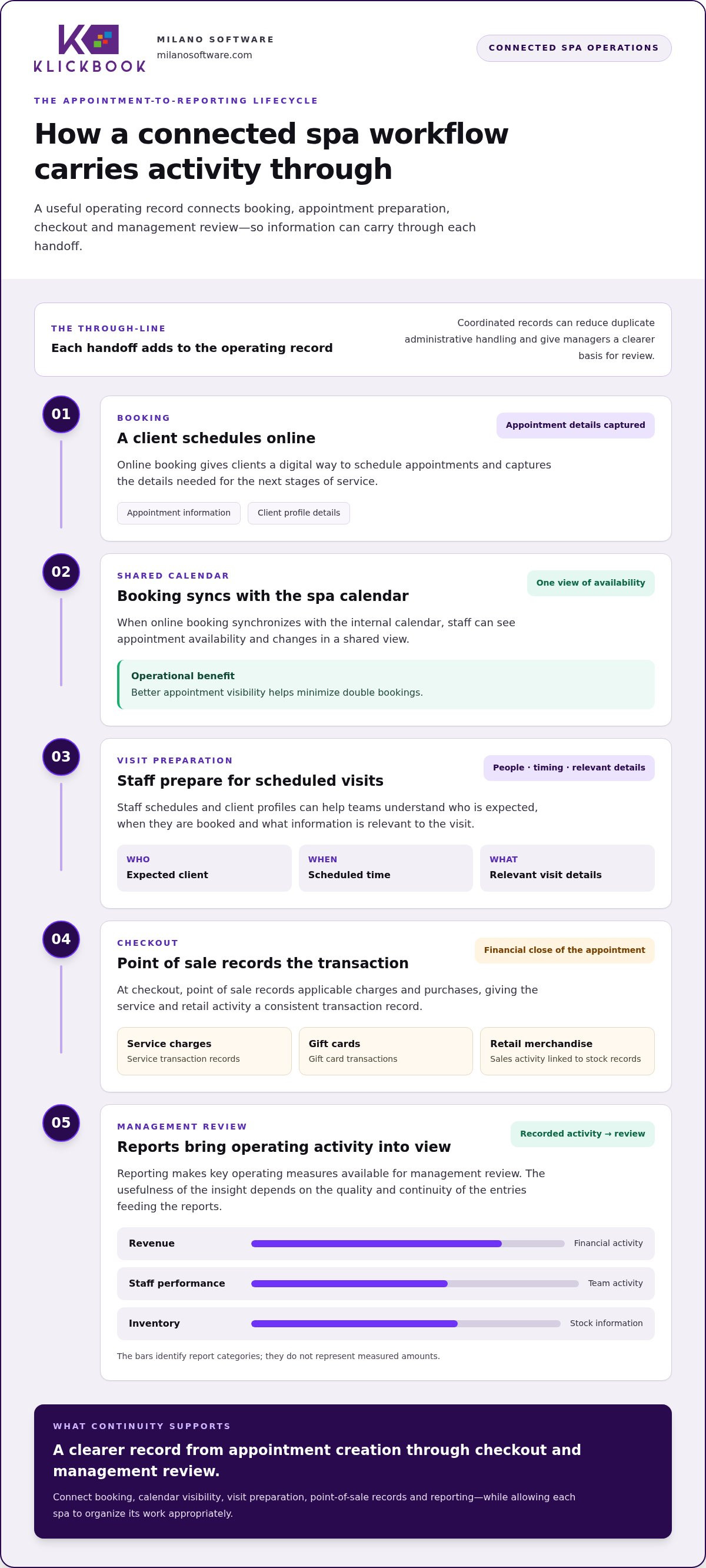
Operational control depends on maintaining a useful record from appointment creation through management review. A connected workflow links online booking with the spa’s internal calendar, supports preparation for scheduled visits, records transactions at checkout and makes sales and inventory activity available for reporting. Each handoff should add to the operating record, rather than create another version staff must reconcile.
From online booking to an operationally ready appointment
Online booking gives clients a way to schedule appointments digitally. When booking activity synchronizes with the internal calendar, staff can work from a shared view of availability and reduce the risk of double bookings. Staff schedules and client profiles can also help teams prepare by showing who is expected, when they are booked and what information is relevant to the visit. When assessing a system, check that the booking workflow reflects how your team manages appointment availability and changes.
The International Spa Association provides professional resources and industry context for spa operators. In day-to-day operations, scheduling technology has a practical role: making appointment status visible to the people coordinating the work.
From checkout records to management reporting
After service delivery, point of sale records the financial close of the appointment. Transactions may include service charges, gift cards and retail merchandise. Consistent checkout records support accurate transaction handling, while sales and inventory records help managers review retail activity alongside stock information.
Reporting turns recorded activity into information for management review. Revenue, staff performance and inventory metrics can inform decisions without relying solely on manually assembled records. The quality of the insight depends on the quality and continuity of the entries feeding the reports.
Connected records carry operational activity from booking through checkout into reporting, reducing duplicate administrative handling and giving managers a clearer basis for review.
Day spas, resort spas and Nordic spas may organize their work differently, but each needs usable records at key handoffs. Explore how Milano spa management software connects online booking, point of sale and reporting across this lifecycle.
One spa platform or disconnected tools: what changes across spa models?
A connected operating model does not require every spa to follow the same process. Day spas, resort spas and Nordic spas have different service contexts, staffing patterns and management priorities. A platform’s role is to coordinate relevant booking, point of sale and reporting workflows while allowing each operation to organize its work appropriately.
With separate tools, teams may need to compare or re-enter booking, checkout and reporting records before leaders can review activity. Connected spa management software can support continuity between those functions, but it does not make every workflow identical. Nor does integration within spa management mean the platform replaces systems outside the spa’s operational scope.
Day spa, resort spa and Nordic spa operating priorities
Each model has a distinct operational emphasis. Use these priorities to identify which handoffs deserve the closest review, not as a claim that every spa follows the same procedures or needs specialized facility-management features.
| Spa model | Operational priority | Management focus |
|---|---|---|
| Day spa | Appointment capacity and staff schedules | Coordinate bookings, service checkout and retail records |
| Resort spa | Spa appointment and service operations within a hospitality setting | Maintain spa-level booking, transaction and performance records |
| Nordic spa | Organize spa appointments and commercial activity around its operating model | Review spa bookings, sales and operational reporting |
A resort spa may operate alongside hotel systems, but spa management software is not hotel property management software. Milano Software supports spa operations for day spas, resort spas and Nordic spas. The distinction keeps responsibilities clear between spa booking and point of sale workflows and broader property administration.
When disconnected systems create a visibility gap
When booking, point of sale and reporting are maintained separately, staff may have to match appointment records to transactions and sales data before management can review performance. This reconciliation takes staff attention and can delay oversight. Leaders may receive a report only after the source records have been checked, making it harder to answer operational questions promptly.
For example, a manager reviewing retail activity may need to compare checkout records with separately maintained inventory information. A coordinated workflow gives those records a clearer operational relationship; with separate tools, more of that connection depends on manual review. The cost is not limited to data entry: it includes time diverted from oversight and less timely information for decisions.
How to assess spa management software through operational readiness
Start with the operating model, not a feature list. Before evaluating spa management software, document how appointments move through booking, staffing, service delivery, checkout, inventory records and management reporting. This makes it easier to see where teams duplicate work, where information loses continuity and which workflows a platform needs to support.
Map the current operating model before selecting a platform
Trace each handoff from the person or system that creates a record to the people who use it next. Mark repeated data entry, manual reconciliations and delays between activity and reporting. Separate essential workflows from optional enhancements so the assessment stays focused on operational needs rather than an ever-growing feature list.
Assign decision owners across operations, finance, front-desk workflows and retail inventory. Ask each owner which records their team relies on and where errors or delays affect the work. Use the answers to build a structured platform assessment and implementation plan.
- Document booking and appointment-calendar handoffs.
- Record how staffing and service activity are coordinated.
- Trace transactions, gift cards, retail sales and inventory records.
- Identify who reviews reports, what they need to see and how often.
Define outcomes executives can review
Set objectives before implementation and capture a baseline using consistent definitions and a regular review cadence. Relevant measures may include time spent on administrative handling, consistency between booking and checkout records, appointment visibility and the timeliness of management reports. Revenue, staff performance and inventory metrics can also support operational review when they align with the organization’s priorities.
Choose measures that can guide action. For example, track how often teams reconcile records manually and how promptly leaders receive the information they need. Review those indicators consistently. Changes in process or reporting definitions can make comparisons unreliable, so document how each measure is calculated. This helps executives distinguish platform impact from ordinary operational variation.
Readiness checklist: workflow owners are identified; current handoffs and duplicate entry are documented; essential capabilities are separated from optional enhancements; baseline measures and review cadence are agreed.
Use the checklist to focus assessment and implementation on measurable priorities. Explore how Milano Software supports connected spa operations across booking, point of sale and reporting.
How Milano Software connects spa management, booking, point of sale, and reporting
Milano Software provides spa management software for day spas, resort spas and Nordic spas. Its platform brings online booking, point of sale and reporting together to support spa administration and commercial workflows. Leaders can assess activity against operational priorities such as appointment coordination, transaction records, inventory visibility and useful management reporting.
The platform is designed for spa activity. A resort spa can coordinate its own appointments, checkout and performance records without treating spa management as a substitute for hotel property management. Day spas and Nordic spas can use the same core capabilities while organizing workflows around their distinct business contexts.
A connected platform for spa administration and commercial workflows
Online booking lets clients schedule appointments, with booking activity synchronizing to the spa’s internal calendar to help maintain appointment visibility and minimize double bookings. Client profiles and appointment information support coordination around upcoming visits. At checkout, point of sale processes transactions that may include service charges, gift cards and retail merchandise, while maintaining inventory and sales records.
Reporting provides operational and financial information for management review. Revenue, staff performance and inventory metrics help leaders examine different aspects of activity. These are management inputs, not guaranteed business outcomes. Their usefulness depends on the questions leaders ask, the records teams maintain and the cadence of review.
- Booking: Coordinate client scheduling with the internal calendar.
- Point of sale: Record service charges, gift cards and retail transactions alongside relevant inventory and sales activity.
- Reporting: Review revenue, staff performance and inventory metrics as part of operational oversight.
Move from operational assessment to a platform conversation
A platform discussion is most useful when it starts with documented workflows. Bring the handoffs that matter to your operation, the repeated administrative tasks you want to address and the measures you intend to review. You may prioritize appointment visibility, consistent checkout and retail records, or a clearer reporting cadence. This keeps the conversation focused on operational fit rather than an undifferentiated feature list.
Milano Software connects spa management, online booking, point of sale and reporting for spa businesses with different operating models. Explore Milano Software for spa operations and see how the platform aligns with your priorities for booking coordination, transaction records and management visibility.
Build a more connected operating model
Stronger operational control starts with understanding how appointments, checkout records and reporting move across your spa. Map the handoffs, identify where teams repeat work and set clear measures for administrative effort, record consistency, appointment visibility and reporting cadence. Those priorities give executives a practical basis for assessing spa management software beyond a feature checklist.
A connected platform brings online booking, point of sale and reporting together so leaders can review activity across the appointment lifecycle. Milano Software provides these capabilities for day spas, resort spas and Nordic spas, including booking synchronized to the internal calendar, transaction and retail records at checkout, and reporting on revenue, staff performance and inventory.
Use your operational priorities to guide the next step. Explore Milano Software’s spa management platform to see how its connected capabilities align with your workflows.
Frequently Asked Questions
What is spa management software?
Spa management software coordinates core business workflows such as appointment scheduling, client records, point of sale and operational reporting. It supports continuity from booking through checkout and management review, reducing reliance on disconnected records and manual handoffs. Platform scope differs, so assess capabilities against your operation’s needs rather than assuming every system includes the same modules.
What features should spa management software include?
Relevant capabilities may include online booking, calendar synchronization, staff scheduling, client profiles, point of sale, inventory and sales records, and operational reporting. The right scope depends on the spa’s workflows and business model. Separate essential operating needs from optional functions during assessment. Marketing tools, clinical records, hotel property management and hardware are not universal requirements for spa management software; include them only when they fit the operation and its system responsibilities.
How does spa management software help prevent double bookings?
Online booking synchronized with an internal calendar can keep appointment availability aligned as reservations are made. This gives staff a clearer view of scheduled appointments and helps minimize duplicate bookings. Accurate staff and service schedules also matter: outdated availability can still create conflicts. Treat synchronization as a scheduling control that supports visibility, not as a guarantee that every scheduling issue will be eliminated.
Can one spa management platform support a day spa, resort spa, and Nordic spa?
A platform can support different spa models when its workflows align with each operation’s requirements. Day spas may prioritize appointment capacity, staff schedules, checkout and retail. Resort spas coordinate spa activity within a broader hospitality setting, while Nordic spas need workflows suited to their own operating model. Booking, point of sale and reporting can serve as shared capabilities. A spa platform manages spa operations; hotel property management is a distinct software category.
How much does spa management software cost?
Subscription pricing varies by platform scope, business requirements and implementation needs. Rather than relying on a market average, assess the subscription and services required against the workflows your operation needs to coordinate. Consider the administrative effort you aim to reduce and the reporting capabilities required for management review. This gives executives a practical basis for comparing the proposed operating model with business priorities, without treating price as a substitute for operational fit.
Does spa management software include point of sale?
Some spa management platforms include point of sale capabilities, while others use separate systems. Relevant POS workflows can cover service charges, gift cards and retail transactions, along with sales and inventory records. Connecting checkout data with booking and reporting can support consistent operational records and management review. Assess the POS capabilities against the transactions and records your spa needs to manage.
What reports can spa management software provide?
Operational and financial reports may cover revenue, staff performance and inventory metrics. Consistent reporting gives leaders a structured basis for reviewing activity, identifying areas that need attention and guiding decisions. Software alone does not guarantee stronger profitability or performance. Results depend on data quality, management processes and follow-through. Establish clear reporting definitions and a review cadence so executives can interpret operational information consistently.