

A full appointment book can still conceal underused rooms, uneven staff capacity, missed retail opportunities, or inventory pressure. Spa operational analytics software brings booking, point-of-sale, staffing, and inventory information into reports, but dashboards alone don’t improve performance. The value comes when a measure points to a decision: adjust coverage, investigate cancellations, review service mix, or replenish stock before it constrains service delivery.
Operational information often sits across separate systems, and reports can show outcomes without making the next step clear. A consistent view of capacity, sales, and service delivery makes it easier to identify where attention is needed. This guide explains which operational measures are useful and how to translate performance signals into practical management decisions.
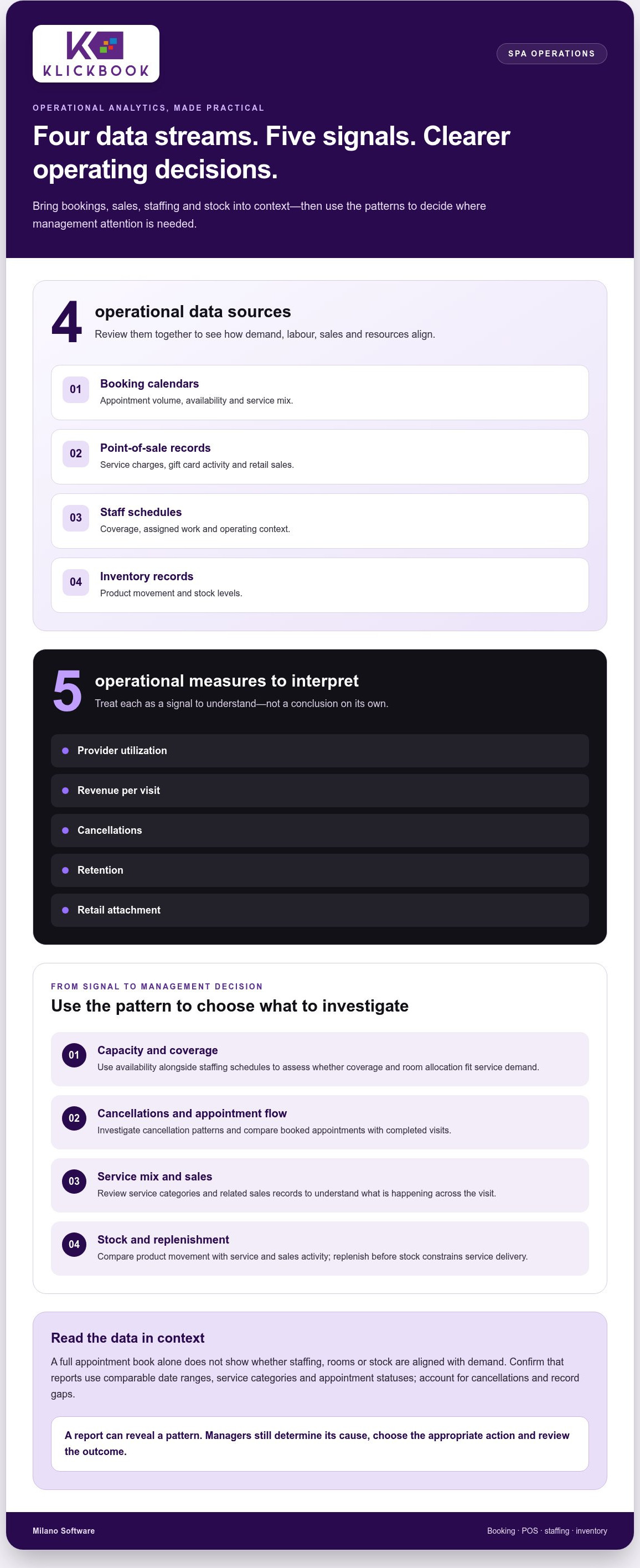
We’ll examine indicators such as provider utilization, revenue per visit, cancellations, retention, and retail attachment, then consider how connected booking, point-of-sale, and reporting tools can clarify daily operations across day, resort, and Nordic spas.
Key Takeaways
- Use operational reporting to move beyond recorded results and identify where management attention is needed.
- Connect booking, point-of-sale, staffing, and inventory information to build a more coherent view of daily operations.
- Organize performance measures around decisions about demand, staff capacity, revenue, and stock rather than relying on an undifferentiated dashboard.
- Apply spa operational analytics software through a disciplined process: define the question, validate the data, interpret context, assign action, and review results.
- Assess how connected booking, POS, and reporting workflows can support clearer operational and financial insights.
What spa operational analytics software reveals about daily performance
Spa operational analytics software organizes booking, sales, staffing, and inventory data into reports that help spa leaders assess daily performance and make informed operating decisions. It turns activity records into a usable view of capacity, service delivery, and resource demand.
Operational reporting complements, rather than replaces, financial statements. Financial reports summarize results for accounting and oversight; operational reporting helps explain the activity behind those results. Guest-facing booking functions let clients view availability and reserve appointments. Analytics gives managers a way to examine the patterns behind that availability, such as whether demand aligns with staff coverage or room capacity.
These signals are most useful in context. A busy appointment calendar, for example, doesn’t show by itself whether the spa has the right staffing, whether transactions correspond to completed services, or whether stock levels support planned demand. Reading bookings, sales, staffing, and inventory together can help leaders identify what to investigate. A report can reveal a pattern; managers still determine its cause and decide what action is appropriate.
Operational reporting versus a collection of disconnected reports
Separate exports can show appointments, transactions, and resources as isolated totals. That makes relationships harder to see: a manager may need to compare dates, service categories, or staff records manually before identifying a capacity issue. A connected operational view brings relevant information into a more coherent frame, whether the systems are integrated or the data is consistently consolidated. Analytics supports decisions; it doesn’t make them independently.
For example, appointment availability can be considered alongside staffing schedules and sales records to assess whether the operating plan reflects actual service demand. The result isn’t an automatic instruction to add shifts or change services. It’s better evidence for evaluating options, assigning responsibility, and reviewing the outcome.
Which spa operators can use operational analytics?
Day spas, resort spas, and Nordic spas can all use operational reporting, but their operating models shape which measures deserve attention. A day spa may focus on appointment flow and staff capacity. A resort spa may need to interpret service activity within a broader guest operation. A Nordic spa may examine how its service mix and inventory demands align with the way guests use its facilities.
Those differences reflect the breadth of history and types of spas, not a single standard workflow. Select measures that relate directly to your operating model, resource constraints, and service delivery priorities. A report is useful when it answers a defined management question, not simply because it adds another dashboard to review.
How spa analytics brings booking, POS, staffing, and inventory data together
Useful analysis starts with the operational question, then identifies which records can answer it. Booking calendars show appointment volume, availability, and service mix. Point-of-sale records capture transactions, service charges, gift card activity, and retail sales. Staff schedules provide coverage context, while inventory records indicate product movement and stock levels. Together, these four sources help leaders assess whether demand, labour, sales, and resources are aligned.
The data doesn’t have to originate in one system to be reviewed together. However, comparisons depend on consistent definitions, date ranges, service categories, and complete records. If one report counts booked appointments while another counts completed visits, the figures describe different activity. Before drawing conclusions, confirm that the measures use comparable periods and statuses, and account for cancellations or record gaps where relevant.
Booking and appointment data
Appointment records can help managers examine demand by time, service category, and available capacity. Online reservations synchronized with the internal calendar provide a clearer view of booked and open appointment times, supporting a review of whether demand aligns with the operating schedule. For instance, repeated availability in one service category alongside a fuller calendar elsewhere may prompt a closer look at staffing, room allocation, or the service schedule. It is a signal to investigate, not proof of a single cause.
Booking information becomes more useful when leaders understand how guest reservations connect to operational workflows. This is the focus of spa booking software and connected operations.
POS, staffing, and inventory records
Transaction records add sales context to scheduled activity. Leaders can review service charges, gift card transactions, and retail merchandise sales, then compare relevant patterns with appointment and service records. Staff performance measures also need context: schedules, assigned work, and operating conditions can influence what a period’s results show. A ranking without that context risks treating different workloads as equivalent. Spa staff performance reporting is more useful when it supports a fair operational review rather than an isolated comparison.
Inventory records complete the picture. Reviewing stock alongside sales and service activity can help managers identify products with changing demand or potential replenishment needs. This is particularly relevant when retail merchandise and service-related inventory follow different usage patterns. The goal is not simply to collect more data. It is to connect records that clarify a defined operating question.
For spa operational analytics software to support dependable decisions, each source must be interpreted within its limits. Klickbook by Milano Software brings online booking, point of sale, and reporting together, with reporting on revenue, staff performance, and inventory metrics. Explore Klickbook by Milano Software, from Milano Software, a division of Milano Computer Systems Inc., to see how connected operational information can support spa management.
Which spa operational metrics help leaders assess performance?
A useful dashboard is organized around decisions, not a long list of available figures. Spa operational analytics software can help leaders assess demand, capacity, sales, and stock, but each measure should answer a defined operating question. The right set depends on the spa’s service mix, scheduling practices, and the records its systems capture.
A metric needs context before it supports action: the same result can signal different issues depending on demand, staffing, service mix, and the period being reviewed. Compare like with like. Confirm that reporting periods, appointment statuses, and metric definitions are consistent before interpreting a change.
| Operational question | Measures to review | What to investigate |
|---|---|---|
| Is appointment demand using available capacity? | Appointment volume, open availability, cancellations | Demand by service, time, or day alongside scheduled capacity |
| Does staffing align with scheduled work? | Provider utilization, staff performance measures | Schedules, assigned services, and workload context |
| What sales activity accompanies service delivery? | Revenue per visit, service and retail transactions | Changes in service mix or transaction patterns |
| Does stock support operating needs? | Inventory levels and recorded product movement | Items that may need review for replenishment or usage patterns |
Capacity, appointment availability, and staff performance
Review appointment availability alongside staff schedules and service mix. If open time persists in a service category, examine whether it reflects demand, shift coverage, room availability, or how appointments are allocated. Provider utilization can indicate how scheduled capacity is being used, but it isn’t a complete assessment of an individual’s performance. Workload, service duration, assigned responsibilities, and operating conditions all shape the interpretation.
When reviewing performance, compare periods with similar service mixes and workloads. This helps distinguish a change in capacity use from a difference in the work being scheduled.
Revenue, transactions, and inventory
Service and retail transaction records support both financial review and operational analysis. Leaders can examine revenue per visit or compare transaction activity across service categories and periods, then investigate what changed before revising staffing or service plans. These measures describe recorded activity; they don’t explain its cause on their own.
Inventory measures can surface follow-up questions. A change in recorded product movement, for example, may warrant checking the sales mix, stock records, or replenishment process. Definitions and available data vary by workflow and system setup, so establish what each measure includes before using it for decisions or comparisons. Avoid treating another spa’s results as a direct benchmark when its services, capacity, and recording practices differ.
How to turn spa analytics into operational decisions
Analytics creates value when a review ends with a clear operational response, not simply another dashboard. More measures don’t automatically produce better decisions; excess indicators can distract from the issue leaders need to resolve. Spa operational analytics software is most useful when managers apply a consistent process: define the question, validate the records, interpret the operating context, assign an action, and review what follows.
A measurable signal identifies a change or pattern; it does not, by itself, establish the cause.
Start with the operating question, not the dashboard
Frame each review around a specific concern, such as appointment availability, sales mix, or inventory movement. Before comparing results, confirm that reporting periods and service categories match, and that records are complete enough to support the comparison. A correlation between two changes can guide investigation, but it doesn’t prove that one caused the other.
- Define the question. Specify the operating issue and the decision the review needs to inform.
- Check data quality. Verify date ranges, categories, record status, and completeness.
- Interpret context. Consider schedules, service mix, and other relevant operating conditions.
- Assign an action. Name the person responsible and state the change or investigation required.
- Review the result. Revisit the same measure and question to assess what changed.
Assign ownership and review the operational effect
An insight without an owner can remain a reporting observation rather than an operational improvement. Assign follow-up to the appropriate manager or team lead, record the action, and set a practical review point. Compare subsequent results with the original question and the spa’s own operating context, not an unsupported industry benchmark. If the result differs from expectations, revisit the interpretation before making another change.
For example, a manager notices recurring appointment availability in a particular service category. Before changing schedules, they verify the calendar records, compare the period with staff coverage, and check whether service demand shifted. If the evidence supports a schedule adjustment, the manager assigns it to the scheduling lead and reviews availability and bookings in a later reporting period. The review tests the decision; it doesn’t presume that schedule changes will resolve the issue.
Connected spa management software can support this discipline by bringing booking, point-of-sale, and reporting workflows into a clearer operational view. Explore Klickbook by Milano Software to see how connected reporting can support your management decisions.
How connected spa management software supports operational analytics
Operational analytics is most useful when it fits the way leaders already manage the business. Platform evaluation should focus on whether the information available can support recurring decisions, whether teams can interpret reports consistently, and whether the reporting approach suits the spa’s operating model. The aim isn’t to accumulate features. It’s to make routine oversight more coherent and easier to apply.
Assessing whether a connected platform fits the operation
Review the decisions managers need to make and the information they rely on today. Identify where staff reconcile reports manually, where terms are used inconsistently, and where leaders lack a dependable view of operational performance. Then assess whether the platform’s reporting can address those gaps in a form managers can use. Day spas, resort spas, and Nordic spas may have different priorities, so relevance matters more than the number of available features.
Consider how the reporting process will fit into management routines: who reviews the information, how it supports discussion, and how follow-up is documented. This keeps software evaluation grounded in practical use rather than a feature checklist.
From spa data to a more consistent operating view
Connected spa management software provides an operating framework for reviewing information across business activities. For spa operational analytics software to be useful, its reports should help leaders recognize where further investigation or management attention is warranted. Klickbook by Milano Software brings online booking, point of sale, and reporting together, including reporting on revenue, staff performance, and inventory metrics.
Milano Software, a division of Milano Computer Systems Inc., provides spa management software for day spas, resort spas, and Nordic spas. Explore Milano Software’s spa management platform to see how its reporting tools can support operational oversight.
Make operational insight part of the management rhythm
Treat analytics as a continuing management discipline, not a one-time reporting exercise. Select a recurring review where leaders can assess whether current operating priorities remain aligned with the spa’s needs. As those priorities evolve, refine the questions and measures used to guide discussion. This keeps spa operational analytics software connected to real decisions rather than turning reporting into an end in itself.
Start with a review cadence your team can sustain. Give decision-makers a clear view of what requires attention, who owns the follow-up, and when the result will be reconsidered. Over time, that discipline can help leaders respond with greater consistency and direct attention to the operational issues that matter most.
Explore Milano Software’s spa management platform to see how its online booking, point-of-sale, and reporting capabilities can support your operational priorities. Make connected reporting part of your management rhythm with Milano Software.
Frequently Asked Questions
Can spa operational analytics software forecast future demand?
It can support demand planning, but forecasting depends on the platform’s capabilities and the data available. Historical reports show recorded activity; they don’t automatically project future bookings. Before using a projection to plan staffing or capacity, review the periods and appointment statuses included, note unusual closures or service changes, and compare the estimate with current reservations. Treat projections as planning inputs, not guaranteed outcomes.
Does spa operational analytics software replace accounting software?
No. Keep accounting workflows for tasks such as reconciling deposits, reviewing adjustments, and preparing period-end records. Operational reports can help managers investigate activity that may need follow-up, such as a variance between recorded sales and completed appointments. Establish which system is authoritative for each record, and define a reconciliation process between operational transaction data and accounting entries. This reduces ambiguity when managers and finance teams review the same activity.
How often should spa leaders review operational analytics?
Set the review cadence according to how quickly a decision needs to be made. A manager overseeing near-term coverage may check upcoming reservations frequently, while a review of broader inventory movement can follow a regular reporting cycle. Assign an owner and keep the schedule consistent. Before responding to a short-term change, check whether it reflects a sustained pattern or a temporary fluctuation in the spa’s operations.
Can a spa compare operational performance across multiple locations?
Yes, if locations apply comparable definitions and recording practices. Align service categories, appointment statuses, reporting periods, and metric rules before reviewing results. Then document meaningful differences in capacity or service mix so leaders can distinguish local operating conditions from process inconsistencies. Use the comparison to identify where further review is warranted, rather than relying on a simple ranking to determine which location’s practices should be adopted across the group.
What is the difference between spa operational analytics and financial reporting?
Operational analytics helps managers monitor business activity, while financial reporting supports accounting review and formal financial records. For a practical workflow, use an operational view to identify a change in booking or service activity, then work with the appropriate financial report when reviewing how transactions were recorded for a reporting period. Agree on shared reporting periods and terminology so operational and finance teams can discuss related information without treating the reports as interchangeable.
Can software show whether a spa promotion increased sales?
Software can support promotion analysis when the relevant transactions are identifiable. Establish a consistent promotion label, record which sales qualify, and choose a comparison period that reflects the offer’s timing. Review results by relevant service or retail category, and account for cancellations, refunds, or transactions that don’t qualify. These preparation steps make the resulting analysis more useful for evaluating the promotion and planning how to measure future offers.


