
The booking itself is rarely the main administrative burden. It’s the handoffs. To reduce spa booking administration, teams need more than an online form: they need a clear path from reservation to internal calendar, with fewer repeated entries and updates across separate systems.
Schedule changes, cancellations and guest questions can all trigger follow-up. Managers may also struggle to see where booking work is accumulating. Reducing that friction doesn’t mean removing staff oversight. It means connecting routine steps while preserving time and attention for exceptions and guest-specific needs.
This guide explains how to map the work behind spa reservations, identify repeated handoffs and build more connected booking workflows. It covers how online booking that synchronizes with the spa’s internal calendar can support smoother operations, and how reporting can help managers assess workload patterns and operational impact. The goal is practical: clearer processes for day spas, resort spas and Nordic spas, without promising specific time or cost savings.
Key Takeaways
- Map each reservation from enquiry through completion to identify where manual updates, guest communication and reconciliation accumulate.
- To reduce spa booking administration, connect booking details to a shared record and internal calendar to limit repeated entry and status checks.
- Use automation for routine, repeatable steps while keeping staff review in place for exceptions and guest-specific needs.
- Start with a high-volume booking process, standardize its rules and review the results before changing other workflows.
- Track administrative patterns and direct available staff capacity toward guest support, staff coordination or operational review without assuming a specific financial return.
Reduce spa booking administration by mapping the work behind each reservation
Booking administration is the work required to create, update, communicate and reconcile reservations. It goes beyond entering an appointment: staff may respond to an enquiry, check availability, record details, send a confirmation, process a change and update another calendar or record. Mapping that lifecycle makes the work visible before a spa changes its processes or systems.
Trace each reservation from the initial enquiry through confirmation, appointment changes, arrival and completion. At every stage, record who acts, what information they use, where they enter it and what triggers the next handoff. This is a practical application of Business Process Management (BPM), which focuses on examining and improving processes. The objective isn’t to automate every interaction. It’s to distinguish personal guest service and judgement-based decisions from routine coordination that can be standardized.
Which spa booking tasks create the most administrative work?
Inventory enquiry handling, availability checks, data entry, appointment changes, cancellations and confirmation follow-up. Classify each task by frequency, staff role, channel and decision-making required. Repeated status checks or the same guest detail entered in separate records can signal friction, but don’t establish on their own that a task can be removed.
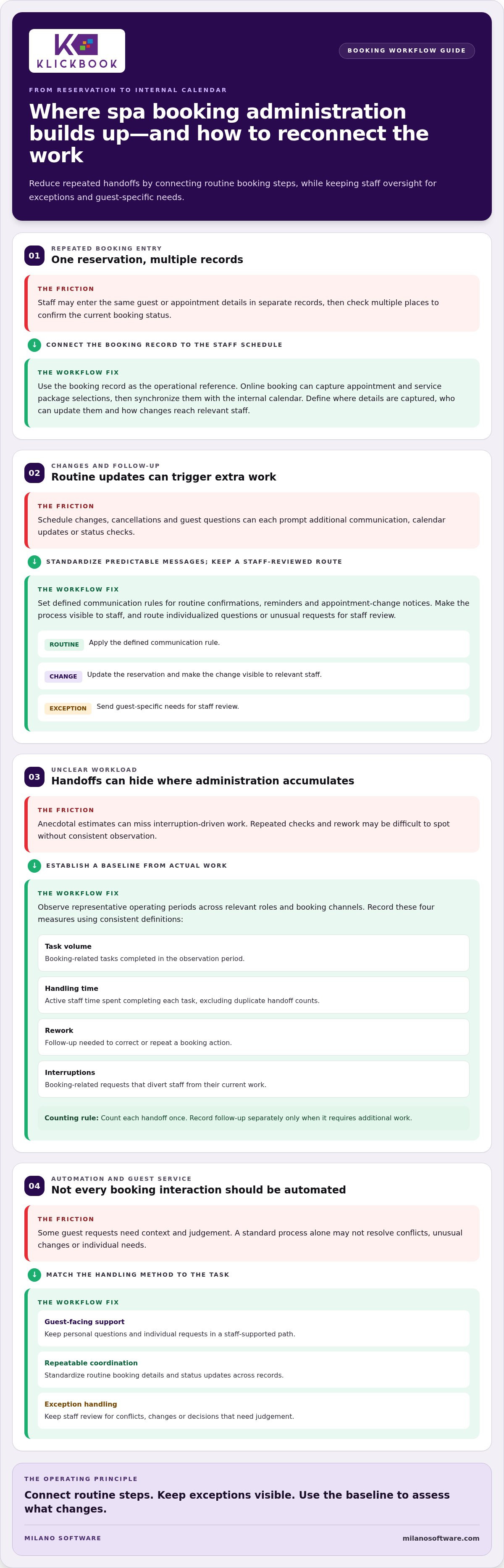
- Guest-facing: answering a specific question or supporting a guest’s individual request.
- Repeatable coordination: recording standard booking details or updating appointment status across records.
- Exception handling: resolving a conflict or change that requires staff review.
Base these distinctions on the spa’s actual workflow. A day spa, resort spa and Nordic spa may have different booking paths, service packages and staff handoffs.
How can a spa establish a booking administration baseline?
Observe representative operating periods across relevant roles and booking channels. Anecdotal estimates can miss interruption-driven work. Log task volume and active handling time, then note rework, repeated status checks and booking-related interruptions. Count each handoff once, even when multiple staff members touch the same reservation. Record follow-up as a separate task only when it requires additional work.
Use consistent definitions so later comparisons remain meaningful:
- Task volume: number of booking-related tasks completed in the observation period.
- Handling time: active staff time spent completing each task, excluding duplicate handoff counts.
- Rework: follow-up needed to correct or repeat a booking action.
- Interruptions: booking-related requests that divert staff from their current work.
This baseline helps managers identify where administration accumulates and assess workflow changes without assuming a specific savings outcome.
How connected booking workflows reduce spa booking administration
A connected workflow keeps each reservation’s status and details aligned as work moves from guest booking to staff scheduling. The operational gain comes from removing avoidable handoffs, not simply adding more digital tools. If staff must re-enter appointment information or check separate records to confirm the current status, the process remains fragmented.
Make the booking record the operational reference for each reservation. Define where appointment details are captured, which staff roles can update them and how changes reach the people responsible for delivering the service. Online booking can capture appointment and service package selections, then synchronize them directly with the spa’s internal calendar. That connection reduces manual transfer between guest booking and the staff schedule.
What changes when online booking connects to the internal calendar?
Synchronization gives staff a consistent view of booked appointments without requiring a separate re-entry step for each online reservation. Its reliability depends on the rules behind the schedule: service options, durations, staff assignments, resources and availability must be maintained consistently. Define those rules before expanding online access. Synchronization reduces handoffs, but it doesn’t eliminate every conflict, exception or need for staff review.
Which booking communications are suitable for standardization?
Routine confirmations, reminders and appointment-change notices can follow defined triggers, such as a new booking or an updated reservation. Standardize the information and timing rules for each message, then make the process visible to staff. The communication workflow needs to match the tools and processes the spa uses; don’t assume every message or exception can be handled automatically.
Keep individualized questions and unusual requests in a staff-reviewed path. A guest asking about a specific booking need may require context and judgement that a standard notice can’t provide. The aim is to automate predictable coordination while preserving a clear route for staff intervention.
- Routine event: apply a defined communication rule.
- Booking change: update the reservation and make the change visible to relevant staff.
- Guest-specific exception: route the request for staff review.
This operating model can help reduce spa booking administration without treating personal service as work to eliminate. For broader context on connected workflows, read the spa management software executive guide. Milano Software’s spa management software connects online booking with the spa’s internal calendar, supporting more consistent booking handoffs.
Can automation reduce spa booking administration without weakening guest service?
Reducing administration doesn’t require removing personal service from every interaction. Assign routine, predictable work to clear processes while keeping staff involved where context, judgement or recovery matters. A confirmation can follow a standard rule; a guest request that falls outside the booking policy needs an accountable person.
Use a three-part operating model to decide how each task should be handled:
| Handling model | Best fit | Operational control |
|---|---|---|
| Manual handling | Requests requiring context or individualized support | Staff owns the interaction and records the outcome |
| Rule-based automation | Repeatable steps with defined booking data and triggers | Apply a consistent rule and verify the resulting record |
| Staff-reviewed exception | Ambiguous requests, service recovery or policy exceptions | Route to a named role and track resolution status |
Evaluate automation against three measures together: booking accuracy, staff workload and continuity of service. A workflow that reduces repetitive handling but creates incorrect appointments or unresolved guest requests has shifted the burden, not removed it. Review errors and follow-up alongside task volume to understand the full operational effect.
Which booking tasks are appropriate to automate?
Prioritize steps with consistent inputs, clear rules and a defined trigger. Routine confirmations or notices following a standard appointment change may be suitable when the booking data and communication process are set up accordingly. Keep a review step where an error could affect the appointment record or guest experience. Automation should execute an established process, not substitute for one.
Retain staff review for unclear requests, unusual booking changes and service recovery. These interactions may depend on details that don’t fit a standard rule. Make the boundary explicit so staff know which cases proceed automatically and which require a decision.
How should a spa handle exceptions and guest-specific needs?
Set an escalation path for unresolved booking requests. Assign an accountable role, define how the request is marked as pending or resolved, and keep relevant booking context accessible to the staff member taking ownership. That continuity helps prevent guests from having to repeat information as a request moves between team members.
Review exception patterns as part of workflow governance. Recurring requests may point to unclear booking rules, missing options or a process that needs adjustment. Use those findings to refine the standard path while preserving staff discretion for cases that remain individual. This helps spas reduce spa booking administration while maintaining deliberate oversight of guest service.
A practical workflow to reduce spa booking administration
Turn the baseline into a controlled improvement cycle. A focused workflow change is easier to evaluate than a broad redesign. It gives staff a clear operating standard while managers assess the effect.
- Map the task. Document the booking steps, handoffs, systems, staff roles and completion criteria as they operate now.
- Select a friction point. Rank tasks by frequency, staff effort, rework and guest-service impact. Choose a repeatable process with clear inputs and ownership.
- Standardize the rules. Define how routine bookings, changes and exceptions are handled. Document decisions before changing roles or systems.
- Configure the workflow. Set up the agreed steps in the relevant booking process, assign an owner and ensure staff know how to manage changes or unresolved requests.
- Review the results. Compare post-change measures with the baseline and record operational context, including staffing or demand changes that may affect the comparison.
Start with one high-volume, repeatable process, such as a standard appointment change, rather than revising every booking rule at once. Assign a process owner to maintain the documented procedure, clarify responsibility for exceptions and identify when the workflow needs review. A focused first change limits disruption and makes the results easier to interpret.
How should a spa prioritize booking workflow changes?
Use the baseline to rank candidate tasks by frequency, active staff effort, rework and guest-service impact. Then select a workflow with defined inputs, an accountable role and an observable end point. Record the current sequence, including manual workarounds. Otherwise, a change may shift effort to another team member without resolving the underlying friction.
Which measures show whether administration is improving?
Track staff time, repeated data entry, unresolved booking requests and booking corrections. Set a consistent review period and compare like with like. Seasonal demand, staffing levels and operating patterns can change workload independently of a workflow adjustment. Report those factors alongside the measures rather than attributing every change to the new process.
Define each measure before collecting data. For example: Booking correction rate equals the number of corrected reservations divided by total reservations reviewed in the same period. Keep the calculation and data source consistent across baseline and follow-up reviews. Spa management software reporting can help assess operational patterns, including staff metrics, but interpretation still depends on the measures and context selected by the spa.
Spa management software can support connected booking operations and help you evaluate workflow changes against your baseline.
Turn reduced booking administration into reliable spa operating capacity
Lower administrative effort creates capacity for other work; it doesn’t guarantee a specific financial result. Leaders decide how to use that capacity based on documented operational priorities. A day spa may focus on guest support during busy periods, while a resort spa or Nordic spa may need closer coordination across teams and booking activity. The right allocation depends on each operation’s service model.
Make the decision explicit. Review workflow measures with relevant staff, identify where capacity is available and assign it to a defined need rather than assuming it will translate into additional revenue.
How can spa leaders use reclaimed staff capacity?
Direct available staff attention toward priorities such as resolving booking exceptions, coordinating schedules or reviewing service coverage. Discuss the proposed changes with the teams responsible for those activities so added capacity supports a real operational requirement. Then reassess the booking measures. If repeated corrections, unresolved requests or manual handoffs remain, the workflow still has friction to address.
Maintain the measure definitions used for the baseline and record relevant operating context. This helps distinguish a workflow effect from changes in staffing or demand. Operational reporting can support the review, but the data should inform decisions rather than stand in for them.
How does Milano Software support connected booking operations?
Milano Software’s online booking lets spa clients schedule appointments and service packages 24/7 from any device. Online bookings synchronize directly with the spa’s internal calendar, connecting guest scheduling with the staff-facing schedule and reducing a manual handoff. Spa teams can use this connected workflow as part of a broader approach to managing bookings and daily operations.
Operational and financial reporting provides visibility into revenue, staff performance and inventory. Leaders can review performance patterns alongside booking workload, then determine whether a process change is working as intended. Reporting supports assessment; it doesn’t promise a particular efficiency gain or financial outcome.
For day spas, resort spas and Nordic spas, operating details will differ, but the management discipline remains consistent: measure the work, connect routine booking steps, preserve staff oversight and direct capacity toward priorities.
Build a more connected booking operation
Reducing booking administration starts with understanding the work behind each reservation. Map the handoffs, establish a baseline, then improve a focused, repeatable workflow. This gives spa leaders a practical way to reduce spa booking administration while retaining staff oversight for exceptions and guest-specific needs.
Connected booking processes can limit repeated data entry and make routine coordination more consistent. Review staff time, corrections and unresolved requests after changes, and interpret results alongside operating conditions. Lower administrative effort creates capacity, but it doesn’t guarantee a specific financial outcome. Leaders can direct that capacity toward guest support, staff coordination or operational review.
Milano Software supports online booking for appointments and service packages 24/7 from any device, with online bookings synchronizing directly with the spa’s internal calendar. These capabilities connect guest scheduling with internal operations.
To explore how connected booking workflows can support your spa’s operating priorities, explore Milano Software’s spa management platform. Start with one process, measure carefully and build on what the results show.
Frequently Asked Questions
What is spa booking administration?
Spa booking administration is the operational work required to create, update, communicate and reconcile reservations. It can include checking availability, entering appointment details, processing a change, following up on a request and confirming that the booking record is current. Mapping these activities across the reservation lifecycle helps managers separate necessary guest-facing service from repeated coordination. A consistent definition also creates a comparable basis for workload reviews before and after workflow changes.
How can a spa reduce booking administration?
A spa can reduce spa booking administration by documenting each booking handoff, then targeting repeated actions such as duplicate data entry or manual calendar updates. Standardize routine rules, assign ownership for appointment changes and connect booking information with the internal calendar. Establish baseline measures for staff effort, rework and unresolved requests before changing the workflow. Keep a defined escalation path so unusual guest requests receive appropriate staff attention.
Can online booking reduce administrative work for a spa?
Online booking can reduce administrative work by letting clients schedule appointments and service packages without staff manually entering each booking. When online reservations synchronize directly with the spa’s internal calendar, teams can avoid re-entering the same appointment details. The workflow still depends on accurate service and availability rules. Staff oversight remains important for booking changes, unclear requests and individual follow-up that requires judgement.
Which spa booking tasks should be automated?
Automate frequent, repeatable tasks with clear inputs, rules and triggers, such as recording standard appointment details or sending routine booking communications when the process supports them. Before implementation, document the process, task owner and exception path. Keep staff review for ambiguous requests, unusual changes or guest-specific needs. Afterward, check booking corrections and unresolved requests to confirm the workflow is operating as intended, rather than shifting administrative effort elsewhere.
How do you measure spa booking administration?
Set a baseline using measures such as staff time spent on booking tasks, repeat data entry, appointment corrections and unresolved requests. Define each measure consistently and review it over comparable operating periods. Workload alone doesn’t show whether service remains consistent, so consider booking accuracy and continuity as well. Record relevant changes in staffing or demand, since these can affect results and make it difficult to attribute a difference to the workflow alone.
Does booking automation make spa service less personal?
Booking automation doesn’t have to make spa service less personal when routine coordination is separated from interactions that need staff judgement. A standard confirmation can follow a defined process, while an unusual request or service recovery issue can be routed to an employee. Make escalation ownership clear and preserve booking context so guests aren’t asked to repeat information. Reviewing exceptions and guest feedback helps leaders assess whether the process supports service standards.
What should a spa do before changing its booking workflow?
Before changing a booking workflow, map the current steps, staff responsibilities and points where information is re-entered or delayed. Establish baseline measures, then choose one focused process with clear rules and completion criteria. Document how appointment changes and exceptions will be handled, and communicate role changes to staff. Review the workflow after implementation, compare results with the baseline and address issues before applying the approach to other booking processes.


